

What have Winnie-the-Pooh, Tannoy, and my granny’s pocket watch all got in common? Give up? They’re all celebrating their hundredth birthday this year.
And what’s kept Tannoy going strong for all those years? If you spin through the latest imaginary guide to hifi jargon there’s a raft of brands now cashing in on ‘vintage’, ‘retro’ and ‘legacy’ models that are soaked in nostalgia.
But Tannoy doesn’t need such a marketing manual, because its authenticity is genuine without the effort. So much so it’s one of the few hifi companies that’s steeped into the public consciousness. Like Hoover and Google, it’s one of those rare brands that people immediately associate the act the product was designed for. We don’t vacuum, we Hoover, we no longer search, we Google, and we don’t amplify over public address, we use a Tannoy – with the brand name gaining a place in the Oxford English Dictionary way back in 1946.

Magnetically attached grilles on or off? Both options look pure class, with inset fabric in the speaker’s narrow sides to match
Sounds of the century
Being the company that set the blueprint for classic looking loudspeakers, Tannoy has never stopped ploughing its own furrow, making models that are unanimous with its design language, which many have (and continue to) replicate. But like Lewis Leathers, Colemans’ mustard and Brylcreem, originality counts. And that’s for good reason, as few other brands can claim historic associations spanning Abbey Road to Winston Churchill.
What it has done though in recent years is react to market trends for smaller and more domestically friendly loudspeaker demands, by shrinking down its iconic hi-end models into compact proportions, alongside its Cathedral-sized flagships, like the stunning Westminster Royal.
The company has of course made more modern looking ‘standard’ compact loudspeakers, but if you’re thinking Tannoy, it surely has to be a Dual Concentric driver in one of its classic corner cabinets, as that’s the whole point.

View from the rear is just as easy on the eye, thanks to the oiled walnut real wood finish
Shrunk in the wash
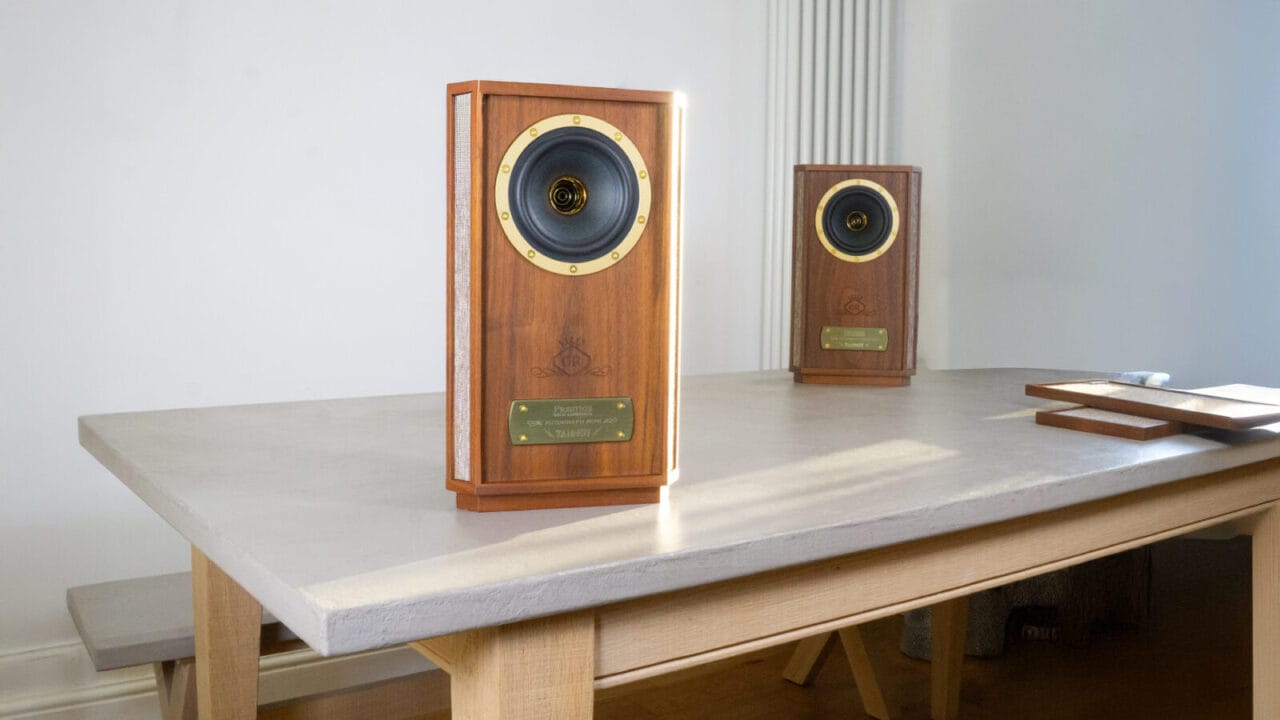
So the Autograph Mini on test here is small, tiny in fact by most speaker standards at just 356 x 209 x 155mm (HWD), which makes it adorable to look at. It’s as though Tannoy look a Canterbury speaker and distilled it down into a concentrated essence. The good looks are also down to its oiled walnut veneer (which accounts for the ‘OW’ in the full Mini-OW model name), that adorns its cabinet. And said cabinet appears even smaller due to its triangular shape that’s designed to reduce internal standing waves, thanks to its non-parallel sides.

The Autograph Mini is ideal for corner placement thanks to its triangular footprint
Aside from its cabinet, what really set this speaker out from the crowd (and goes some way in justifying its £2,200 price tag) is the air moving hardware it boasts. As the Autograph Mini gets a 4″ version of Tannoy’s longstanding Dual Concentric drive unit. The principle of this is simple (while the execution is more complex), in that by placing the high-frequency unit at the centre of the low frequency unit, the sound emanates from a single source, for a more natural and persuasive delivery. It’s the same approach relative newcomer MoFi applies to its drivers, including the V10 which took our 2025 product of the year – imitation, as the say, is the highest form of flattery. Because what this combines is the benefits of a full range driver (due its is single sound source) with those of a two-way system, with dedicated high and low frequency units.
For the high frequencies, a 19mm titanium dome has been specified, sat within the 4″ woofer that’s formed from multi-fibre paper pulp. Helping to integrate the two, Tannoy’s point source Tulip Waveguide is employed to ensure a broad and symmetrical sound dispersion field, all secured to the main cabinet by no less than 10 allen-headed bolts (which is two more than secure MoFi’s massive 10″ drivers, not that I’m counting…).

Tannoy’s trademark Dual Concentric driver array is pure eye and ear candy
Continuing the bespoke approach, the speaker’s internal crossover features custom engineered Tannoy capacitors, low loss laminated core inductors and close tolerance wire-wound resistors, all for a (claimed) 106Hz to 20kHz frequency response (+/-3dB).
And given much of this tech is based on what’s in Tannoy’s aforementioned Westminster at £55k, the price tag starts to make more sense, as you’re basically getting the same main course in a side serving.
A good grilling
Unboxing the Autograph Mini is a treat in itself, as they’re so well made and finished, it’s a joy to clap eyes and hands on them. I’m so pleased Tannoy has retained the traditional look oatmeal finish grille which complement their style to a tee, making them one of few speakers that look just as good with their covers on as off.
Their Prestige Gold Reference badges and embossed wood also tells you you’re in the presence of something special. My only minor gripe is the rear bass port, mainly because having luxury materials adorn the cabinet throughout makes its black plastic stand out a bit (despite it probably being the best material for the job). Would a gold plated tube be too much to ask? Probably.
Foam bungs are provided should you want to block those tubes, but given the speaker’s modest low-frequency output, I’d expect this would only be in the extremes.

Supplied grilles blend yesteryear styling with modern fit and finish
Performance
Given the size and intention of these speakers, it perhaps wouldn’t be fair to expect them to drive my 30m² listening room as that’s not what they’re designed for. Instead it’s to my upstairs office (or ‘box room’ in old money), with them sited on my desk as close range monitors, 1.8m apart and toed in to my listening position, driven by my legacy Naim Unitilite all in one and Alchemist Forseti amp with covers removed.
I swap between various loudspeakers in this space, including models from Q Acoustics and Dynaudio which do a fine job if providing a well rounded sound that’s non-fatiguing up close. But with the Tannoy’s in situ the presentation is transformed into something some levels up.
The realism and clarity the Tannoys provide is just exceptional – especially in the sweet spot of vocal harmonies. Immediately I’m reaching for Kraja’s 2015 CD Hur långt som helst that also got a thorough airing in our recent Atlas cables review, and while in my larger space the vocals seemed omnipresent, via the Tannoy’s in this smaller toom they sound so much more direct, and so much more intimate – as though I’m being treated to a personal performance all of my own that is hair-raisingly lifelike.

Single set of multiway speaker terminals are vertically positioned on the speaker’s rear spine. Rear bass port comes with a supplied foam bung, should it be needed
Sure footed
I’m going to correct what I said earlier a little when I mentioned only one minor gripe, because there is another, and that’s the supplied ‘feet’, which are little more than tiny transparent rubber domes. They do a decent job in protecting the speaker’s real wood undersides, but little else.
Instead if these were mine I’d be spending a few quid on something proper, such as Deflex Audio’s Sorbothane Polipods, as I did. I have the Tannoy’s mounted on dedicated stands for review purposes , but given the speaker’s size and intended use, I can well see these being placed on bookshelves or even (mixing) desktops in many homes, and isolating them pays dividends. That said I can’t really use this as genuine criticism, as how many standmount speakers even come with any form of feet? So the point is more that if you want to get the best from them, budget for some decent supports.

Prestige in name and nature, proudly embossed branding and badge denote a true speaker legacy
With these installed the music continues to flow with a clarity I’ve rarely experienced from a speaker this size, this really is Rogers LS3/5A territory, albeit with a slightly mellower tonality that’s a little easier on the ear.
Hear Evening Hymns’ Rescue Teams from their 2015 Quiet Energies album and that lovely languid rhythm is as clear sounding as it is relaxed, with those backing stings being so well placed it makes we wonder why I don’t use this system more for day to day listening (perhaps because I don’t have the Tannoys in it day to day being the obvious answer). The bass has punch, but perhaps isn’t quite as shelf shaking as larger rival stand mounts but I’d argue, nor does it need it to be when it’s this well articulated. To use a grape refiner’s analogy, I’d rather sip a shot of Bollinger than guzzle a barrel of shandy. In otherwords it’s a presentation focussed on refinement, over outright volume.
That said they no slouches when the tempo is dialled up, pipe string quartet Quatuor Ébène’s rendition of Beethoven’s No. 14 in C-Sharp Minor, Op. 131: V. Presto through them and you’re in for a dazzling display of instrument separation and showboating that’ll keep you going back for more – and more I did, as these are hard to walk away from.
In summary
While clearly a loudspeaker aimed at a certain system and room size, if you’re in the market for a compact speaker that majors on articulation and clarity, look no further.
The Autograph Mini sound as good as they look, backed by a longstanding legacy which has spawned a whole sub genre of loudspeaker brands emulating the Tannoy approach. And when seeing and hearing these in their oiled walnut flesh, it’s easy to see why. As true hifi, these are highly recommended.