
Although I’m reluctant to give away my review summary right at the start, I’ll set the tone by proclaiming that Acoustic Energy’s AE320² loudspeaker is the best value hifi floorstander of 2025. Here’s why…
As the latest model to get a revamp in the mid-level AE300 Series, the next-gen AE320² showcases the maker’s flair for balancing elegant design and performance at a great price. This new range sits between the entry-level 100 Series and flagship 500 Series, but the improvements Acoustic Energy has delivered with its completely redesigned Mark 2 revisions redefines performance expectations at the price.
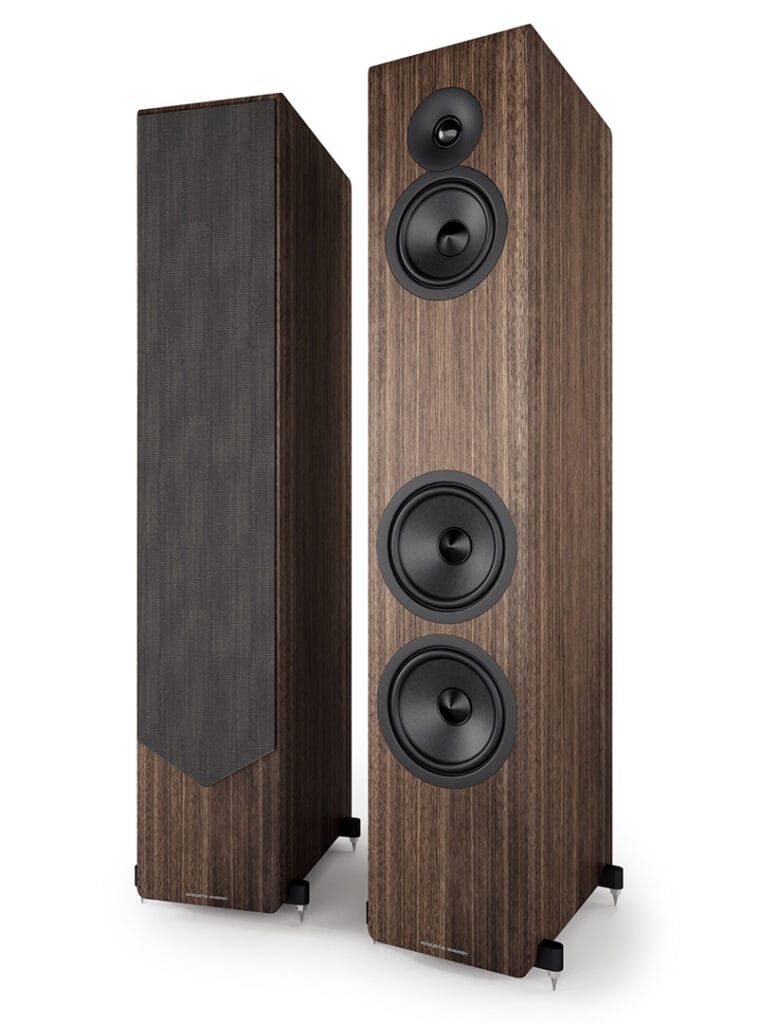
Standing proud at just over 1m high, this is a lot of speaker for the cash
The AE320² costs £1,999 per pair, which remains the same whether you go for the walnut veneer finish (as reviewed) or choose one of the ‘silk-touch’ matte black or matte white finishes. That compares to £1,599 for the black or white piano gloss versions and £1,699 for the walnut veneer finishes of its predecessor.
While the Mark 2 model’s cost more than those they replace, this new AE320² is however one of the most competitively priced floorstanders around, especially when you consider that it benefits from the learnings found in the company’s cutting-edge Corinium design, priced at three times as much.
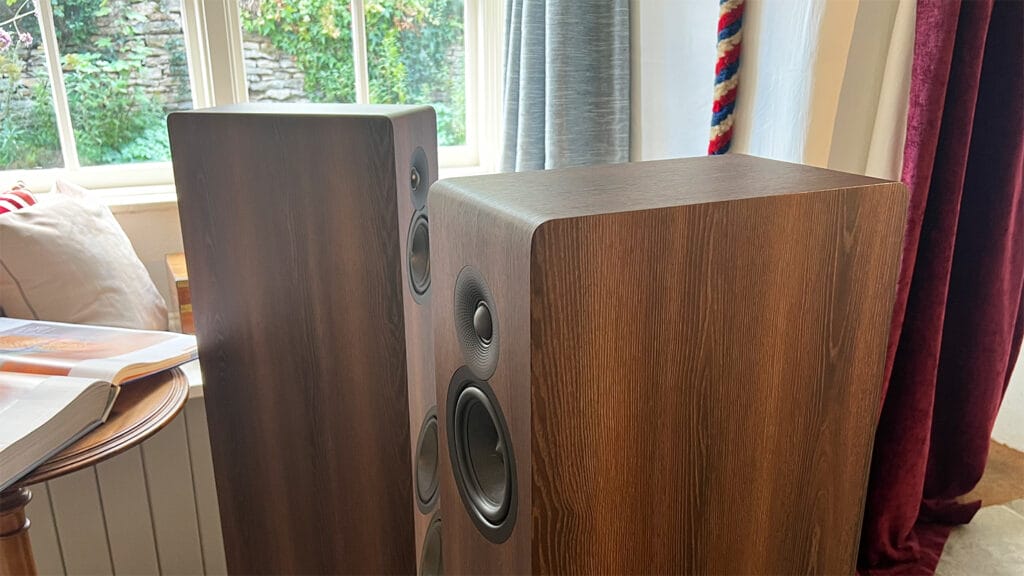
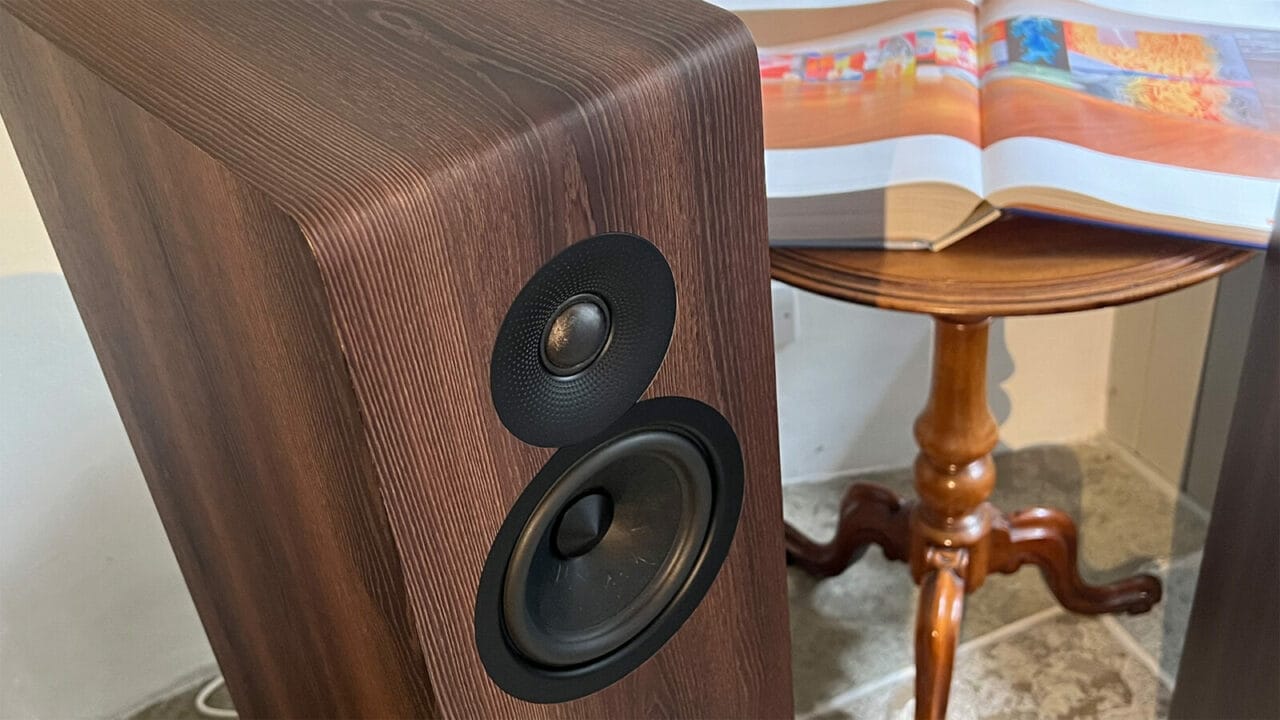
The AE320² looks resplendent in walnut veneer. I particularly like the gracefully rolled edges at the top of the front and rear cabinet baffles
I love the proportions and finesse of the new floorstanding cabinet, which stands slightly taller, wider and deeper than the original design. It feels well suited to my mid-sized living room and I’m particularly impressed by the high standard of finish. In fact, I challenge any hifi speaker buyer not to be seduced by the elegant aesthetics of the cabinet construction and the seamless look of the front baffle that has no driver or grille fixings to distract the eyes.
It comes with adjustable aluminium floor spikes to aid stability and there are also scratch resistant covers included to help protect wooden floors, along with cloth covered three-quarter height magnetically attached speaker grilles.
Acoustic properties
Founded in 1986, Cirencester-based Acoustic Energy has established a considerable reputation for engaging speaker designs that started with the launch of its first compact speaker in 1987. The AE1 revolutionised the market at the time and continues to be such a popular design that an Anniversary version was recently announced to mark the company’s upcoming 40th year in business.
Since then Acoustic Energy has developed everything from hi-end flagship designs to premium budget speakers. Over the last few years it has been busy refining its lineup to offer greater choice for all kinds of customers under the expertise of designer Mat Spandl.
While I didn’t get to experience the original AE320 or the £6,000 Corinium flagship floorstander at home, I’m excited to be one of the first in the UK to try out the AE320 Mark 2.
My review unit (the only one in the UK at the time of writing) looks superb in the walnut veneer finish. The new floorstanding cabinet is constructed from 18mm constrained-layer MDF/bitumen, which is the same ‘Resonance Suppression Composite’ (RSC) technology used in its Corinium flagship. There’s a slot-shaped bass reflex port on the bottom half of the rear cabinet and a circular port tuned to the midrange section sits towards the top.
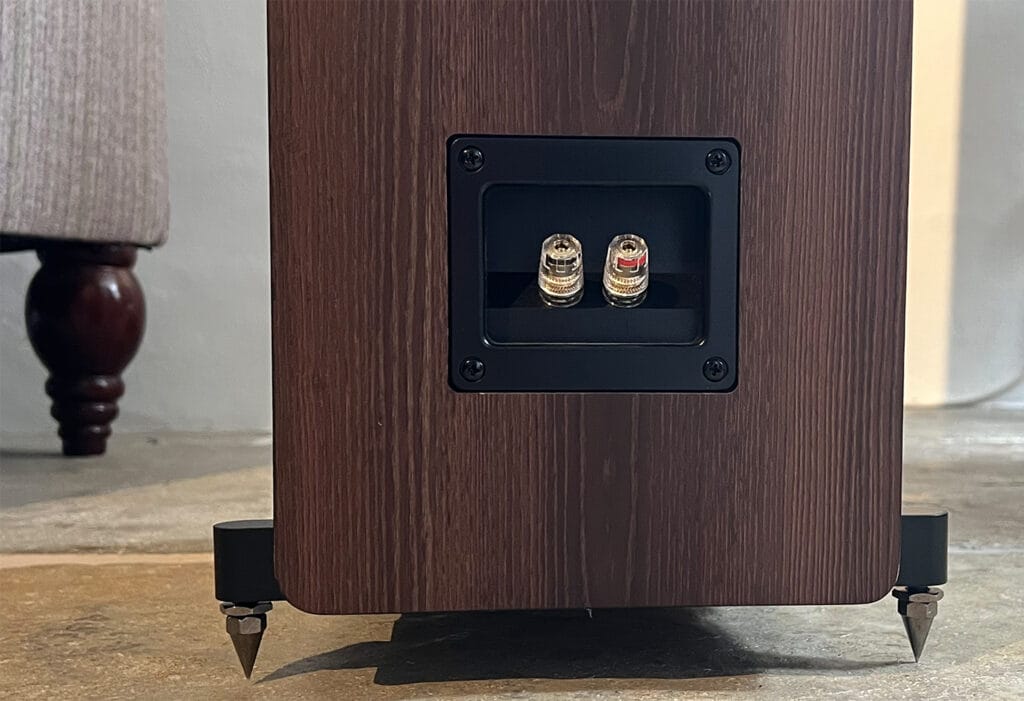
Single pair of loudspeaker binding posts cater for spades, banana plugs and bare wire
Although it’s fairly unusual to find a dedicated midrange port on a floorstanding speaker at the price, I’m convinced that this is what helps give the speaker a superb sense of soundstage and airiness around its vocal performances (more on this later).
Natural fibre
The three-way driver array ditches the aluminium cone structure of the bass and midrange drivers on the original AE320 in favour of a new hybrid material made from paper and coconut husk. The twin bass drivers each measure 140mm wide while the smaller midrange is 120mm. These are paired to a 29mm soft-dome fabric tweeter derived from the Corinium flagship, replacing the 28mm ceramic aluminium sandwich dome tweeter used in the original.
One detail I particularly like about the new design is seeing the twin bass drivers move lower down the front baffle. Based on principles developed for AE’s flagship Corinium speaker project, it helps to balance out the front baffle over the first gen model.
As with the original, the treble frequency range extends to near 30kHz, while bass frequencies start at 30Hz. The changes to the cabinet and driver materials mean the midrange and high frequency crossover points have shifted to 240Hz and 2.8kHz respectively, which compares to 380Hz and 3.4kHz crossover points on the first generation.

The AE320² comes with three-quarter height magnetically attached speaker grilles, elegantly pointed on the lower edge
Performance
As a hifi reviewer, I spend a lot of time fine tuning speaker placement in my room to achieve the best performance. I have a tried and tested process when it comes to floorstanding loudspeakers and I know what works well in my space. Imagine, then, my joy when I unboxed this pair of hefty towers and moved them into place (at 26kg each) to be instantly impressed by their sound in the very first position I tried.
Driven via my Musical Fidelity M6 500i integrated amplifier connected to a Cambridge Audio CXN100 network player, the AE320² immediately shows the seductive way it makes music. In my experience, speaker reviewing doesn’t typically start out so positively, and the new design scores extra points for being remarkably unfussy about placement.
The cabinet structure is impressively solid thanks to the inert cabinet walls and considerable internal bracing. Although it’s one of the factors for the speaker’s higher cost, the attention to detail poured over its internal architecture and acoustic design has undoubtedly helped to achieve a deliciously dry, textured and detailed bass sound that doesn’t compromise clarity.
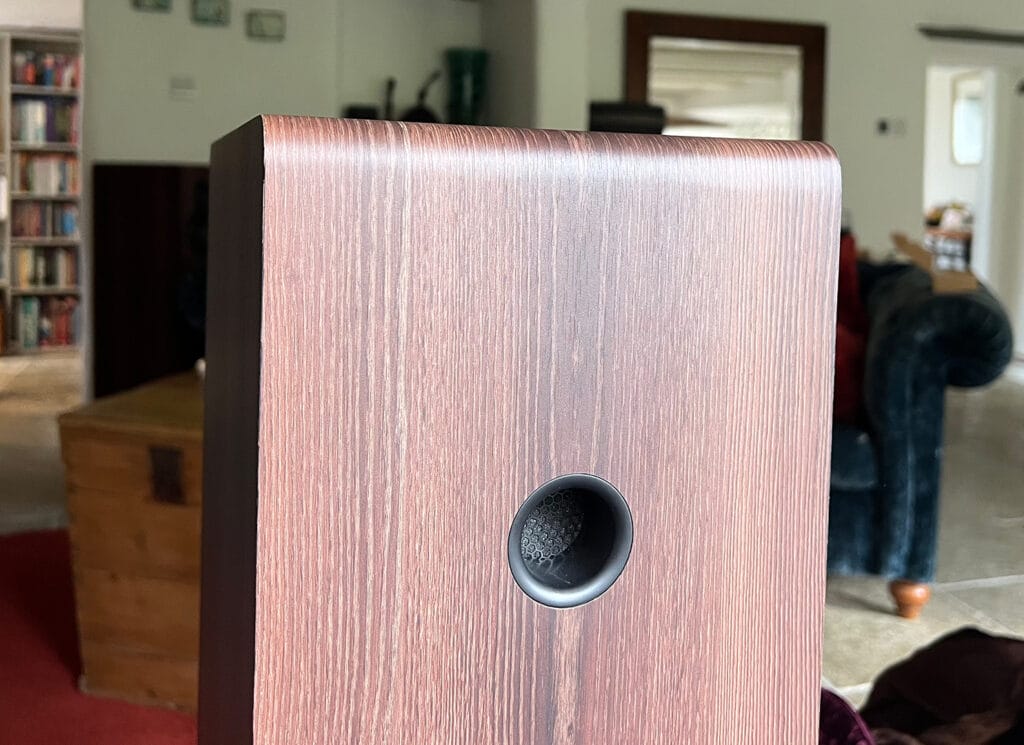
On the rear baffle, as well as a slotted bass reflex port there’s also a circular port that’s tuned to the midrange section
For example, the timpani drum effect on Lauryn Hill’s Ex-Factor track streamed via Tidal at 16-bit/44.1kHz has a tremendous sense of its own space in the soundstage. It’s a thrilling experience to hear the track on the AE320², with the powerful drum clearly placed behind the plane of the speakers in the soundstage. It’s an element that I’d not been made hugely aware of on my listening sessions with other speaker designs, showcasing this loudspeaker’s exceptional clarity and stereo imaging capabilities in all directions.
The soundstage stretches across the width of my listening room with a sound that’s remarkably open and more deeply layered than I anticipated. This is the kind of expansive stereo soundstage that anyone can appreciate, no matter where they are in the room.
Perfect pop
Treble handling is smooth too. The new soft fabric tweeter sounds detailed and refined without spotlighting anything too harshly. It has a light characteristic that brings vocals to life without sounding brash. Voices and instruments sound natural if a fraction more forward than I’m used to, but I love the open and airy sound the new treble and midrange driver materials bring.
The port at the back of the midrange section of the cabinet is surely what helps give this speaker its extra sense of openness around voices. A midrange port is a rare inclusion (at least not one I’ve often encountered) and I’m convinced it’s one of the factors that breathes life into the way this speaker delivers vocal performances. Artists sound natural and realistic, and vocals sound as convincing as anything I’ve heard from floorstanding speaker designs costing twice as much.
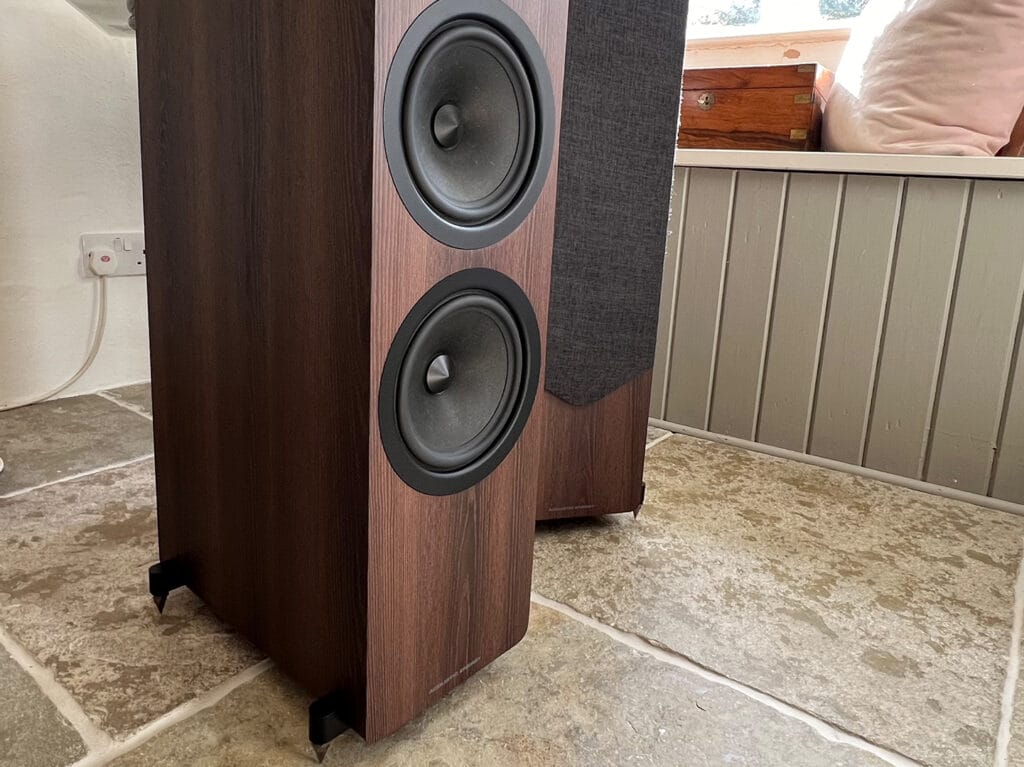
The twin bass drivers use an all-new cone material made from paper and coconut husk
Everything from the mix of soulful and hip-hop vocals on The Miseducation of Lauryn Hill album, to the saxophone playing and Helen Terry’s stunning backing vocal gymnastics on Culture Club’s Colour By Numbers album (streamed via Tidal at 16-bit/44.1kHz) sounds superb. Performances unfold before me and really do feel like they’re coming to life in my living room.
I’m a sucker for so-called ‘chamber pop’ productions (tracks that blend orchestral and pop elements), and The Divine Comedy’s Absent Friends album streamed via Tidal at 16-bit/44.1kHz FLAC scratches that itch nicely. Neil Hannon’s tenor vocals have superb midrange presence and I love the album’s theatrical string elements, which sound rich and expansive on the AE320², making the album a joyful listen despite its downbeat song themes.
In summary
The Acoustic Energy AE320² is unquestionably a lot of floorstanding speaker for the money. Its size means that it’s ideally suited to mid and large sized rooms where it will deliver a thrilling listening experience that will excite and impress both hifi newbies and aficionados alike with all kinds of music.
My only slight criticism is that the bass performance could be a little more fluid. I’ve never really encountered a speaker where I’ve considered the bass sound to be ‘too tight’ or ‘too dry’, but after a day or two of listening, I found myself tinkering with the speakers’ positioning in relation to the boundary walls to loosen up the sound just a fraction in my easily overcharged room. Either way though, that doesn’t diminish the fact that the AE320² is an exceptional floorstander that brings music to life and sets the standard at the price.