
It cannot be denied that the Italians have a certain panache. Stylistic cues that point at an item’s origin. This is my intro to Opera loudspeakers, and removing its rather heavy Mezza v2 loudspeakers from their robust boxes had me immediately thinking, Italian.
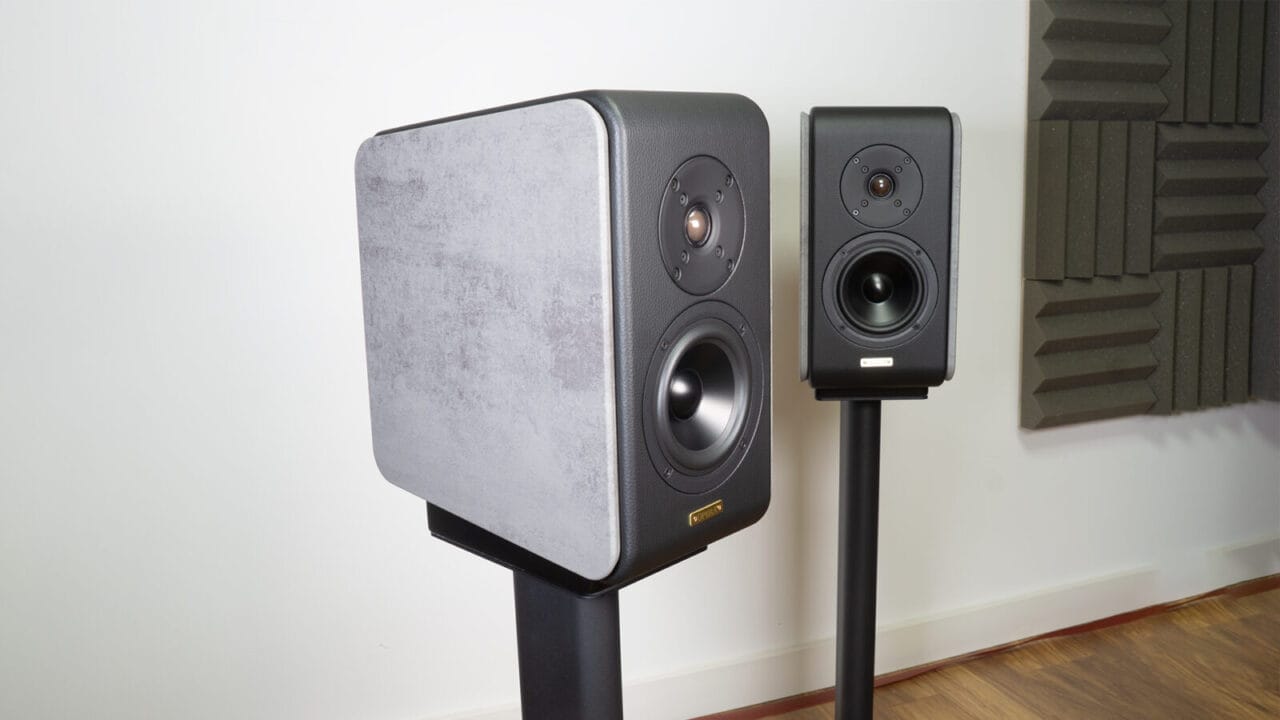
I confess, I am a bit conservative and generally prefer a more traditional design approach but first impressions? Even the stick-in-the-mud that I am loves the Mezza v2’s concrete (brushed grey) clothed sides and leatherette centre piece (an alternative rosewood finish is also available if that’s more your cup of coffee).
Out in the open and it’s clear to see that this is a very nicely put together speaker.
Keep it in the family
Opera was formed in 1989 by Giovanni Nasta, and is still owned and run by the family. All Opera speakers are made in its Treviso workshop, in Veneto, north of Venice.
The Opera Mezza v2 is the smallest speaker in the company’s Classica Series, which debuted in 2014. These speakers are not just a simple update over the MkI model, and are instead a redesign using new materials, including its eco-sourced leather.
At £2,400 the Mezza v2 is the smallest speaker in the range measuring just 382/203/372mm (HWD). For an extra £500 per pair, you can also opt for their dedicated SP1 stands, which we did of course.
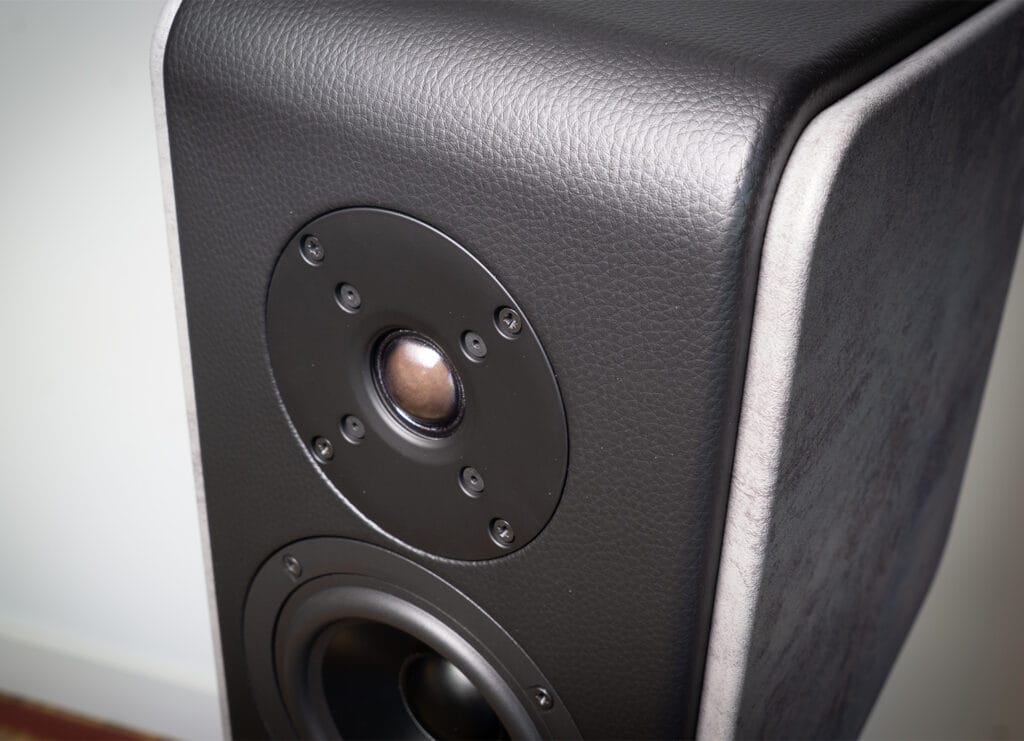
The Mezza v2’s soft dome tweeter sits in a curved and clad cabinet for finessed form and function
A two-way bass-reflex bookshelf speaker, the Mezza v2 sports a 26mm soft dome tweeter, with a double ferrite magnet and aluminium faceplate, firmly affixed by eight screws. This sits above a 150mm mid/bass woofer that’s custom designed with Scan-Speak, sporting a black anodised aluminium cone.
The v2’s bass port is situated on the speaker’s rear panel, higher up than I’d expected and is reasonably large in proportion to the speaker.
The cabinetry is made from MDF, as thick as 4cm for the front baffle, making it suitably heavy with each speaker weighing in at 12kg each. It’s also been designed to eliminate unwanted resonances with reinforcements and internal compartmentalisation.
On to the crossover which is laden with top-quality components and does its crossing over at 2,200Hz (which, coincidentally, is just above the upper level of human singing).
To protect the v2’s exposed air-shifting hardware, Opera includes a pair of magnetically attached cloth-covered grilles, which I applaud, along with Opera’s insistence on sourcing its parts from local producers. Also worth noting is the speaker’s 88dB sensitivity combined with a nominal 4 Ohm impedance, making them not an overly difficult load to drive.
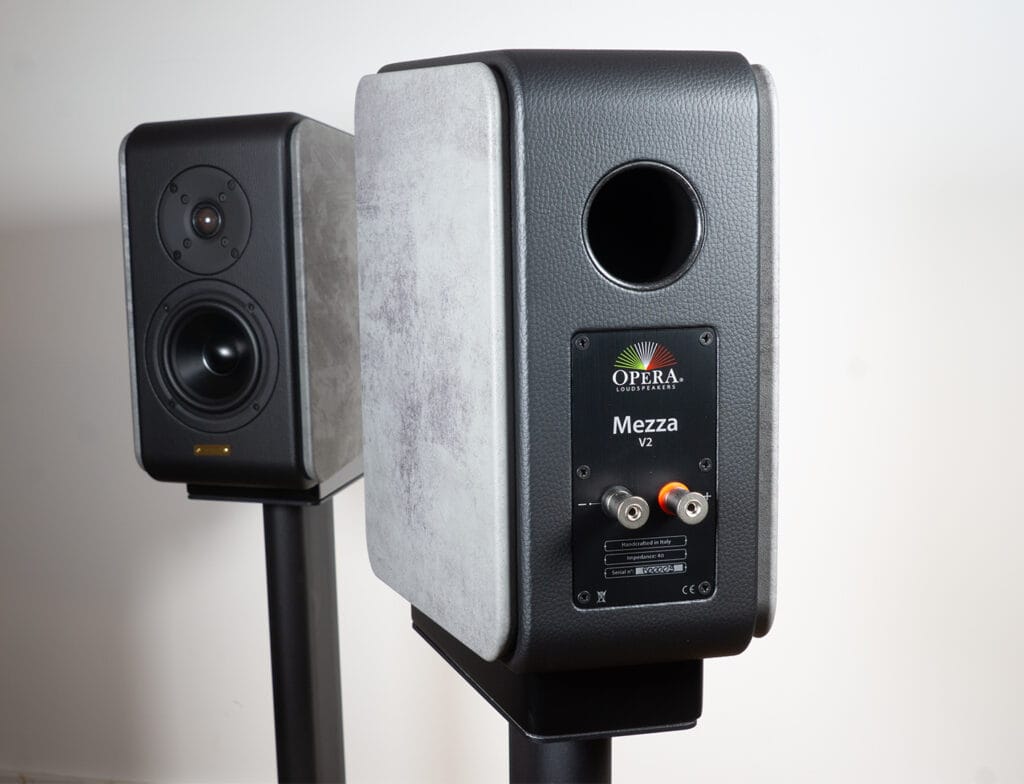
Volte-face, the v2 sports a single set of quality multiway binding-posts and a large rear bass port
And to meet these needs, Opera recommends an amplifier in the 25 to 100W range. I confess when testing them in my small office I also used a diddy 15W per channel Class A integrated for a time to good effect.
Near and far
To get the measure of the Mezza v2, I installed them in two separate environments. Firstly on my desk in my nearfield office based system and latterly in my main 11’ x 10’ listening room, on their dedicated stands.
For the former, this means citing them on my desk, sat on acoustic foam that tilts smaller speakers to fire their tweeters at a point just in front of my head, while sitting about a metre from each ear and listening to the speakers with minimal reflection.
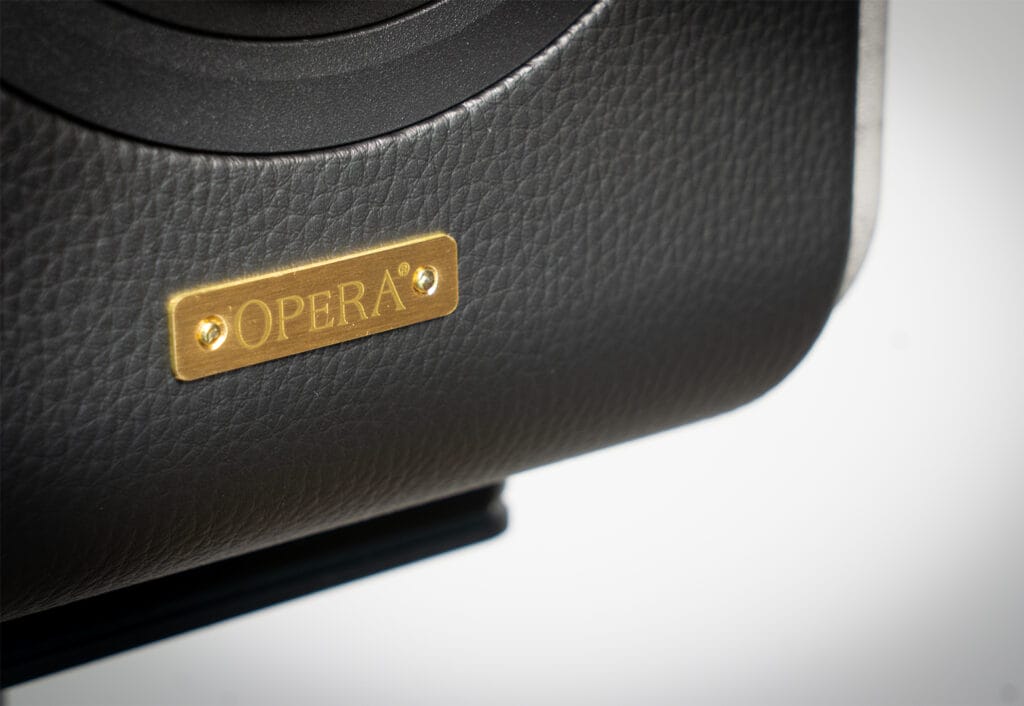
Black leather baffles adds more than a smattering of Italian luxury
For the latter, this means building the stands first by bolting their top and bottom plates in place using the supplied hex key. Once done, they measure around 715mm high and include an internal channel for routing speaker cables, bringing the Mezza v2’s tweeter to ear height, which is optimum.
The bottom of the stands include four threaded holes which accept the supplied knurled spikes, allowing for easy levelling. The point of the bolts sit in supplied metal pucks and I confess I would have preferred a locking nut to have been provided as well for a more secure fit, but once adjusted there were no issues and I was happy with the results I obtained.
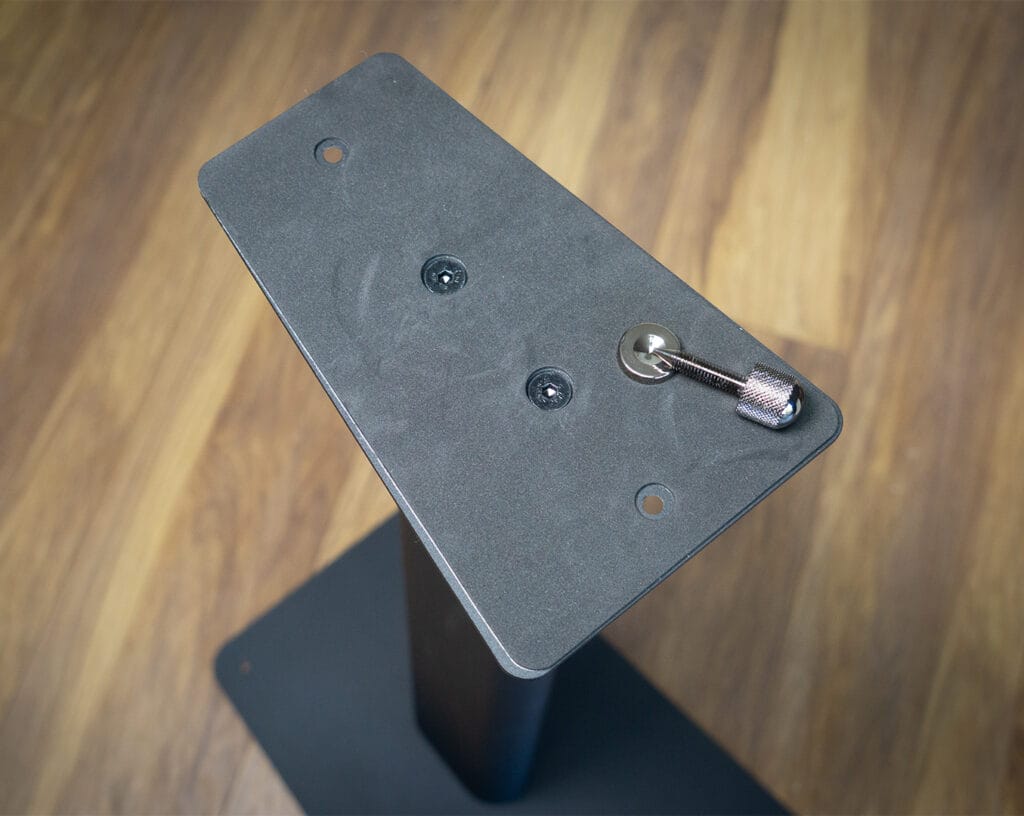
Time to make a stand, well two actually. Note the floor spike and cup in shot for reference on the stand’s padded top plate
The stand’s top plate echoes the shape of the Mezza v2’s base, and is clad with dense foam.
It also offers two holes through which supplied bolts screw to the speakers, firmly fixing them together, a design choice with which I fully approve of (having had a pair of speakers tumbled over by a pair of frolicking felines).
For positioning in my main listening space I initially followed Opera’s instruction manual, firing the two speakers directly at my listening position, and being 40cm from the rear wall.
My sources included a Linn LP12/ARO/Troika/Armageddon vinyl rig into Tron 7 GT phono stage, while on the digital side my dCS network bridge into Weiss 204 DAC fed from a Weiss 102PSU was called into action. Music was streaming from Qobuz or a Minim Server via Qobuz Connect or dCS Mosaic.
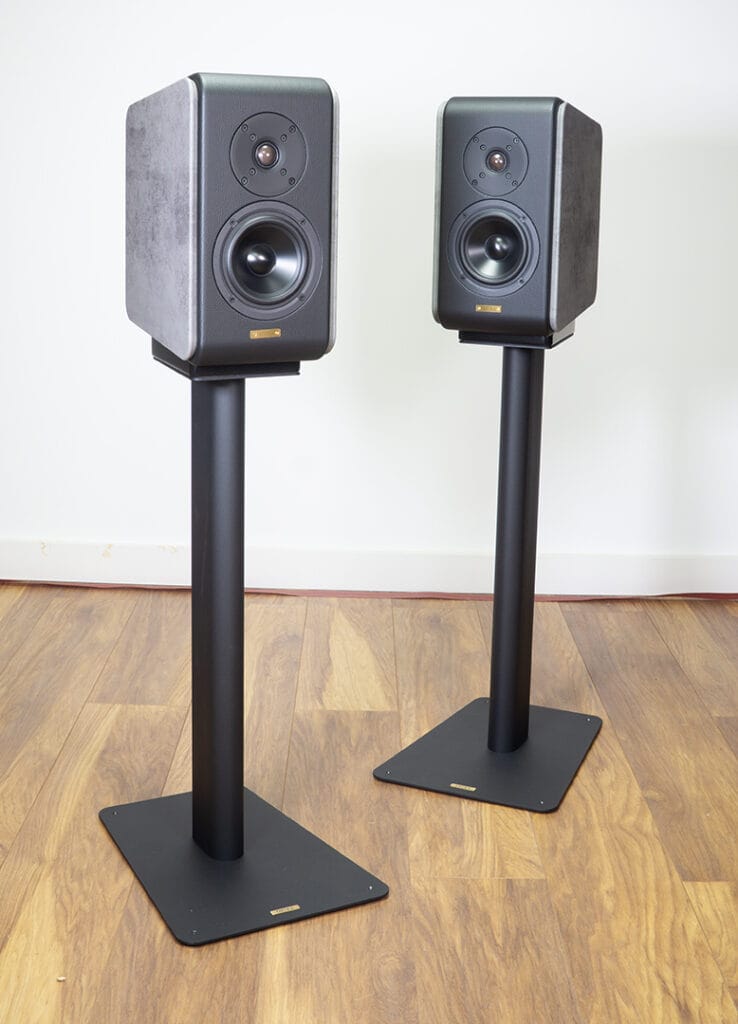
The Mezza v2 atop their dedicated stands offer plenty of style while being nice and stable
Performance
Starting off with my nearfield system allows me to test the Mezza v2 with amps of various flavours. As I progressed through Class A, solid state and valve, through to AB and D, the changes were readily revealed by the Opera Mezza v2.
It should also be noted than my nearfield speaker positioning has caused issues with port re-enforcement in the past with some speakers, but the Mezza presented no problems in this respect and passed with flying colours.
After some hours, I settled on my Icon 4 passive autoformer pre and a Naim NAP140 power amp. The v2’s 4 ohm/88dB load/efficiency doesn’t need a power plant to get it moving and these amps also gave the Operas plenty of up-top detail, good dynamics and headroom.
My usual nearfield speakers are a pair of Chartwell LS3/5a. Excellent speakers, but ones with a particular voicing, and made for a specific purpose for monitoring live outside broadcasts. As with all designs this requires choices, and compromises. I was looking forward to juxtapositioning these with the Mezza v2.
In this setting, the choices made in designing the Opera Mezza v2 makes music that I thoroughly enjoy all the more inviting, meaning a range of albums are more frequent visitors to my system. An example would be the 12”/80s Love triple CD set containing a range of belting ’80s singles. Whole discs happily were spun through uninterrupted.
Surprisingly to me, some rock numbers were also enhanced. The Who are a group that I recognise for their contribution to the art, but often leave me a bit cold. I know, I am a philistine. The Mezza v2 increased lower-mid presence added a layer of resonance that before was absent, and this added interest and excitement that had me bouncing along to Won’t Get Fooled Again and Baba O’Riley.
After a week welcoming them as office companions it was time to move them downstairs for grander presentation and a greater appreciation of what these speakers do with voices, which I love whatever the genre.
First up was James Blake’s, Limit To Your Love (16-bit/44kHz) from his eponymous album to test the Opera Mezza v2’s bass performance. Or so was the plan, as I was immediately positively distracted by his vocal presence, as he was imaged just before the speakers with the backing ranged behind him. And, when the bass did hit (at about 56secs in), it was reassuringly well rendered through the Operas, with more gusto than my LS3/5a can manage, and with a slight vocal sharpness removed. I just wish he would sing “waterfall” with a T, (what the heck is a “wadfall”?).
In terms of bass depth, the Mezza do a sterling job for their size, but they can’t overcome physics. A passive bass driver of 5″ or so is not going to move substantial amounts of air, although, they certainly loaded my small listening room very satisfyingly. With Frankie Goes to Hollywood’s Welcome To The Pleasuredome (LP) for example, the bass drops gloriously. The Mezza made a valiant attempt to capture it fully all the way down, but perhaps unsurprisingly could not realise the effect on a scale that some bigger woofed rivals can at the price.
But it’s not all about the scale, as speed and tonality are equally important. Love Games by Level 42 (16-bit/44kHz) is an excellent example of slap bass, and the Mezza reproduced this with a wonderfully rich tone and energy. Indeed, with an amount of texture and timbre that I was unused to, and I love what this speaker can do with such tracks.
It was time to call the cops via Sting and co. For reasons that escape me, bass is a driving part of the Police’s music, and Every Breath You Take (Remastered 2003) at 16-bit/44kHz is no exception. The presentation through the small Opera speakers is rather different from what I am used to. The bass is present, correct and easily followed, but my initial impression was that its drive seems slightly diminished. But thinking about this, I have been conditioned through years of listening to my LS3/5a speakers which have a skewed V-shaped frequency distribution. This I suspect, emphasises bass leading edges, while reducing upper bass bloom, giving increased midrange clarity. The Opera Mezza v2 however leaves these tones and textures in place and this is what I was experiencing, without overemphasis on particular elements. In other words neutrality, not reduction.
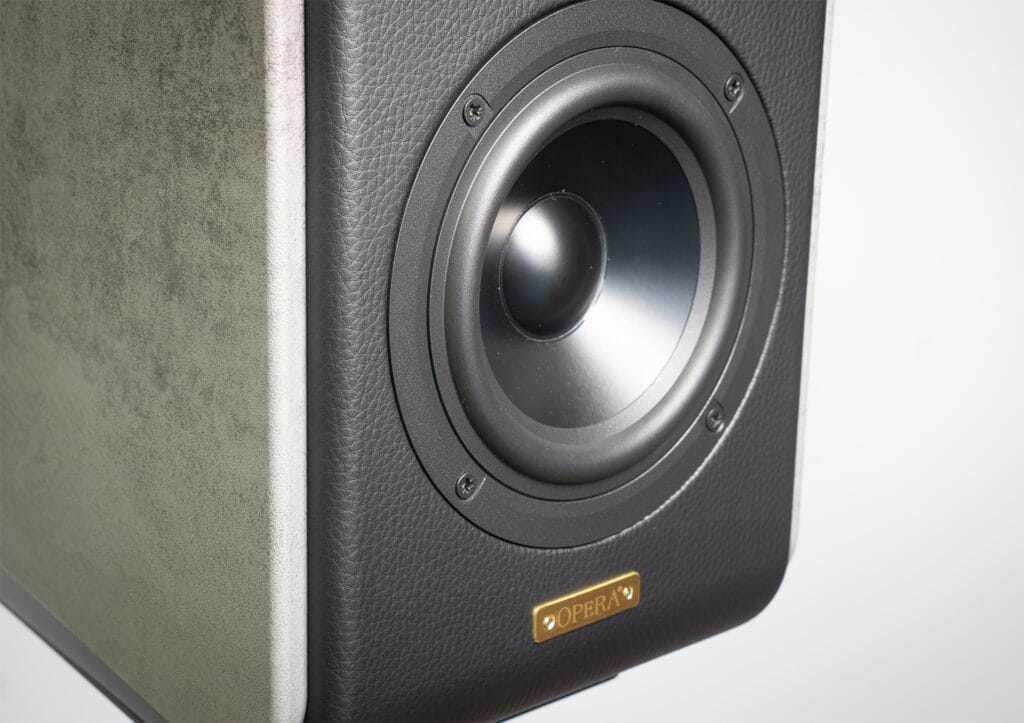
150mm Opera/Scan-speak bass driver boasts a large voicecoil and aluminium diaphragm
Karajan’s Mozart Requiem (1975) (24-bit/96kHz), with the Berlin Philharmonic and Vienna Choral Society, is an excellent example of the Opera Mezza v2’s skilled felicity in this respect. These speakers image very well. The soloists are rendered between the speakers, with each of the four clearly drawn left to right: Soprano, Alto, Tenor and Bass. Behind them range the orchestra and the choir, with the singers going back and gaining height.
The recording places you a bit further back into the auditorium, so that while the orchestral sections are easily differentiated, the individual players are less so. The four sections of the choir are articulate, with good diction. Is this the best recording of this piece by Karajan? Perhaps not, but it is really enjoyable, with the Opera Mezza v2 reproducing the arresting choral dynamics with ease.
Baba Yaga by Anatoly Lyadov is a powerful piece. The album Showcase is a Reference Recording featuring the Minneapolis Symphony Orchestra under Eiji Oue (16-bit/44kHz), and is a fine example, which is well realised by the Mezza v2 which bring a growling menace to the performance with a superbly captured percussion. An example being the xylophone, whenever it arrives it does so with importunistic insistence, with the woody character of the instrument well presented, along with the strident strikes.
That is not to say that poor recordings are not identified too, as these are informative speakers. When used in my desktop system with the Icon/Naim amp combo, I would have described the speakers as sounding slightly on the warm side of neutral. But when placed in my main system with ModWright LS36.5 pre and Naim power amp, I found them to be more neutral.
In summary
The Opera Mezzo v2 is not a budget set of speakers by any means, but their quality realisation make them an excellent addition to the small speaker fraternity, and one with its own set of strengths.
This is a speaker with a tad more upper bass presence, timbre and tone than I am used to, having a stronger bass underpinning and good detail definition.
It’s also a speaker that I could listen to for many hours, and I’m sure many readers will too. A night at the Opera? I had quite a few, and enjoyed every one.