


“I told you so”, not something I often say in these pages. But when I heard MoFi’s SourcePoint 888 as the year turned, the impression they left was so big, I had to ask myself that if this is what MoFi can do to complement its 8″ SourcePoint driver, imagine what it could do with a tower model based around the 10″ one.
But I was only half right, because while I consider the SourcePoint 888 one of the best loudspeakers I’ve experienced in quite some time at the price, the SourcePoint V10 Master Edition isn’t just its little brother beefed up for bragging rights (not that either speaker could be classed as demure), as it has a few unique surprises of its own.

Not many speakers have the presence of MoFi’s SourcePoint V10 Master Edition, and in walnut wood they celebrate a retro appeal, with black ash as the alternative
Because while the 888 model is a lot of speaker with its triple 8″ drivers (with two dedicated to bass reproduction), the V10 boasts a full five. You read that right – five 10″ drive units per speaker. Although all may not be what it seems…
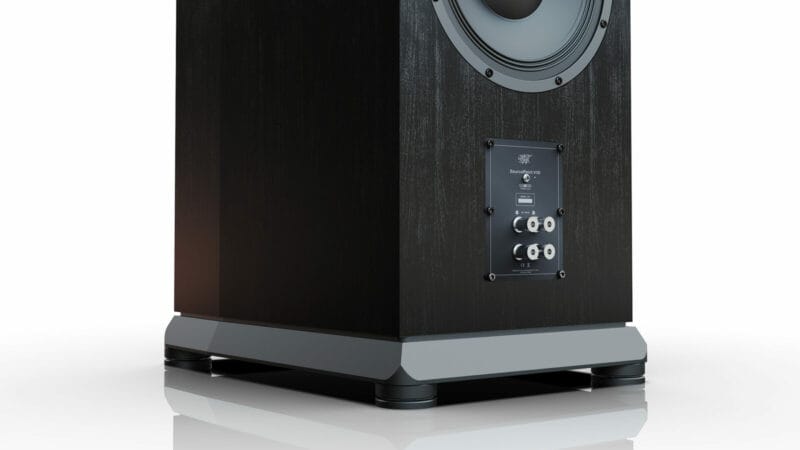
Up front, as with the 888 model, you get a triple array, with the 888’s main drive units swapped out for 10″ variants of MoFi’s own paper-coned woofers (chosen for its stability within a larger cone vs alternative materials). But spin the cabinets around (which takes some doing, at almost 73kg each) and instead of twin bass ports you’re greeted by twin passive bass radiators, which are essentially the front-firing woofers replicated, sans magnets and coils.

SourcePoint V10 Master Edition looks just as epic from the rear as it does the front, thanks to its five-strong driver array
Why? Because venting bass drivers of this size that shift so much air can lead to ‘chuffing’ and ‘chunking’ in a conventional bass port, thereby muddying the sound. Whereas a passive radiator affords you much more control, while keeping cabinet depth proportionate.
But to do this right you need a loudspeaker designer of some merit, and let’s remind ourselves that MoFi has one of the best in the business in Andrew Jones. And this aint his first passive radiator rodeo either, having earnt his stripes at KEF, Pioneer, TAD and Elac along the way.
If you want the full story of Andrew’s career and thinking that led to the V10, tune in to our exclusive interview with the man himself below.
Master at work
As we saw with the SourcePoint 888 model, these bass drivers are highly spec’d, boasting dual-opposed neodymium magnets, with a short coil/long gap arrangement and ‘underhung’ motor, which Andrew has employed for greater linearity in their behaviour (compared to long coil/short gap designs).
And with so much bass tech, it’s almost too easy to overlook this speaker’s other raison d’etre which runs throughout MoFi’s loudspeaker family, that all important dual concentric SourcePoint high/mid driver assembly.
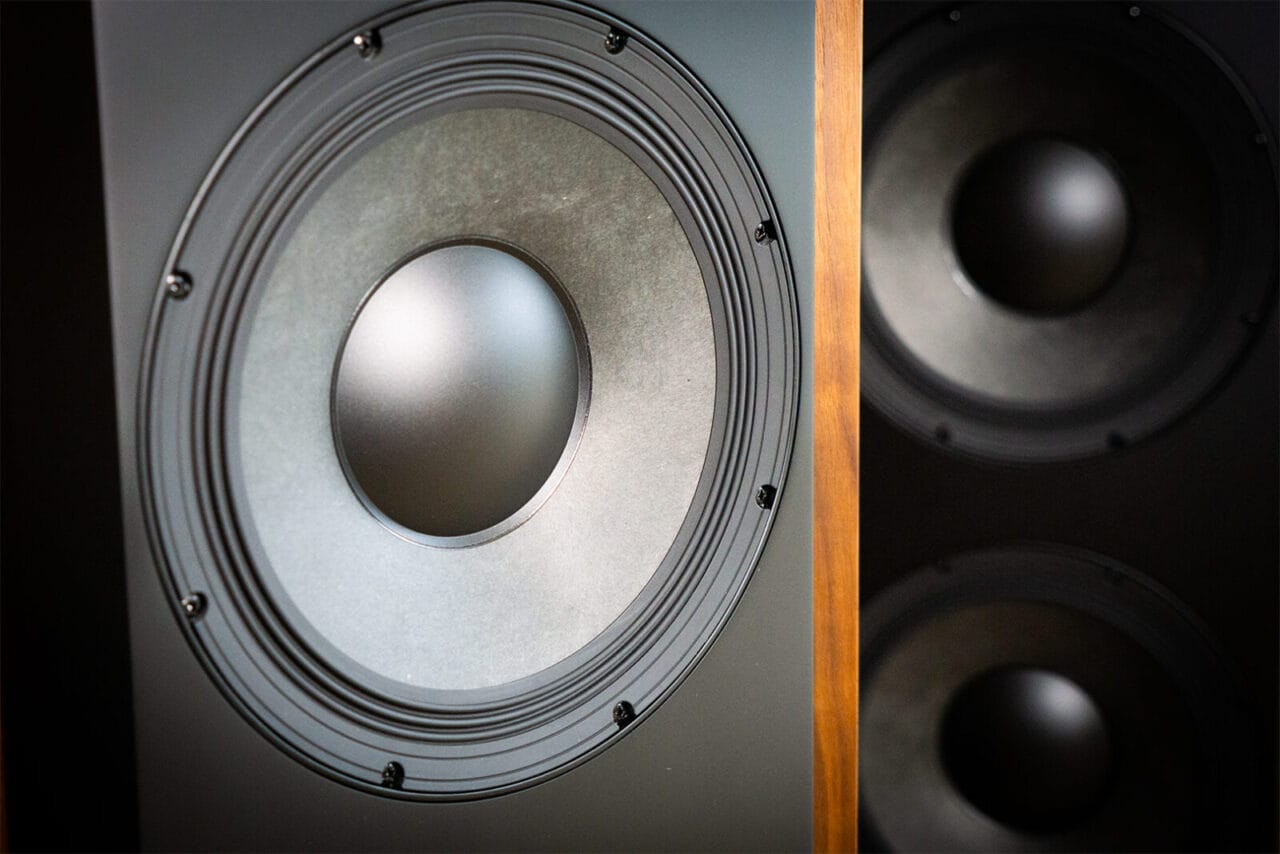
For the V10 this means a 1.25″ (32mm) soft dome tweeter with 28mm copper voice-coil neatly nestled in the throat of a 10″ (254mm) cone. And like its bass drivers, each unit also gets opposed neodymium magnets, coupled together in what MoFi labels a ‘Twin Drive’ array, to reduce distortion.

Trademark SourcePoint dual concentric tweeter/midrange unit sits at the centre of MoFi’s speaker ethos. Note the ribbed roll surround for greater control while having a lower external profile for greater sound dispersion
And the refinements for the V10 don’t end here, as their Master Edition status eludes to the V10’s new crossover, allowing it to pull up a pew at MoFi’s top table alongside the MasterDeck and MasterPhono products.
These crossover improvements translate to polypropylene film capacitors, metalised‑film resistors, and air‑core inductors with separate boards for bass, mid and high frequency circuits. It’s tuneable too, thanks to a three position rocker switch for treble with low/mid/high output settings offering around 1dB difference between each.
And as is Andrew’s way, he’s devised his own slopes that best blend the drivers together with phasing that’s all about being flat on axis and a flat power response, which goes back to my earlier point, as what you’re getting here is Jones’s decades of knowhow in a no holds-barred loudspeaker.

Rear speaker terminals offer bi-wire/amp connections should you need them, while three tweeter level settings are there for tweaking the V10’s high frequencies to suit your room
Existing owners of the standard SourcePoint 10 can also retro-fit the new crossover at £389, bringing them bang up to spec with the latest versions (the new SourcePoint 10 Master Edition standmount costs £3,600 all in).
All this hardware requires a cabinet that’s up to the task, and the V10 is formed from high density MDF that’s around 25% thicker than the carcass of the 888 model, with each bass driver and partnering passive radiator sharing their own enclosure, meaning extra bracing as a result.

At half a metre deep, shy and retiring these are not. Book matched walnut veneer is just gorgeous though (it must have been a big tree!)
Being so heavy, and me such a wee slip of a lad, unboxing these speakers requires some planning to avoid damage to man or machine. I opted for laying the boxes flat, opening both ends and then pushing each speaker out with my feet, within their protective foam packaging. I may have looked ridiculous in action but it worked. This then allows you to fit their supplied knurled cylindrical flat feet or spikes before uprighting them. (And a note on the spikes, as given this speaker’s weight I’d pop cups under them, otherwise they’ll go into your softwood floorboards like nails.)

Front baffle is faceted to minimise reflections, while being slightly recessed for a seamless fit with their magnetically attached front grilles
For a speaker at this price, experiencing the build, fit and finish wont leave you feeling short changed in any way whatsoever, as the quality is frankly top drawer. With them in situ, I’m reminded of the G Plan statement furniture my grandparents saved so hard for back in the day, that looked just as good decades on. (And with their ’70s charm, the V10 speakers would have been ideal room mates.)

Not an optical illusion, the V10’s cabinet intentionally narrows from front to back to reduce internal standing waves, thanks to less parallel surfaces
And I doth my cap to MoFi for this styling approach, by bucking the trend towards slender towers, because I like good hifi to be seen as well as heard. That said there aint no denying that these are whoppingly big speakers by anyone’s standards at 1.3m high and over half a metre deep, and unashamedly so. What’s even more worthy of cap dothery though is for how MoFi has managed to achieve all of what’s gone into the V10 while keeping the price tag under five figures. If these had cost double, I wouldn’t have been surprised, so impressive is the package.
Performance
Positioning a pair of V10s isn’t as chin strokingly difficult as you might imagine (and a relief given their size and weight).
And that’s because, a bit like the comparatively little ATC’s I tested a few weeks back, they’re less sensitive than many to room positioning. You’ll still want to take some time to get them in their optimal spots, but if not, they’ll perform consistently regardless as their soundstaging is excellent.
This is in part due to their bass response, which I was anticipating taking some managing, like taming a muscle car in slow traffic. But I was wrong, as those passive radiators means that while the V10’s low frequency delivery is frankly astonishing, it also resists boom and bloom, even when cited close to a rear wall (more so than the smaller 888 model by comparison).

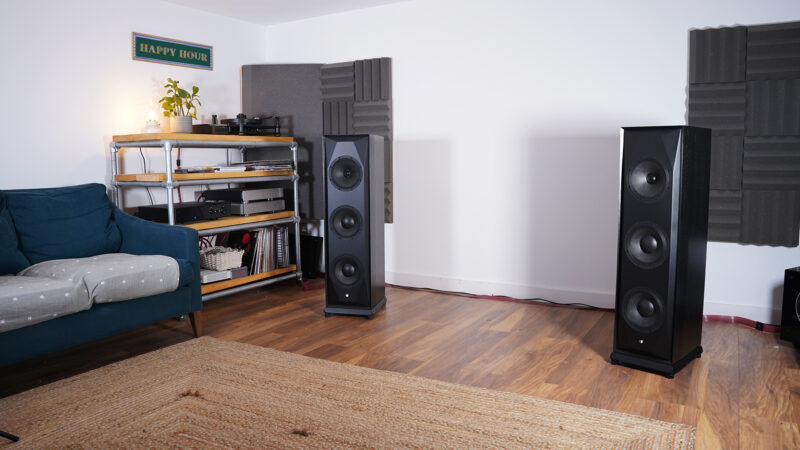
MoFi’s mighty V10 at Audiograde HQ. Despite those massive passive woofers, this speaker works well closer to a rear wall than I’d presumed it would
In my room, with them 60cm from a rear wall and with them toed in so that their axis meets just behind my listening position is ideal. My space is on the hotter side of neutral acoustically, and the V10’s middle treble setting seems to work best.
Popping a ReDISCovered pressing of Nick Drake’s Five Leaves Left LP onto the SME underlines the full picture these speakers paint. We’re not just talking rich soundstage that’s in front of you a’la ‘wall of sound’, because the V10 seems to breach these boundaries by some margin, enveloping you in the music, despite this being a stereo presentation.
And this is perhaps the characteristic that defines the V10’s performance the most, in how effortless they sound at all volumes in every direction. They’re able to drive a listening space with such ease, that the music just washes over you in a dense sea of detail and dynamics, as though they’re able to make the air between you and them heavier with sonic substance.
And before you start wondering if I’ve been at the cooking sherry again, the obvious reason for this is just good ol’ physics, as with all those drivers they’re shifting more air with less effort than smaller rivals.

Full frontal grilles follow the V10’s chamfered profile, with contrasting cream covers for the walnut model and matching black for the black ash. These can also be bought separately should you want an alternative look
Gentle giants
Sticking with the Drake album, I’ve spent over 20 years discovering the layers in its production, and the MoFis have an ability to lift its lid even further. Listen to Cello Song for example and you’re in for a treat, because while they may look like big cuddly loudspeakers, all fuzzy around the edges – in practice they’re seriously revealing. The strings and finger-picking on this track sounds blink and you’ll miss it performance stuff, which is rare from a box this size.
And when you really up the production ante, be prepared for some sonic fireworks on a grand scale. Peter Gabriel’s So is an obvious case in point, with Sledgehammer doing things in my listening space from the MoFis that few speakers can muster. It’s also the gentler moments on this album that tell me the V10 is something special. The vocals and atmospherics on Don’t Give Up, combined with moments like that oh-so-wait-for-it bassline at the end is why I got into hifi in the first place, and hearing the MoFi’s underlines why I’m still here. It’s an experience to utterly savour.

“Grab you grilles, your coming with me…” The V10 with yours truly, making its UK debut at The Hi-Fi Show Live in September
The ‘large’ elephant in the room I’ve (intentionally) not made detailed reference to yet though is the V10’s lower frequency response. Because to simply see these as a bigger MoFi with more bass is seriously underestimating what Jones & co has achieved. Bass is incredible of course, down to a claimed 27Hz, and it feels like it. But its not just about a low thump gut punch, and if this is what you’re after then just buy a sub and a smaller set of towers for less. But will you get the seamless integration and consequential musical realism that the V10 offers from the latter? I doubt it.
Hear Robert Plant’s superb latest album Saving Grace and the way each instrument is conjured via the V10 hammers this home. Having seen him perform it live some weeks before, I can vouch for the V10 offering a true reference into the performance with a sense of scale, balance and authenticity that does the living legend justice.
There’s many a high-end speaker that’s blown me away sonically, pinning me to my seat with astonishing accuracy and power, but could I live with them everyday? I’m not sure. The V10 though gets this balance right, as they sound every bit a grail loudspeaker but with a blend of insight and smoothness that just keeps you going back for more.
In summary
I loved MoFi’s 888 model – it’s such a great speaker for the money (I almost bought a pair) – but boy do I love these more. Unashamedly big, unashamedly bold and unashamedly brilliant. This is one of the most accomplished loudspeakers I’ve heard in some time, regardless of price.
And while MoFi isn’t alone in being brave enough to embrace big drivers in such a statement speaker (obvious company being JBL, Klipsch, Tannoy, Wilson et al…), the V10 stands apart for what MoFi has managed to pack into it, making it a game changer for under ten grand. Providing you have the space, sonically it’s so easy to live with day to day because it just does everything right. It’s my favourite loudspeaker on the market right now, it really is that good.