


If I was to curate a list of high-end integrated amplifiers I could live with longterm then this, alongside offerings from Rotel (Michi), AVID and Devialet would be on it.
Because all of these established brands offer models that while being in flagship territory, can also be slotted into an average domestic setting without taking up a corner of your house. And all offer something different. From Rotel you get its no compromise in-house power supplies, Devialet brings you access to its cutting edge digital architecture, and with AVID it’s the un-compromised build quality. But with Musical Fidelity, it’s many of these things plus those all important nuvista devices adding some valve sweetness married to oodles of power.

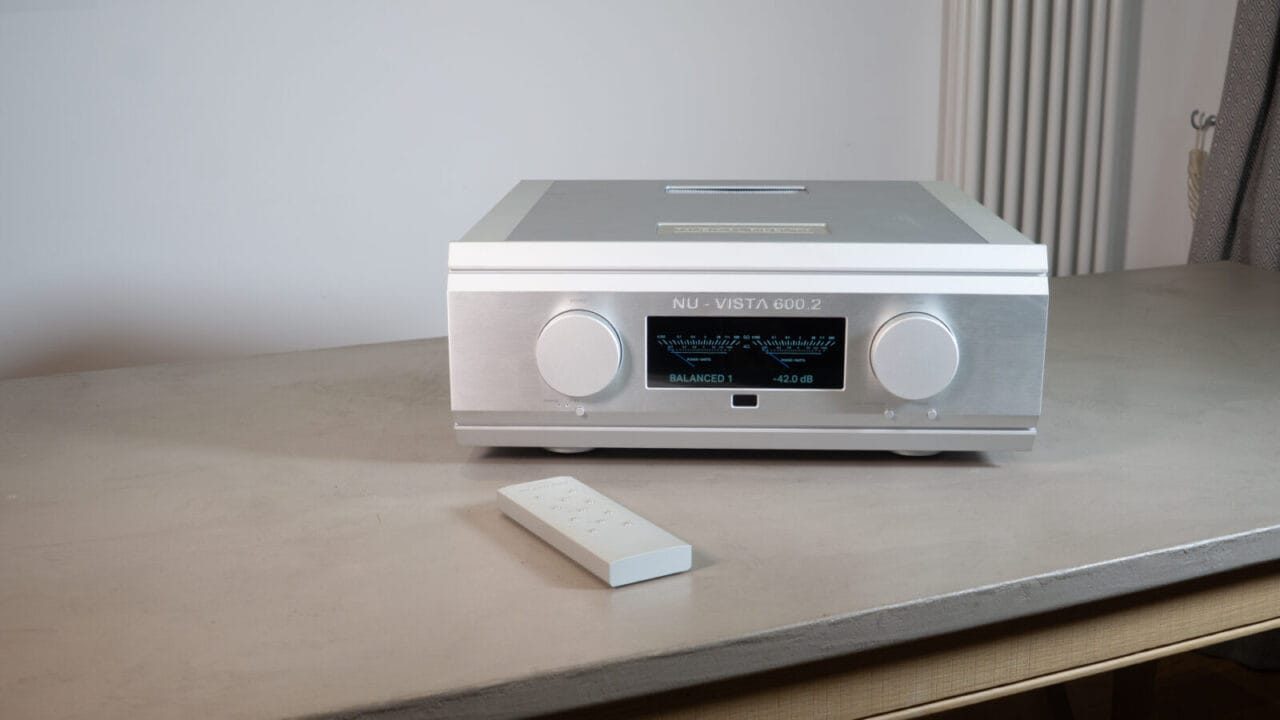
Resplendent in brushed silver, like the rest of the Nu-Vista range, there’s also a black option
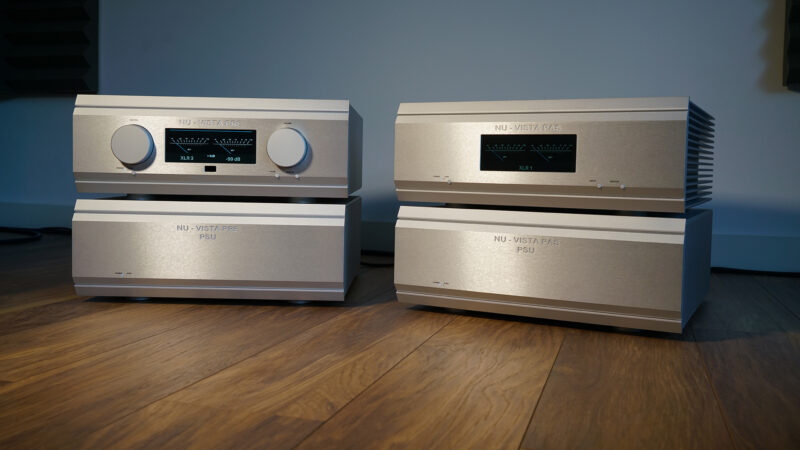
We have of course been in Nu-Vista territory before with its range-topping PRE and PAS pre/power amps, which took our best separate amps of the year award in 2023, but they are seriously big, with each packing their own equally sized separate PSU meaning you’ve got four boxes the size of the 600.2 to accommodate (weighing in at over 100kg combined), costing north of forty grand.
The 600.2 integrated then offers a sizeable slice of Musical Fidelity’s Nu-Vista pie in a much more digestible portion, and with a much more attainable price tag at £7,999. Being the latest updated model re-introduced to MF’s range in 2025, it’s also the cheapest Nu-Vista amp in the range, slotting in under the £10,999 800.2 integrated and offering less power, yet perhaps surprisingly, a richer set of connections.
In resurrecting the 600 to .2 guise, as well as increasing its price tag, the folks at MF and parent company Audio Tuning Vertriebs GmbH also took the opportunity to upgrade its internals with new dual-mono preamplifier circuitry, a redesigned front-panel and display, laser-trimmed volume control and improved dual-mono power supplies, to cement its status as part of the brand’s ultimate range.

Front panel’s digital display has a range of illumination options – but for us it’s got to be those stereo VU’s which look superb
Musical simplicity
What I’ve always admired about Musical Fidelity and its approach to hifi is that it doesn’t over complicate things, and in many ways the higher you climb its product ladder, the less complicated they become. Because what you get here is an intentionally line-level analogue only amplifier that’s extremely well made to last a lifetime, and that’s largely it. So we’re talking four single-ended inputs over RCA and two sets via balanced XLR connections, which is one more set of XLR inputs than the 800.2 model gets. It also offers fixed XLR outputs, alongside fixed and variable RCAs, which again is more than the 800.2 model, which only has RCAs.

Rear panel is clearly laid out with RCA socketry at the top and XLR below plus mains input and speaker connections
Of course as well as those dual mono internals, the technical icing on the Nu-Vista models’ cakes are those rarified nuvista tubes, which offer much greater performance than traditional glass bodied types while retaining their sonic qualities that valve amp users know and love. For the 600.2, this means a pair of 6S51N nuvistas per side (the same that are used across the range) incorporated into its Class A preamp stage, married to two pairs of Sanken output transistors per stereo channel, which help account for its 160W into 8Ω output (almost doubling to 300W into 4Ω). While this may be a chunk less than the 800.2’s 330W into 8Ω (500W/4Ω), in real world systems? It’s still plenty.
And if you’re worried about what happens if these wear out or go pop then fear not, as Audio Tuning has hoovered up tens of thousands of remaining stocks to ensure its products are catered for well into the future.
Anything I’d add? A headphone socket would be nice, especially since MF no longer offers a range of standalone headphone amps, but there are plenty of others out there to choose from if you value having a cans listening option.

Those all important nuvistas, illuminated to show their status with blue denoting they’re warmed up and ready to rock
Standout build
Unboxing the 600.2 highlights how well made this thing is. I’ve owned the brand’s M6 pre/power amps as a reference for many years, and had forgotten how much of a step-up in build quality and finishing the Nu-Vista line is by comparison, right down to the 600.2’s chamfered and profiled 25mm thick front panel and embossed logo. And whereas my Rotel Michi X5 (which occupies a similar physical footprint to the 600.2) is all about sleek and understated design, the MF is much bolder, especially in all silver, as we opted for. It feels every bit what an £8k amp should be like and then some, and can more than hold its own alongside integrateds from the likes of Levinson, Krell and D’Agostino at over twice the price.
The 600.2’s massive twin front rotary dials are there for input selection and volume control, flanking a large backlit screen which offers four visual modes showing input and volume as large text only, or via analogue style VU meters, with can be set to backlit in black or white, with adjustable brightness levels (including an auto-dim option). These brightness options also allow you to illuminate the valves under the top plate through the mesh window, should you want to remind yourself what’s cooking inside the 600.2’s case.
And then there’s the remote control, cast from solid alloy that’s so chunky it even gets its own feet – another nod to the amp’s high-end credentials.

Large volume knob with front panel display option buttons below
Performance
Partnering kit on the analogue side is an SME 20/2 deck with AVID arm, feeding a Primare R35 phono stage, while on the digital side it’s Primare again, this time via a CD 15 Prisma. Cables are from Atlas and Nordost, driving MoFi’s SourcePoint V10 Master Edition loudspeakers.
Kicking off with some classic rock via Pink Floyd’s Wish You Were Here LP reveals the 600.2 to have one of the most open and extended top ends I’ve experienced from an integrated amplifier at this price. From that initial guitar riff through to the crashing percussion and keyboards, there’s a sense of the music leaving the speakers with absolute freedom to extend in all directions, making it sound like there’s much more than those 160W driving the MoFi’s.
And as the music gathers momentum, the sound stage conjured by the MF amp is vast and richly populated, as though despite the volume being at wedding disco levels, the 600.2 is barely stretching its legs.
There’s detail too in abundance, but not in an overly analytical sense. Take Tracy Chapman’s For My Lover at 16-bit/44kHz (Qobuz) from her self-titled 1988 album for example, hearing how the percussion and vocals image and escape the soundstage is such an inviting listen, as you’ve got the scale and dynamic control that’s typical of the best of the (Class AB) solid state breed, wrapped in a valve-like rich tonality. In many respects the 600.2 offers a performance that’s closer than it’s price tag would suggest to MF’s Nu-Vista PRE/PAS models it looks up to. And hearing them back to back wouldn’t be a night and day difference, but a bell curve in terms of performance, as you get a lot of what that pairing offer, but at less than a quarter of their price. In other words this is a lot of amplifier for the money.
Low frequency extension and control is also typical Musical Fidelity, being graced with plenty of depth, scale and punch, which the MoFis lap up. Dial in Deadmau5’s Seeya track from his double disc while(1<2) album and hear what the 600.2 does with it, as it’s quite something. But it’s not just about the lowest notes, as it’s in the upper bass where this amp seems to revel too, showing its balanced tonality across the frequency range.

Supplied accessories include a hefty alloy remote and spiked/cupped feet to ensure minimal vibration reaches the amp’s internals
The valve effect
Given the other kit in rotation at Audiograde HQ, I cannot help compare and contrast the MF with my Rotel Michi X5. With the series 2 X5 being within a few hundred quid of the MF amp, I’d expect these to perhaps be auditioned side by side by prospective buyers.
What this reveals is two very different yet equally accomplished amplifiers. Whereas the Rotel is all about control, it’s perhaps a little softer sounding and less forward in the treble and midrange than the MF. Bass is exceptional from both amplifiers, with the MF sounding that little bit less constrained, as though it wants to push further and firmer than the Michi. I could (and do with the Rotel) live with either of these day to day. If I wanted the more civilised option I’d plump for the Michi, if I wanted something with more bite, attack and to an extent fluidity, it’d be the MF – as both are the amps to beat at the price. My only regret is that I have to give the latter back, as I’ve enjoyed every second spent with it.

Just look at that build quality, I won’t be glad to see the back of the 600.2
In summary
The 600.2 is probably the best value high-end amp to come out of Musical Fidelity in quite some time. Because while its cheaper M6SI500 and M8 XI models take some beating as class leading powerhouses, there’s an extra level of sonic refinement here that pushes this amp into super league territory, being of direct lineage to Musical Fidelity’s ultimate statement Nu-Vista PRE/PAS amps at a fraction of the price.
It’s a taste of ultimate hifi that you can actually live with day to day without fuss, making it a high-end reference with real world appeal. And that’s a hard match to beat.