




You have to admire Rega Research. In an industry beset with challenges from all sides, ranging from the constant onslaught of convenience over quality, to digital vs analogue, not only has it stuck to its guns for half a century, it’s also managed to do so while constantly evolving and making a real success of it, compared to a glut of rivals that have fallen by the wayside.
And that’s largely down to co-founder Roy Gandy, the James Dyson of vinyl (who was so long before Mr Dyson got into the vacuum cleaner game). Gandy’s belief that analogue isn’t just still relevant, but can better digital still drives him, as does his approach to using lightweight, rigid materials that minimise energy absorption, which is the DNA that’s run through his turntables going back decades.
Rega still makes digital products of course, and very good ones too – like the Isis DAC/CD player range – but a quick glance at its current product line is a vinyl enthusiast’s delight, with no less than 10 turntables, 10 cartridges, six phono stages and five tonearms to pick from, spanning starter to grail levels.

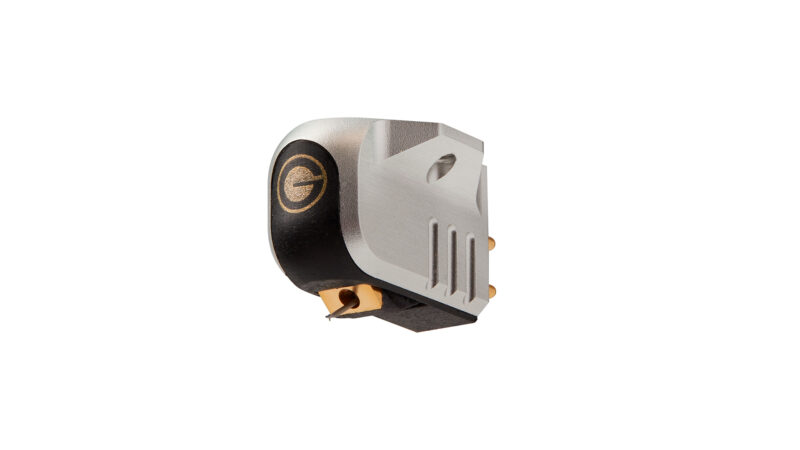
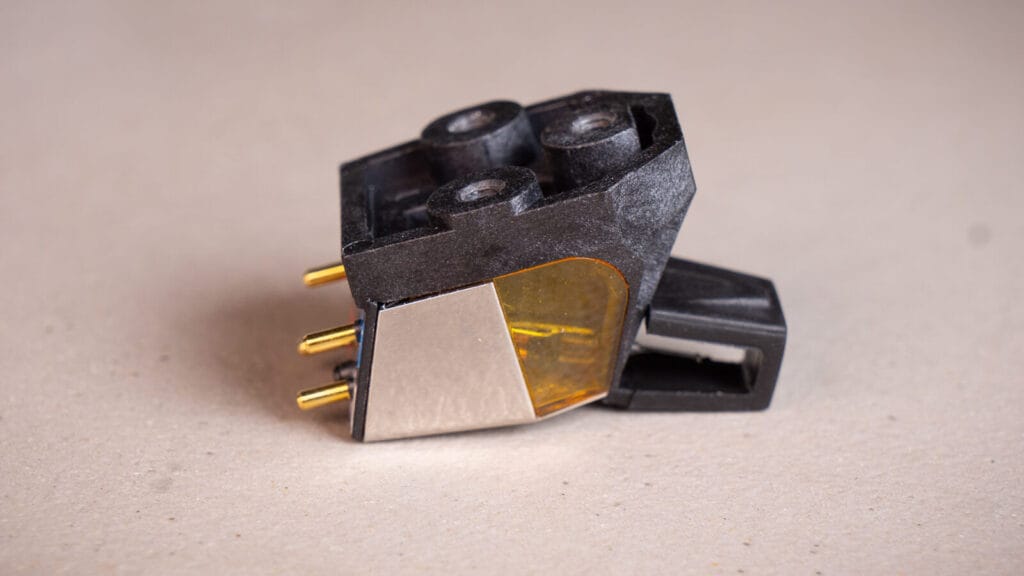
Rega’s Nd9 pick-up, identifiable via the amber tint to its see-through side windows
The Nd9 is the latest cartridge to leave Rega’s Southend-on-Sea stable, released last November alongside the brand’s Mercury/Solis pre/power amps, and taking Rega’s moving-magnet (MM) cartridge top spot in the process, being pitched above the Nd3/5/7 models, while still managing to be competitively priced at £695.
Those familiar with this brand’s MM pick-ups will instantly recognise the Nd9’s body material as Rega’s injection moulded glass filled polyphenylene sulphide (PPS), chosen for its lightweight and highly rigid properties (staying true to Rega’s ethos), inspired by the brand’s moving-coil (MC) range. Also in-line with the wider Nd range is the use of a Neodymium N55 magnet (hence the Nd in the name), operating against miniaturised parallel coils, which are wound in house using 38-micron wire, with 1275 turns.

The Nd9’s all important cantilever and stylus are what elevate it above the rest of the Nd line-up
Precious metal
And while the Nd9 gets the same fine-line nude profile stylus as that fitted to the Nd7 – meaning a radii Monocrystalline manmade diamond with a minor radius of just 3 microns – for the Nd9 this is mounted to a Boron cantilever, mirroring that of Rega’s Aphelion 2 MC, in place of the aluminium variants used on the rest of the Nd lne. And this is for good reason, with Boron being both stronger and stiffer, to ensure those all important vibrations travelling its length are passed on with minimal degradation.
The reason for this is simple, because when you consider that any compromises here, right at the source of where the music is being extracted will then get passed up the signal chain and repeatedly amplified, getting these materials right for a relatively small extra outlay seems well worth it.
The Nd9’s stylus guard will help keep it safe, and actually looks quite stylish, much more so than the usual chunky plastic affairs most rivals use
This being Rega there are two user features that set the Nd9 apart from the usual MM crowd. The first being its three-point mounting system, meaning that while the cartridge body can be bolted to any standard tonearm, when using one of Rega’s own, a third central mounting hole can be brought into play for a more rigid coupling.
Green credentials
The second is perhaps less practical, because thanks to Rega’s design philosophy, the Nd9 is more like an MC pick-up in having a non-user replaceable stylus, when it wears out. And this is because Rega prefers to avoid the extra mechanical coupling a removable one would create, and the sonic compromises that can come with it. Instead Rega prefers to employ its pivot pad approach, for improved tracking thanks to tighter tolerances than a replaceable option would allow for, making for a more consistent performance.
And this is achieved because said pivot pad is a complex rhomboid with a 5° centre hole to achieve the Nd9’s 27° tracking angle. It’s moulded from Rega’s secret blend of Butyl rubber devised by specialist chemists, that migrates on a molecular level over 24hrs once fitted. This then bonds to the cantilever and bonds to the cartridge body for better control, providing ideal levels of freedom of movement at all angles while achieving enhanced tracking abilities.

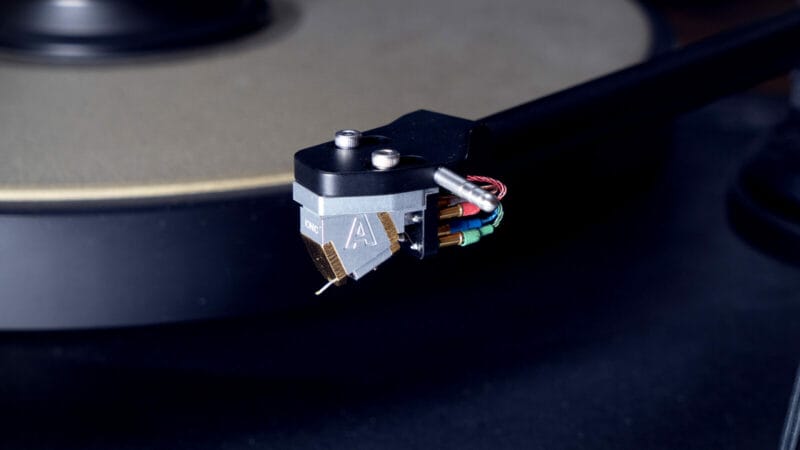
Rega’s three-point mounting system uses threaded holes for easy installation. Note the widely spaced colour-coded cartridge pins, again to aid fitting
But this doesn’t mean that when the needle wears out it’s game over, as Rega offers its own rebuild scheme which typically includes a new cantilever, stylus and pivot pad – all tried and tested as new and sold back to you at a reduced price, which seems a sensible compromise, while also being better for the environment.
Receiving the Nd9, for nearly seven hundred sheets I was initially a little disappointed when I first clapped eyes and hands on its cardboard box packaging. Where was the hard plastic case with various papers and installation gubbins my subconscious asked?

No frills packaging is something to celebrate I’d say
But then common sense kicked in over my materialistic side, as I’ve got a loft full of nice boxes, used once and likely destined for landfill. Instead Rega is being bold in stripping it right back to what you need: the cartridge, mounting bolts, small allen key and tracking force printed within…and that’s your lot. Which, which is all you need. And I’d rather my money was spent on what’s in the cartridge than the box it comes in.
Performance
Mounted on my AVID Nexus V2 arm (fitted to an SME 20/2 turntable), installation and alignment is plain sailing, largely thanks to those nicely spaced connector pins and ‘V’ shaped stylus cover that acts as a precise alignment guide. I also quite like the amber glass flanks when in use, allowing you to peep inside and see where the magic happens.
Also notable is its recommended tracking force of 1.75g, which is approaching the lower end of average, alluding to how well this can track combined with decent levels of dynamic compliance (although specs regarding the latter aren’t published).
Accompanying phono stage is Primare’s reference R35, feeding a Rotel Michi X5 amp and MoFi V10 ME speakers, with the phono preamp’s gain set to 46dB over XLR, which seems to give the best sonic balance for the Rega’s 5-6mV output.
Listening to the Nd9, you can tell within a few albums that not only is its spec and build of high order, but that it’s also been crafted by a company that’s passionate about vinyl.
And while this may seam obvious, what I mean by this is that I’ve heard many MM pick-ups with similar credentials and higher price tags that can all too often leave me cold because of their clear but sterile presentation, vs cheaper cartridges with lesser materials that just gel (like budget Audio-Technica’s for example). What the Nd9 offers though is a balance of both – because you get that analytical attention to detail and nuance, but not to the detriment of plain old musical enjoyment.
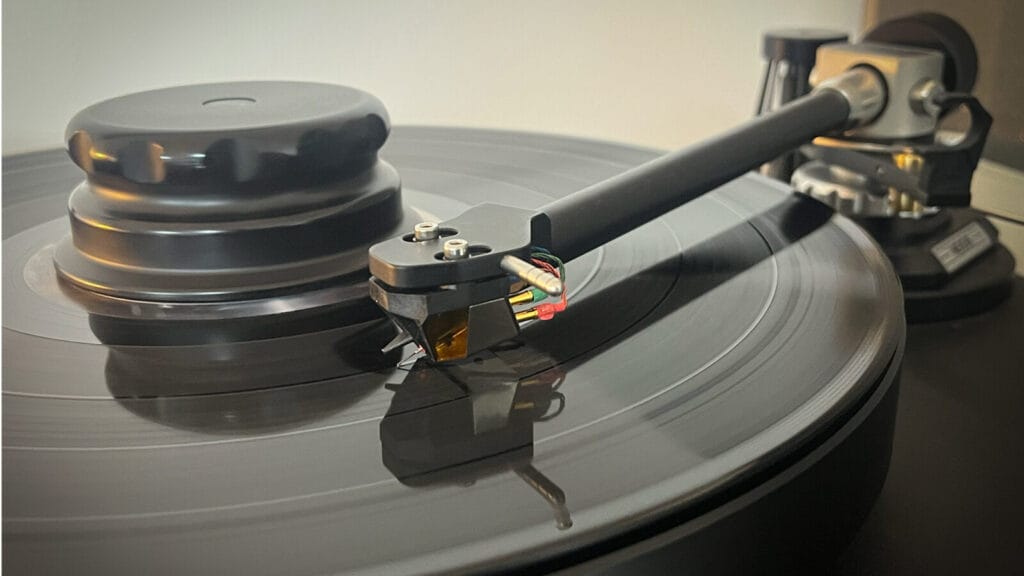
The Nd9 can more than hold its own on some serious analogue replay hardware, such as my AVID and SME combo
Pop on the Handsome Family’s 2003 Singing Bones LP for example and those opening slide guitar notes and deep vocal harmonies wash over you like waves, rather than seemed pushed at you, allowing the album’s melodic richness to fill the soundstage without sounding forced.
No slouch
But does this mean the Nd9 is a relaxed performer? Not really, because while this album has a luscious languid nature to it at times, when the tempo steps up, so does the Rega – with a notable knack for adapting to any music that it’s asked to deliver.
Spinning Marian Hill’s One Time from The Sounds Of Primare Volume 1 reference LP and its punchy beats and water tight production are served up with aplomb. Channel and instrument separation are also excellently rendered by the Nd9, with plenty of air and space afforded around vocals and instruments that elevate the Rega above similarly priced competition in this respect.
Underlining Rega’s design philosophy, there’s a sense of boundless energy too from the Nd9’s sonics, that keeps your attention but without being overly demanding. And this is because of how the Nd9 is voiced, without anything too forward, or far back in the mix. Instead, striking the right balance is this cartridge’s mantra.
Compared to some rivals, such as my similarly priced MoFi MasterTracker, the Rega is more neutral sounding, whereas the MoFi is a bit warmer and bolder in the extremes and this makes the Rega more adaptable to a wider range of musical tastes given how it treats it all equally. To illustrate this, the Fine Young Cannibals’ The Raw And The Cooked album is typical ’80s production, with its polished edges getting a little softening via the MoFi, which some may welcome, while others may want to hear the album as it was intended (raw?), and that’s what the Rega gives you.
If I was after a highly accomplished neutral sounding do it all MM, then the Rega ticks all the right boxes.

Caught off guard? Nope – as the Nd9 is a consummate performer across all genres, with a spec sheet to prove it
Summary
While there are of course cheaper cartridges in Rega’s MM wheel house, because of the spec and performance the Nd9 offers, it’s still cracking value for the money.
Combining well thought out materials with Rega’s decades of dedication to vinyl, the Nd9 has to be one of the best all-round performing moving magnets in its price bracket as it just does everything right. If you’re looking for sophistication but aren’t yet ready for the dark arts of moving-coil commitment then the Nd9 needs to be on your shortlist. Highly recommended.