


This year marks 50 years since the founding of Amplification & Recording Cambridge (as Arcam was known back then) when it greeted the world with the A60 amplifier, a midrange model aimed at the market position that the company has targeted ever since.
Despite joining the mighty Harman group in 2017, Arcam remains based in Waterbeach, Cambridgeshire where the story started all those years ago, with all of its products designed and engineered there.
Over the half century since the A60, ranges including Alpha, Diva and FMJ have showcased a classy but minimalist style for a variety of two channel and home cinema gear at affordable prices, and while the looks of its products have always combined simplicity with quality, there’s little doubt as to where the R&D spend goes when the ‘on’ switch is pressed. It is a philosophy that I have personally embraced having run an A85 amplifier and CD72 disc spinner for many tuneful years. In contrast to its amplifier legacy, Arcam is a relative newcomer to the standalone streamer sector with the ST25 replacing what was its first streamer – the ST60 – that debuted in 2020. That model hit the ground running and quickly acquired a reputation for unfatiguing warmth in its sound that marked it out as a class leader. So there is much to live up to for the devices that follow.

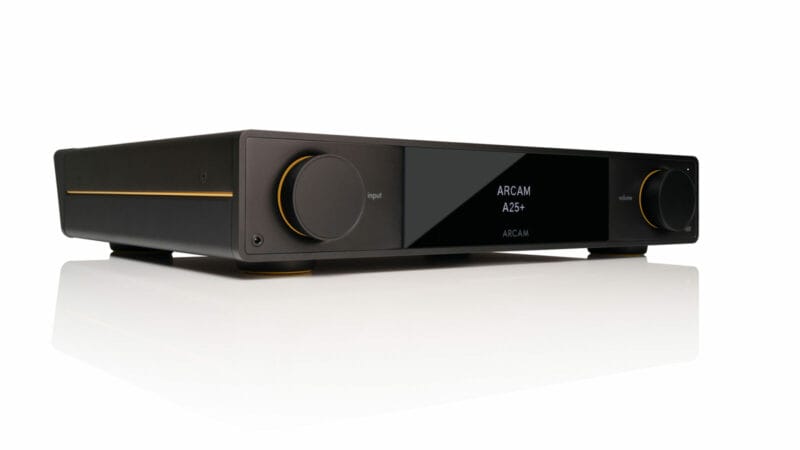
A25+ amplifier makes a statement in the brand’s signature black and yellow accent colours
Make way for Radia
In late 2023 Arcam announced the Radia series, featuring a range of amps, streamers and CD players in a new stealthy design language. The time has since come to expand that range with the amplifier and streamer on test here.
The A25+ (£1,699) is a substantial revamp of the original A25 integrated. A multitude of enhancements have been introduced including the addition of an HDMI ARC port, an upgraded DAC and a redesigned transformer. The Bluetooth module is now 5.4 compliant with added hi-res codecs including aptX HD and Lossless, while retaining transmit capability for wireless headphones and support for Bluetooth Auracast tech, catering for up to 20 connected devices. The amp’s looks are largely unchanged over its predecessor, aside from the addition of a stylish cut glass front panel and new model name, with the twin front dials and their yellow ‘halo’ illumination carried over from the A25.

The all important ‘+’ hints at a raft of upgrades
Another unchanged feature is Arcam’s Class G power supply architecture from the A25. Class G resembles a Class AB design where two power supplies work in tandem, with one providing low power requirements before switching up to a higher power rail as the workload increases. However Class G avoids crossover distortion at the switchover point by feeding signals to the higher rail in a graduated manner, with the overall power profile being a slope rather than a step. It is a tricky engineering feat to pull off, but Arcam has been a stalwart of this technology for many years now in its quest to attain the holy grail of power efficiency without detriment to audio quality. Also unchanged is the power output of 100W into 8Ω (increasing to 165W into 4Ω).
On the analogue front, the A25+ offers three line level inputs, a phono input for the built-in moving-magnet phono stage and a pre-out. The digital camp is represented by the aforementioned HDMI ARC, optical, and two coaxial inputs supporting up to 192kHz and a USB-C supporting up to 384kHz.

Cleanly laid out rear panel offers a decent range of digital and analogue connections, with a service port for firmware updates
Simplicity upstream
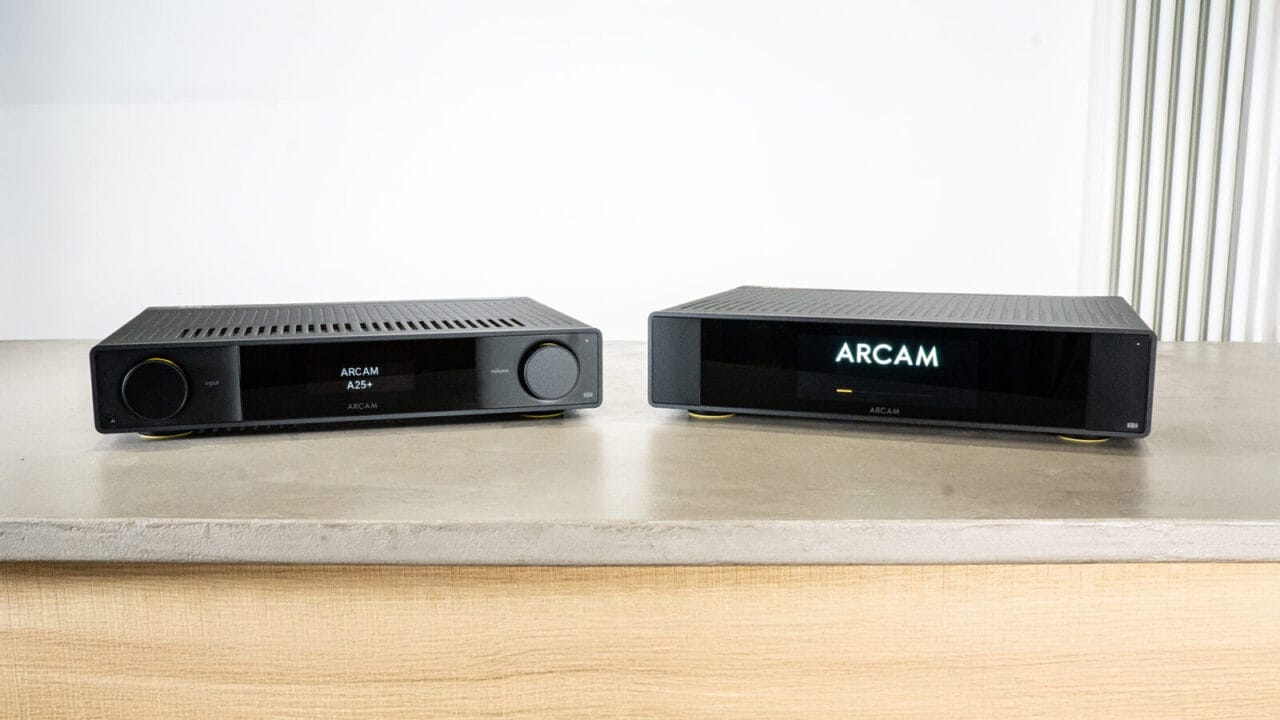
The partnering ST25 streamer (£1,499) slots in above the entry point ST5 (£799). It is a ground up re-design with a deep set chassis mirroring the amp, accommodating a 6.5″ hi-res display for album artwork and programme information. Under the hood, the six layer audio streaming platform incorporates a new Hyperstream iV DAC boasting advanced jitter elimination and a ground plane, to keep audio signals segregated from sources of interference.
Streaming support is included for the usual online suspects including Tidal Connect, Spotify Connect, Qobuz Connect and Amazon Music in addition to being Roon ready and Google Chromecast and Apple Airplay II compatible. Within the settings menu there is a DAC filter too, with four treble tuning options.

ST25 is sleek yet modern, with its front screen offering plenty of full colour drama to show you what’s being piped through it
Arcam has opted to keep things simple with the ST25, as neither digital inputs (beyond USB-A) nor Bluetooth are offered here. Some might see this as a little stingy, especially as both were offered on the ST60, but I see the logic given the close coupling with an amp that incorporates these features, so including them here would introduce unnecessary cost duplication and complexity, and excluding them also encourages you to buy the matching amp alongside the streamer.

Things are kept simple on the streamer with a choice of coaxial and optical digital outs alongside analogue RCA (no XLR), plus USB-A for external media
Light work out
Liberating the A25+ and ST25 from their packaging does not overly tax the biceps. Nonetheless both devices feel sturdy and solidly built. The design is subtle in approach with bright yellow detailing injecting the right level of contemporary style without being crass. Setup is straightforward and completed in a matter of minutes with the power cables, line connectors and the remote connector cable (allowing both devices to be used with a single remote control).
All that’s left to do is get the streamer on my home network, initially over a 5G connection, which proved reliable and negated any need for a wired ethernet cable to my router.
A minor gripe is with the chassis design’s rear overhang at the top of each case, which while looking tidier from above, makes cable connection or even accessing the on/off switches (located on the back panels) from the top something of a game of twister. However most owners won’t be recabling quite as often as those in the reviewing business, so this is unlikely to be a significant pain.

A25+ side on with its go-faster styling. Note the angled rear connector cover which looks great, but makes fitting cables from above that bit more fiddly
The ST25 is controlled via Arcam’s Radia app, replacing Musiclife that performed the same duties for the ST60. And with the updated app comes updated features including Amazon Music, Qobuz Connect and Spotify integration, along with connectivity for uPnP servers and USB media. However some settings found in the on screen menus are not accessible in the app, meaning a smart phone and remote control are both required, making the experience a little unwieldy. None of this is a deal breaker but others do it better, such as the recently revamped Volumio app that we experienced with the Rivo streamer.

Both units’ remotes share the yellow accents of the case design. Streamer and amp can be linked and operated from a single controller
Performance
With the amp and streamer connected and partnered with a pair of KEF R3 Meta speakers, I sought a delicate recording to start and Nick Drake’s 1972 Pink Moon album at 24-bit/96kHz (FLAC) on Tidal fitted the brief perfectly. As the gentle fingerpicking set Which Will in motion, I was struck with the sheer intimacy that allowed me to almost sense Drake’s breath emerging into the room. Partnered with this was the tonal clarity of the acoustic guitar showcasing the style of an artist lost to the world all too soon, but in that moment, brought back for a performance in the demo room in front of me.
What stood out to me here as the ethereal nature of the recording washed over me, was how the ST25’s ability to eliminate interference through simplicity contributed to the resultant low noise floor, emphasising the sense of quietness and demonstrating, as is so often the case, that less is more.
To dial things up a notch or two it was time for the title track off of Steely Dan’s Aja album at 24-bit/96kHz (FLAC), a cornucopia of a performance that mercifully exposes any sluggishness in a system. No such tardiness was evident here however with a sense of timing that would make an atomic clock blush, accompanied by a fastidious delivery of keyboards, drums, guitar and saxophone, the Arcams gave a masterclass in energetic dynamism which was invigorating without ever being tiring. There’s quality abounded in the Arcam pairing’s midrange and treble too, with percussion and keyboards really taking centre stage in the presentation with enhanced musicality.

Moving-magnet phono stage within the A25+ is a welcome inclusion for vinyl fans
Vinyl value
Turning to the other capabilities of the amp, I was intrigued to put its phono stage through its paces via my Project Debut Carbon EVO turntable and a dusted down pressing of Nils Frahm’s All Melody. Listening to The Whole World Wants To Be Touched, and its segue into Sunson was handled delicately, with gentle footsteps piercing the initial silence followed by choral voices and organ maintaining the sense of intimacy, right through to the pulsing dynamism that adds layered soundscapes. This deepening of the fabric of the music was reproduced without sacrifice in the subtlety stakes. True, a higher-end standalone phono stage may represent a useful upgrade in time over what is available here, but the one included in the A25+ is certainly enough to get you started and will give digital devotees a great opportunity to break into the world of vinyl, making the amp great value.
Throughout my testing, another quality of this pairing that came to the fore was how they perform at low volume, with the benefits of subtlety and musicality still being apparent regardless of the genre of music that I threw at it. This is a testament to Arcam’s enduring faith in the technology of course, but more than that, it allows the system to shine more often. Let’s face it, yanking up the dial to the max isn’t always an option – think of those who listen in settings needing neighbourly consideration, or where unappreciative spouses* may roam in close earshot (*mentioning no names). Much as our instincts tell us we need to go loud, it remains a delight to encounter a setup that can still offer a wealth of musical delights when the sound is also set to low. And if you need to go quieter still, you can always connect a set of headphones

Front panel headphone socket is a worthwhile inclusion for hardwiring cans, and you can Bluetooth to them too
In summary
Arcam has negotiated a fine line with this combo, thanks to a balance of features that move the game on while not going overboard at the expense of complexity or sound quality. It is a course that has yielded fantastic results with a rewarding sense of delicacy and rhythmic athleticism as recordings dictate during testing.
At this price I can think of very few products that tread these lines more carefully and with more impressive results. At just over £3k for the pair, I cannot recommend these highly enough.