

“Strength goes in at the mouth kid,” as my granny used to say. And while hi-end hifi wasn’t necessarily what she had in mind, this also rings true for audio equipment.
Because with a power supply being the beating heart of most hifi gear, delivering to that all important heart the highest quality signal you can, can only be beneficial.
Chord Company has known this for decades, and having met the team, I’ve yet to speak to anyone within the organisation that isn’t passionate and committed in equal measures to getting the best from your system via its cables and connections.

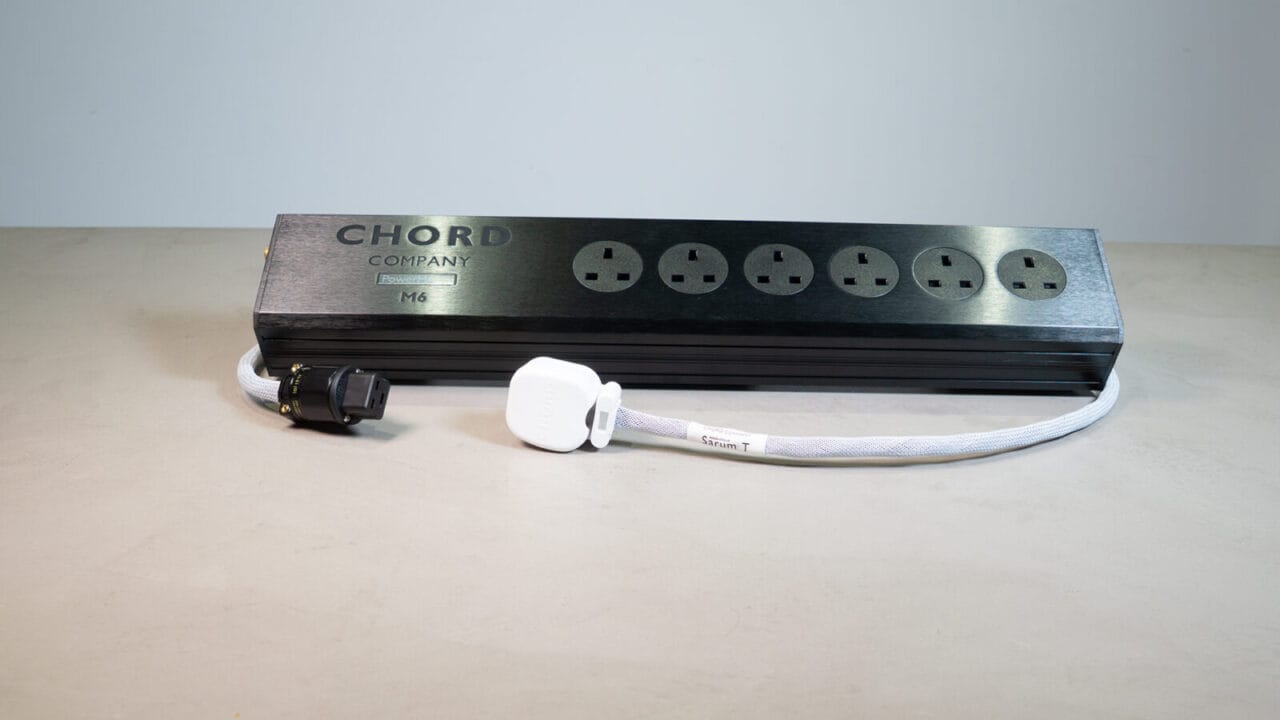
As Chord Co’s flagship mains block, the PowerHAUS M6 is all about delivering the cleanest power it can to your hifi gear
The PowerHAUS M6 mains distribution block is the top model of three six-gang mains supplies Chord Company offers, plugging in above the entry level PowerHAUS P6 and middle tier PowerHAUS S6, with prices starting at £650 for the P model and doubling until you reach the no holds barred M6 at £2,600 – hence entry level this is not.
All three look visually similar in their sleek black aluminium casework, and where the differences lie is largely on the inside, because while each feature the brand’s proprietary ARAY noise-reduction tech, the M model (‘M’ meaning ‘Master’ over the ‘S’ for ‘Studio’ variant) boasts three hybrid variants fitted in parallel, (rather than in series) to its internal bus bars – making it the only model of the three to boast a MainsARAY variant.
And this is intentional, with Chord Co preferring this approach to star-wiring which can be susceptible to RFI. Each bar is carefully isolated with aluminium shielding, with the earth rail also positioned as far away as possible from the live and neutral rails – the cabling inside is therefore kept to a minimum.

Made in the UK, the M6’s casework is solidly constructed with a no-nonsense quality feel, to protect the short runs of heavy-gauge cables and isolated bus bars inside
Like its S6 and P6 siblings, the M6 is intentionally a non-switched design and there’s no power indicator lights either, to avoid filters and powering supplementary internals which can generate noise. Instead the M6 is dedicated to one simple purpose, getting the power to its carefully chosen outlets as cleanly as possible.
The M6’s solid aluminium construction feels premium in its metal flesh and at 3.3kg, it’s reassuringly heavy too, meaning it wont become unstable when loaded up with heavy duty mains plugs and cables (like my Nordost Red Dawn 3 variants for example).

Mains inlet resides on one end, alongside a handy heavy-duty earthing clamp
Power couple
Of course any mains block of this calibre deserves an equally well spec’d mains cable to do it justice, and what better partner than Chord Company’s own SarumT SuperARAY power cable?
Unpacking this reveals one of the most well put together and handsome audio wires I’ve clapped eyes and hands on, from its heavy duty connectors to its woven outer. And so it should be, as at £2,800 for a 1.5m length (£2,400 for 1m) it’s not exactly budget, and instead represents the premium end of Chord Co’s product portfolio.

SarumT power cable comes in 1m, 1.5m and 2m lengths as standard, with custom lengths available to order
Being from Chord Company’s penultimate range, central to the SarumT’s design is its use of Taylon as the insulator over its silver-plated copper conductors, which goes beyond Teflon and the brand’s XLPE (Cross-linked Polyethylene) material that’s used within its cheaper ranges.
Screening and geometry have been carefully considered too, with a complex multi-layer system for the former and with the three conductors (live/neutral/earth) then arranged as twisted pairs using Chord Co’s ARAY formation for the latter.
My only crit? That Chord only offers all three of its power packs in six gang options, as at 600/110/77mm (LWH) the M6 is a chunky unit, and having four or even twin gang models would give customers more to pick from, while potentially saving some rear system space.

PowerHAUS M6 and SarumT all hooked up and ready for action. Note the bespoke design mains plug with silver-plated terminals and pins
Performance
To get the full cut of the Chord Co pairing’s jib, testing was carried out with them installed in both of my main systems, including in my house living room (Naim Unitilite, Pink Triangle Export GTi and Dynaudio Emit 20 speakers) and in my studio (Rotel Michi X5, Primare CD15 Prisma, MoFi V10 loudspeakers, Nordost cables).
Unconscious bias may be the latest buzzword in business speak, but I’ve struggled with it for years in my hifi life. Meaning I was fully expecting the M6 to make its contribution known the most in my living room rig, where it shares its power supply with everything on the ring main from the fridge to every electrical charger ever invented. Whereas the studio set up is fed direct from the fusebox on an isolated spur, and free from unwanted electrical pollution. But not so, as the M6 paid sonic dividends in both settings.
And when I say contribution, I mean the exact opposite, because what this combo specialises in is not imparting its own sonic flavour on your system.

Chunky padded feet are a nice touch on the M6, helping to keep it stable while protecting its underside from getting marked
Rotel is well known for building some of the best internal PSUs in the game (so much so it has being supplying them to other brands for years), and having lived with my Michi X5 for a few years now, I’ve noticed how much it welcomes power cables and supplying gear of equal quality (perhaps more so than my Musical Fidelity M6 pre/power amps, which seem less sensitive in this respect). Plug in a poor quality power cable or feed it from a budget block and the X5 will soon let you know what it thinks, with the music losing some of its essence.
But with M6 and SarumT combo powering things, the X5 sounds delighted. Spinning through Evening Hymns’ back catalogue across vinyl and digital recordings tells me all I need to know. I’d only intended on popping one of the cult folk-rock band’s LPs on, but the atmospherics emerging from my studio system led to a five hour marathon of back-to-back rediscovery, because of how everything just seemed to be performing at its best. That soundstage, those leading edges and those dynamic swings, the strings and the percussion…all have an added sense of purity and polish that makes my reference system sound even more effortlessly listenable than usual.

Making connections the PowerHAUS M6 mains block and SarumT cable make for an ideal partnership
Stuck on the M6
And this isn’t my conscious bias doing the talking either just because I happen to love this band, as digging deep into jazz and classical reveals the same results – with both of my systems sounding as though they’ve had a little shot in the arm to get them performing at their best.
Even my well worn pressing of Gustav Holst’s The Planets LP – an album which I’ve known and loved for decades – seems to have more depth and dimensionality than I’m used to. Again, something I was not expecting.
Fast forward a few light years to 1989 and the Fine Young Cannibals’ The Raw & The Cooked album (Qobuz remastered 24-bit/44kHz) sounds as fresh as the day it left the studio. The funky percussion which underpins I’m Not The Man I Used To Be is blessed with a hypnotic quality thanks to how fluid sounding it is with the Chord Co gear in the mix, compared to how I’ve sometimes experienced it sounding more mechanical and sterile, because there’s just more life to how my system is sounding in a way that’s hard to fully put your finger on, but it’s there nonetheless.
In summary
Now don’t get me wrong, five grand is a lot to trouser on hifi mains gear. But with a system costing around £30k, what these Chord Company products allow is my thirty grand system to sound every bit like a thirty grand system, which is exactly what you want.
Are these the final piece of my hifi’s puzzle? I wish, as their impact has been more than noted, it’s just a shame Christmas is still ten months away…