





Having owned and enjoyed a number of resistor to resistor (R2R) DACs over the decades I had not come across Garlubidor, perhaps not so much a brand as a name designed by committee to be trade marked. As it turns out, Garlubidor is a Chinese company which makes a range of audio equipment, including two R2R DACs.
Garlubidor sits under parent company Guangzhou Danna Audio Electronics Co, which also owns the much lauded Denafrips brand, whose DACs I have enjoyed reviewing in the past. Of the two DACs Garlubidor offers, the more expensive model is the Divinity, sitting above the Phantom under review here.
Both DACs can be bought directly over the internet, but be aware that these prices don’t include import taxes, or local support. Audiostore, who provided the Garlubidor Phantom to us for review, sells the Phantom for £1,465 and the Divinity for £1,950.
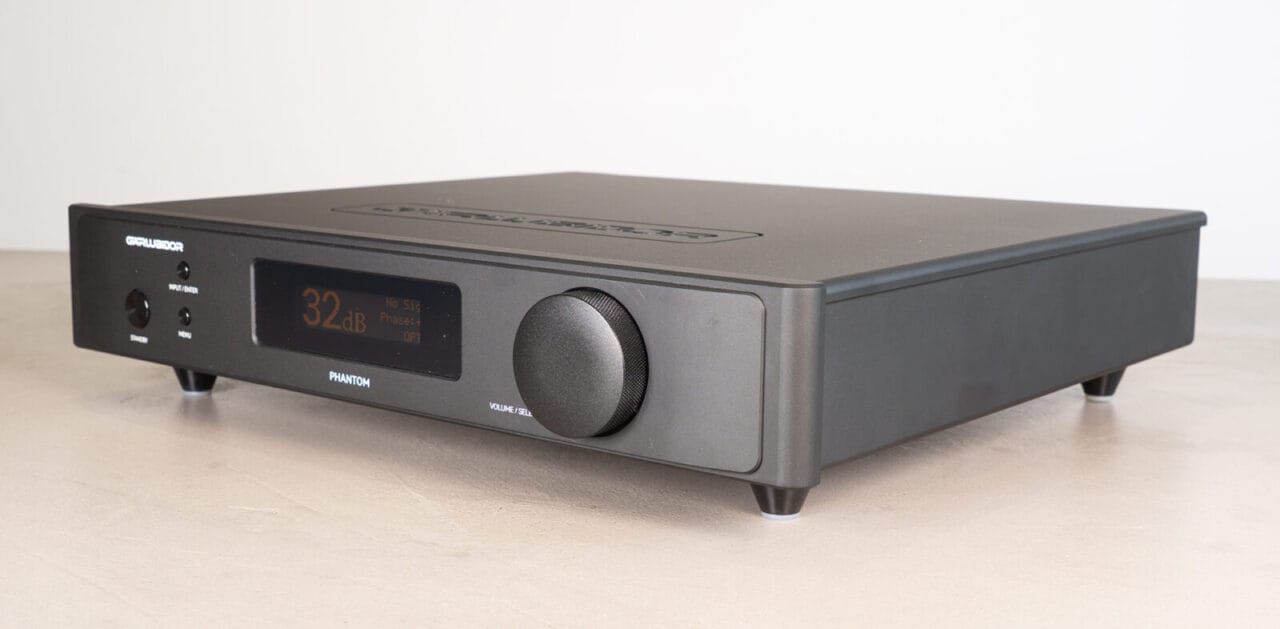
Understated elegance – the Garlubidor Phantom
Removing the Phantom from its double-boxed packaging, it’s immediately clear that the Garlubidor has many stylistic similarities to the aforementioned Denafrips’ range, with both boasting excellent levels of build quality.
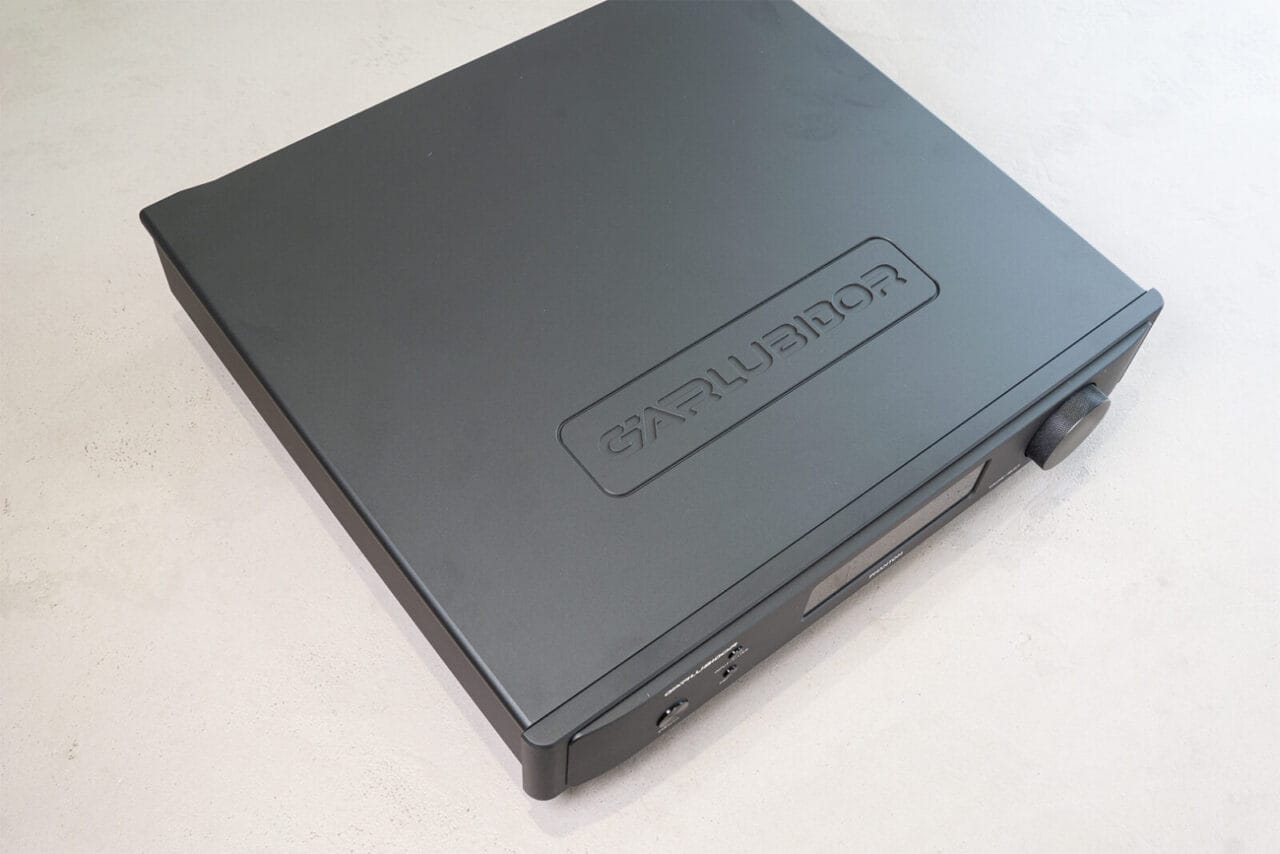
Carve your name with pride, top panel embossed branding makes clear who made its innards
The Phantom’s brushed anodised black aluminium casework is CNC-machined, with the Garlubidor name proudly carved into its top, making it feel like a much more expensive piece of electronics.
This is reinforced by the remote control, feeling like a metal billet. I have used much worse remotes supplied with far more expensive equipment. I’m impressed.
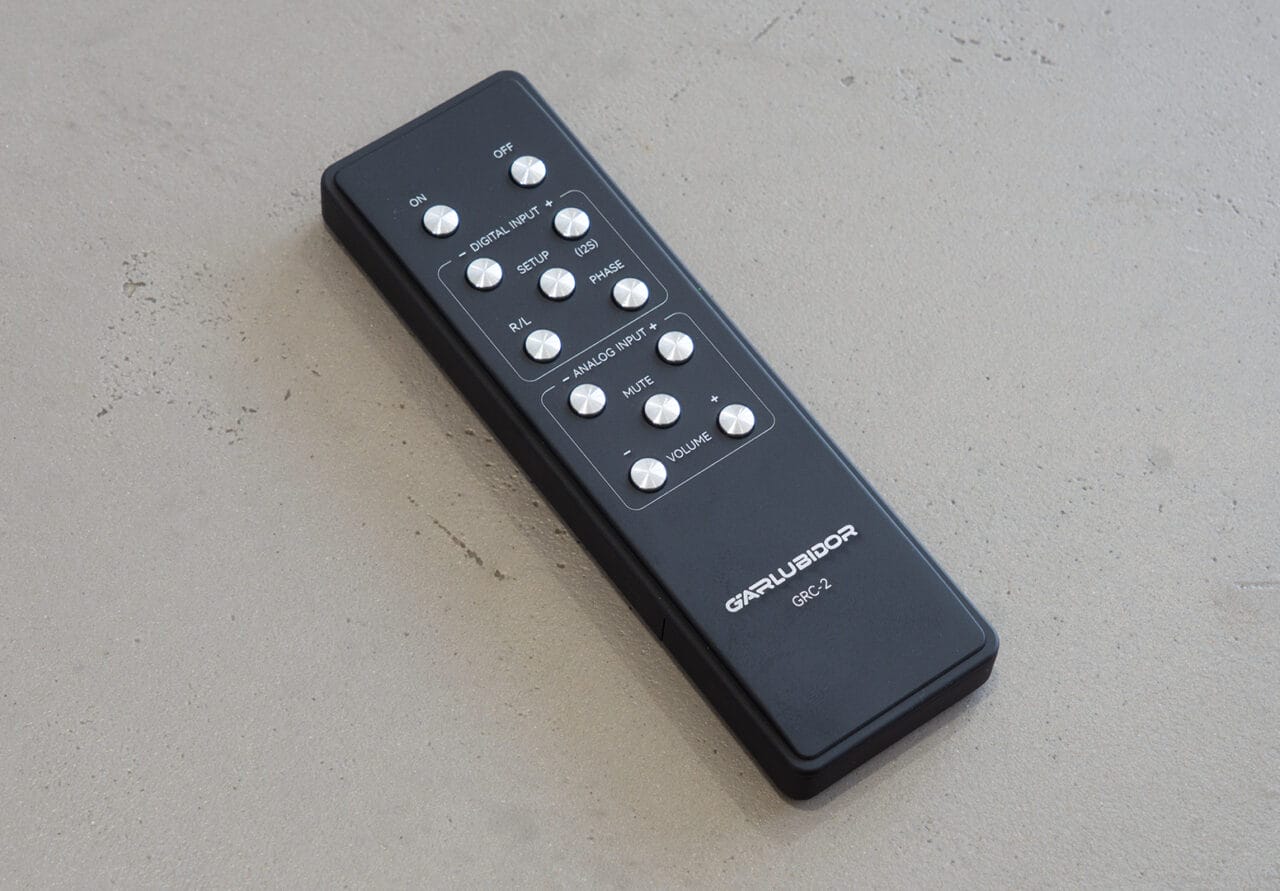
Supplied remote is a step up from many rival brands’ offerings at the price
Screen time
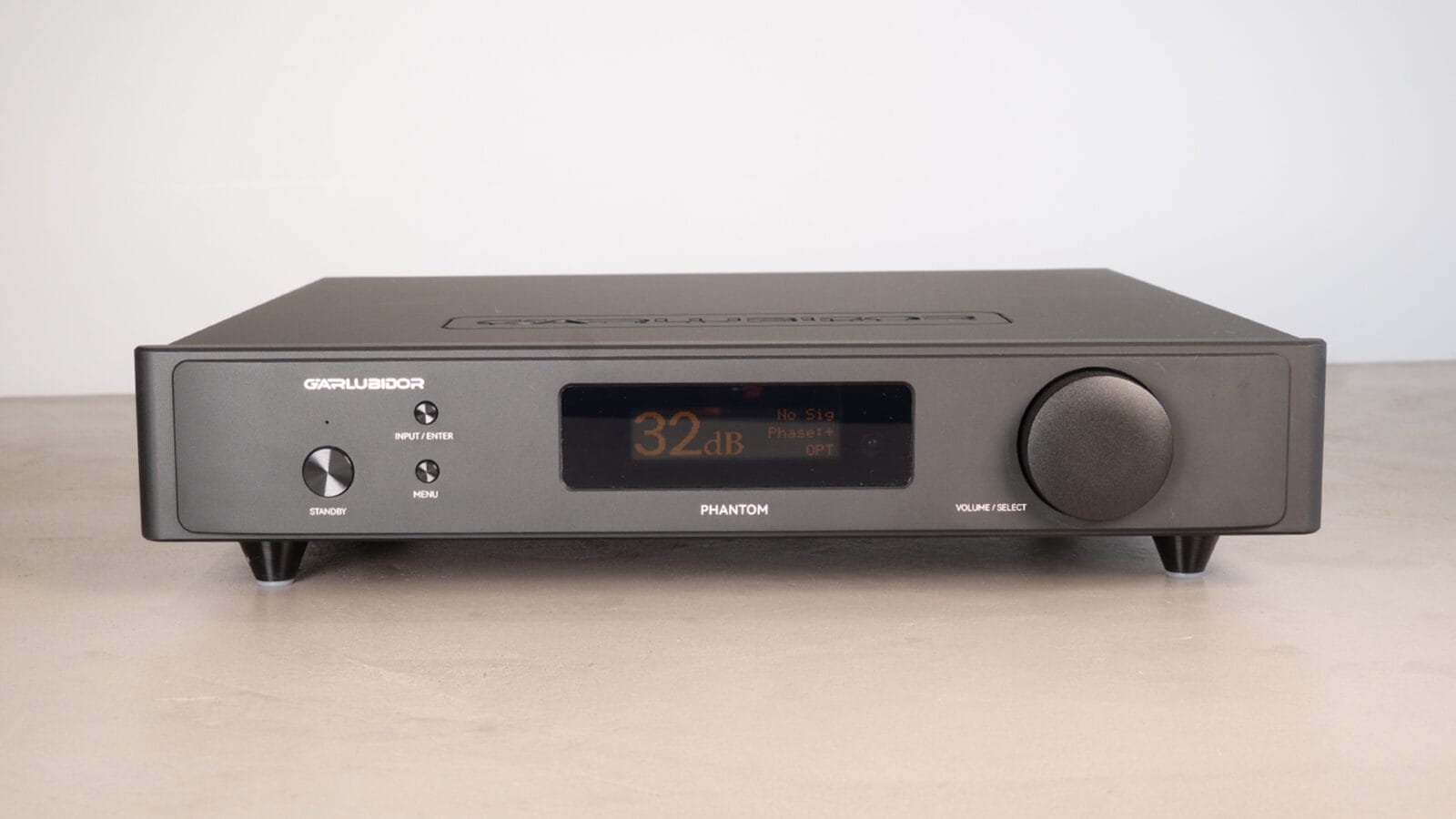
Where the Phantom varies from its cousins is in having a front panel screen and a volume control. I am generally not a fan of screens, as they can be a source of noise, an opinion which seems to be shared by Garlubidor. It has kept the Phantom’s digital window display as simple as possible, while being large enough to be legible from a distance, usefully showing the volume in dB.
The screen matrix is a pleasing orange in colour. There’s no option to vary its brightness, or turn it off, meaning that, like the volume control, it is always in circuit.
And speaking of the latter, this employs a digitally governed resistor-ladder attenuation system. Garlubidor claims this maintains signal integrity while providing precise and repeatable control. When set at its 60dB maximum, Garlubidor states that it’s effectively out-of-circuit entirely, and I certainly heard nothing to challenge this opinion.
There’s also a limiting function here to avoid the loudness shock that many of us have experienced, whereby if the Phantom’s volume is left at less than 40dB when it’s placed into standby, this is stored. But if over, the unit defaults back to 40dB on being reawakened. While I applaud the intention, I’d also welcome an option to take the unit out of preamp mode and have it as a dedicated DAC with 60dB output, but I get Garlubidor’s caution.
In addition to volume, the screen shows the frequency of files being played alongside phase and chosen input. Other front panel furniture includes buttons for Standby, Input/Enter and Menu.
I also found it refreshing not to be overwhelmed by deep menus and superfluous settings, instead the settings on offer are based on what a user may actually need.
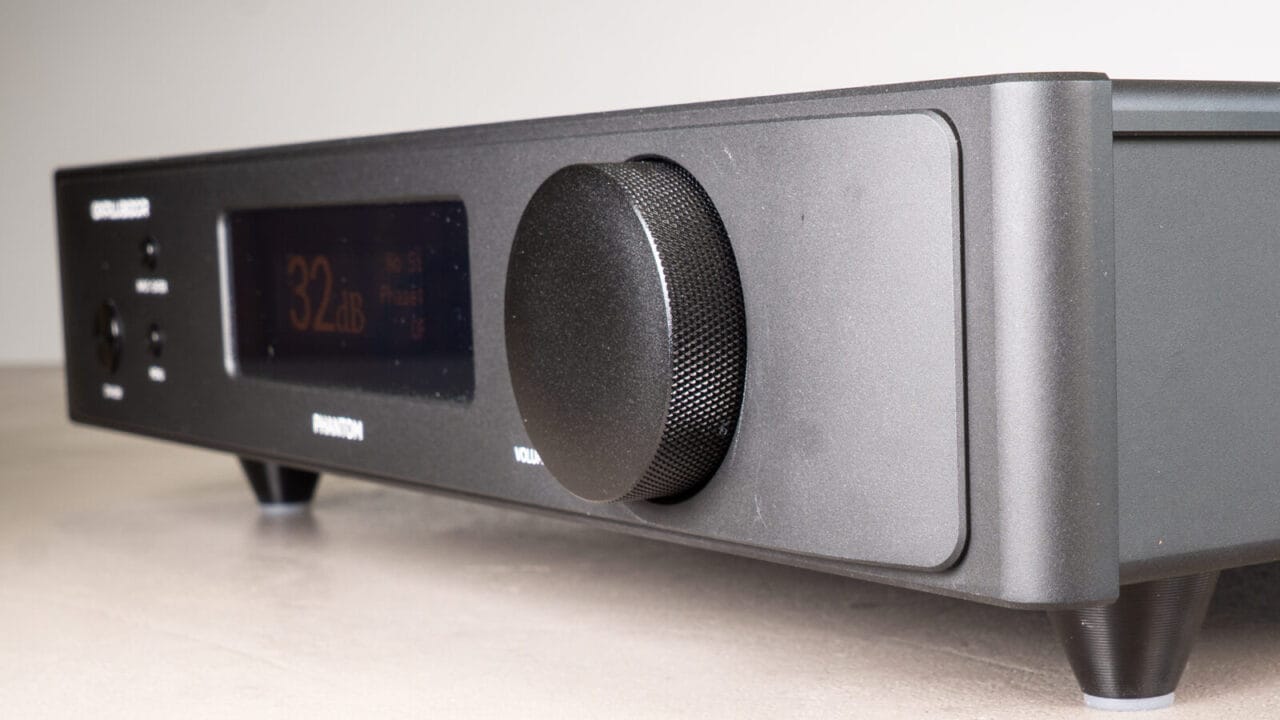
Phantom’s front panel hosts push buttons for standby and accessing its features alongside a large knurled edge rotary volume knob
This is assisted by the Phantom not oversampling, so there are no internal filters. What you do get are are two HDMI interface I²S inputs.
Why I²S? This was developed as an internal bus for sending Pulse Code Modulation (PCM) data between integrated circuits, and is now increasingly included as an option between streamers and DACs, with claimed audible benefits.
The menus include a range of possible pin settings for each of these ports, as there is no agreed standard. Other setup features include phase switching should you be inclined, and firmware updates via its USB input.
Each of the Phantom’s stereo channels employ independent R2R ladder networks and it’s good to see XLR outputs on offer alongside RCA, with the former being ‘true balanced’, based on a fully differential architecture.
Bits and pieces
Wind back a couple of decades and much of the DAC talk was about which chip was being used at the heart of any given device, which soon became understood as representing just one important part of its digital offering, with other elements like intelligent design and well instituted power being just as important.
R2R DAC architecture frequently entered into these conversations, having an impassioned following within the hifi community, and for good reason. Noteworthy brands and designers adopted the approach, and some with unique end results.
In my experience there is a tone and timbre arc between Audio Note at one end, with lots of meat on the bone, and Border Patrol at the other, which is rather more neutral sounding (being based upon Philips’ stalwart TDA1540 R2R chip).
And why favour R2R? In my experience this approach has an ability to side step an overly bright presentation and instead lean more into an analogue sounding presentation.
The Phantom’s R2R circuits are a bespoke design, delivering 24-bit PCM and 6-bit DSD with oversampling (which is my preferred way of listening to R2R DACs), while the digital signal processing is applied through Garlubidor’s own FPGA (Field Programmable Gate Array) based coding.
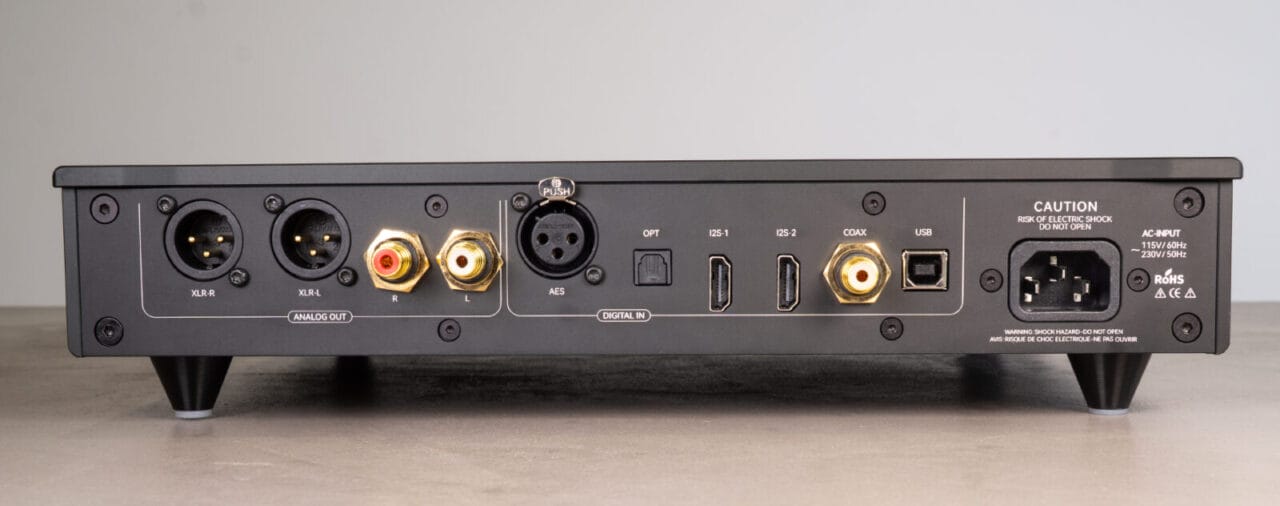
Rear panel hosts digital inputs spread over AES, optical, HDMI, coaxial and USB, with XLR and RCA analogue outs
Alongside its dual I²S over HDMI, the Phantom’s six digital inputs include AES, toslink, coaxial and USB. For the latter, an STM32F4 series MCU built on ARM’s Cortex-M4 architecture is called into play. These then feed two crystal oscillators, with one dedicated to 44kHz data and its multiples, while the other is there for the 48kHz family.
In my experience good power is central to good digital audio and for the Phantom, this means a low-noise customised toroidal transformer.
Performance
I found the Garlubidor Phantom to be a bit of a sonic chameleon that does not force its character onto a system, meaning the results it gives vary from speaker to speaker.
These included my Chartwell LS3/5a, Mk I Linn Kan, and the soon to be reviewed Bowers & Wilkins 707 S3 Prestige Edition in my nearfield system, and Naim SBL Mk II in my main system, with the Garlubidor working well with each.
The Chartwells have all the BBC small monitor attributes and through them, the Phantom sounded textured, bass rich, and with a detailed but slightly darker top-end.
Next up was the B&W 707 which has a sprightly tweeter, which brightened the higher frequencies, together with a punchy upper bass. And then it was time to dial back the decades via my legacy Linns, which served as my main speakers throughout most of the ‘80s. That said with a flat earth setup, they didn’t play well with early digital (I’m not sure what did).
Fed through a Bel Canto Pre 3 pre and Class D S300 power amps, with a Chord 2go/2yu streamer and either a SMSL PO100 pro or Matrix XSPDIF2 Digital Data Converter (DDC), I circled through the Phantom’s DAC inputs, enjoying their performance, but with minor variations. The USB input sounds a tiny bit more detailed and brighter than the more relaxed S/PDIFs, although overall I found my preference was for the I²S option, which combined the strengths of USB and S/PDIF.
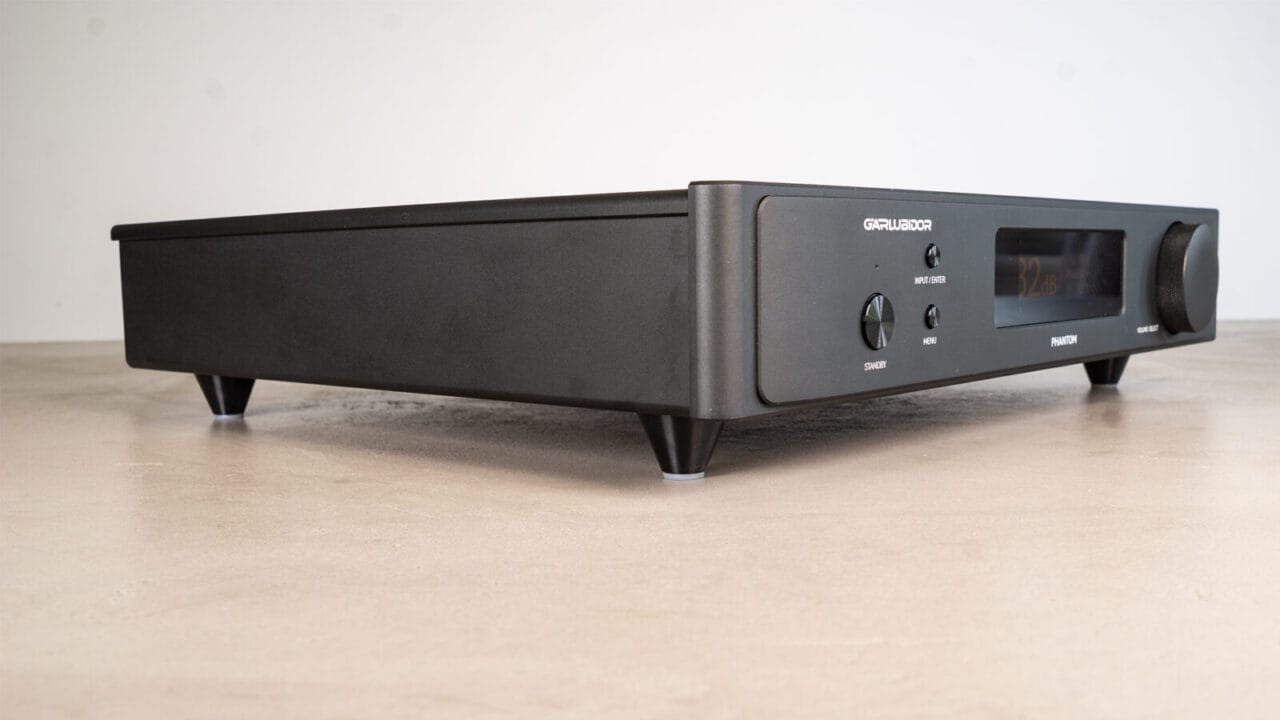
Phantom’s four coned feet feature rubber tips for grip
After using my Bel Canto Pre 3 preamp I switched to the Phantom’s own preamp capabilities. The much more expensive Pre 3 is the better preamp, but it is not a mile in front of the Garlubidor. An example would be Lina Tur Bunet’s Se4sons (24-bit/96kHz), or Vivaldi’s Four Seasons to thee and me. The harpsichord detail was more readily available via the Pre 3. This reveals something of the qualities of the Garlubidor Phantom, yes, it is not quite as detailed, but it is graceful in this. The music is present and enjoyable, with just a shade less information.
Up until now I had listened to Se4sons streamed from Qobuz. To test the Phantom’s high resolution capabilities, I used my local 352kHz version from my Audiostore Ultra Server which brought increased levels of body and warmth via the Phantom. Up to this point the music had been more focused on the bowing attack, now it became more balanced by the underlying instrumental resonances.
I often use Angel, from Massive Attack’s Mezzanine – 20th Anniversary Deluxe Edition (Qobuz, 16-bit/44kHz) to test bass. The Kans when fed by the Phantom are fast with an ability to kick that lifts the track, this was becoming a good listening session! It has been a while since I enjoyed Angel this much, pressurised pleasure.
Jeff Wayne’s War Of The Worlds (Qobuz, 16-bit/44kHz) is frequently used as ‘proof’ of analogue’s superiority, but the truth is that this particular CD transfer is simply bad. For this reason I use it as a source of problem tracks. Thunder Child is a great song that I sadly frequently cut short, as the fricatives bite. But not here with the Phantom in the mix. Yes, I can hear the places where the problems exist, but they were not pushed to the extent where I felt obliged to reach for the remote control.
Phantom goes to Hollywood
It was time to move the Phantom to my main system and hook it up to my dCS Network Bridge which only offers S/PDIF outputs, but has better sound quality overall compared to my nearfield rig.
After warming the unit up, I dived into well known tracks including Frankie Goes to Hollywood’s Welcome To The Pleasuredome (Qobuz, 16-bit/44kHz). There are a couple of places where the bass falls and broadens, and boy, did the boot drop. Big grin.
Next up, Music From The Films Of Charlton Heston, by The City of Prague Philharmonic Orchestra (Qobuz, 16-bit/44kHz). Truly captivating. The bass is strong and well realised with some wonderfully rasping brass. Real orchestral verisimilitude and excellent dynamic punch.
Album followed album, including Se4sons again, now through my Modwright LS36.5 and Naim NAP300DR pre/power amp combo, where there was no lack of detail and good imaging. I have to say I feel the style of playing on this piece is over-egged, almost a parody, and the Phantom does not hide this, but it allows me to concentrate on the more virtuoso elements.
Turning to some Motown recordings where the quality is more questionable and the Phantom did nothing to massage this, but the music was infectiously portrayed.
At this price point my reference is Chord Electronics’ Qutest. This has more upper frequency information, with slightly more leading edge detail. In comparison the Phantom’s vocal contributions stand clear with excellent diction, when provided by the recording, as does the well realised timbre.
Returning to my initial question, the Garlubidor Phantom is not marinated in resonance, it is very balanced and effective in being neutral in its presentation. It is not a genre specific DAC, but I love what it does with orchestral music. The Phantom will not jab you in the ear with poor recordings, presenting them in their best possible light. But, give it something better and it will shine, especially if it includes a human voice.
Garlubidor’s decision to use its R2R approach has resulted in a DAC that doesn’t spotlight upper frequencies and some will describe it as ‘analogue’ sounding, I am certainly an enthusiast of this well priced box.
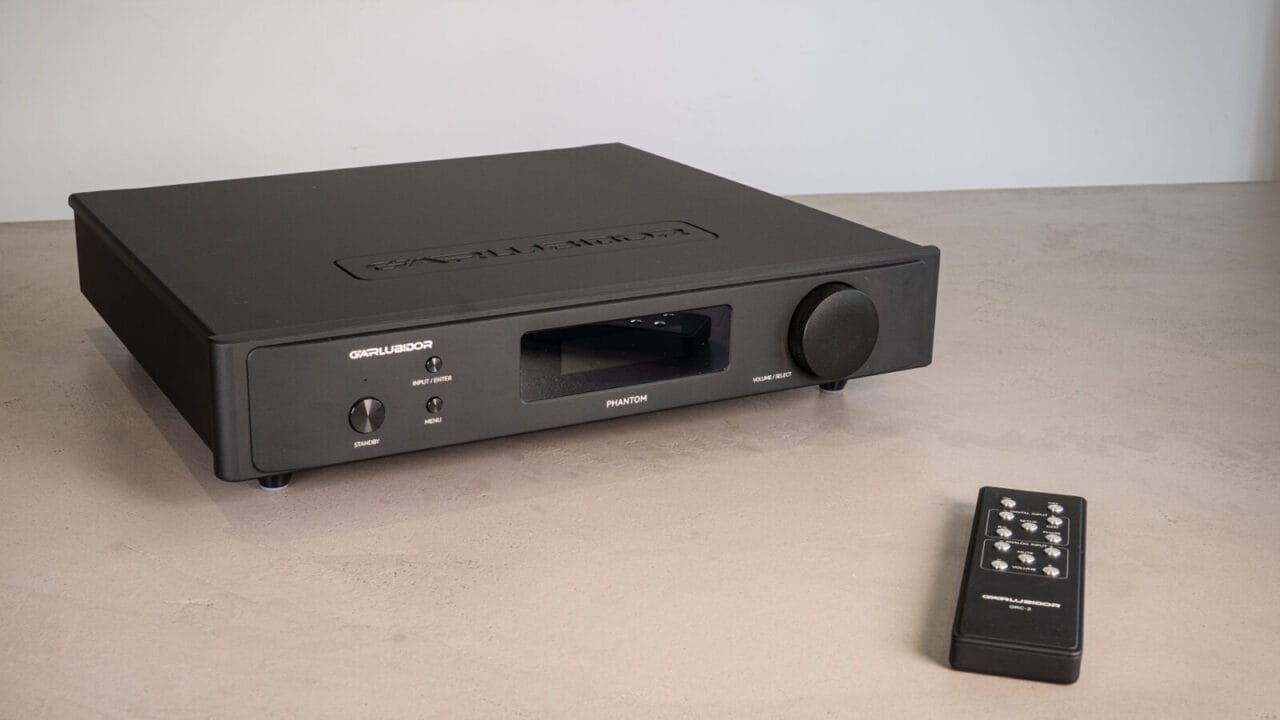 Don’t be spooked, as Garlubidor’s Phantom favours a real-world analogue performance
In summary
Garlubidor is now a name that has firmly hit my radar and for all the right reasons, as the Phantom is an excellent DAC, with a very capable preamp that offers superb value for money.
Whatever the musical genre, the Phantom will give you many hours of musical enjoyment, with an enticing ability to portray the human voice in a clear and enthralling way.