




While most hifi brands make bold claims to have pioneered new tech and approaches in audio, few can hold a stylus to Pink Triangle Products Ltd and all it did for vinyl back in hifi’s ’80s and ’90s heyday.
Think low noise DC motors on belt driven decks (positioned to be more sympathetic to a stylus’s motion), acrlyic platters that you placed the record on directly (sans slip mat) and materials designed to absorb and dissipate energy – all of which are now commonplace approaches – can all be credited to Pink. Or to be more precise, one man – Arthur Khoubesserian, Pink Triangle Products’ Co-Founder who rather than follow the trends of the times, preferred to follow the laws of physics (and in my opinion doesn’t get the recognition he deserves for doing so, bringing benefits to vinyl replay across the industry, well beyond Pink).
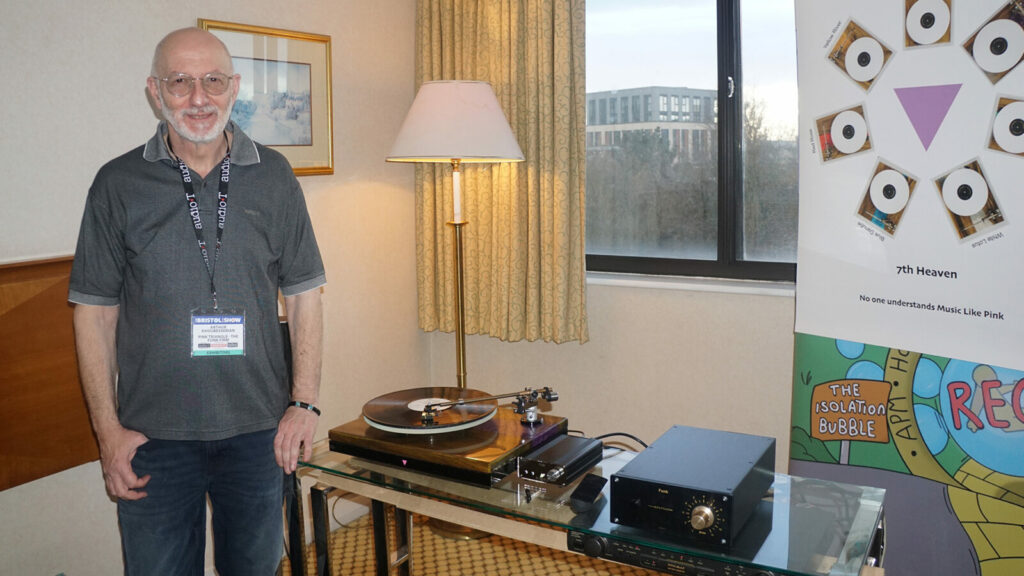
Pink Triangle and Funk Firm Founder Arthur Khoubesserian at 2023’s Bristol Hi-Fi Show
Arthur’s still at it of course, with his eye-catching and innovatively designed Funk Firm products (which include great value upgrades for any deck, as we discovered when we put its Isolation Bubble concept to the test back in 2023).
But while Funk’s machines still carry many of Pink’s design approaches, they’re different beasts, being rigid rather than suspended designs (perhaps representing how market demands have shifted in the decades since). Of course thanks to Arthur’s approach to engineering you can have the best of both, by ‘Funking’ up a Pink Triangle to bring it bang up to date.
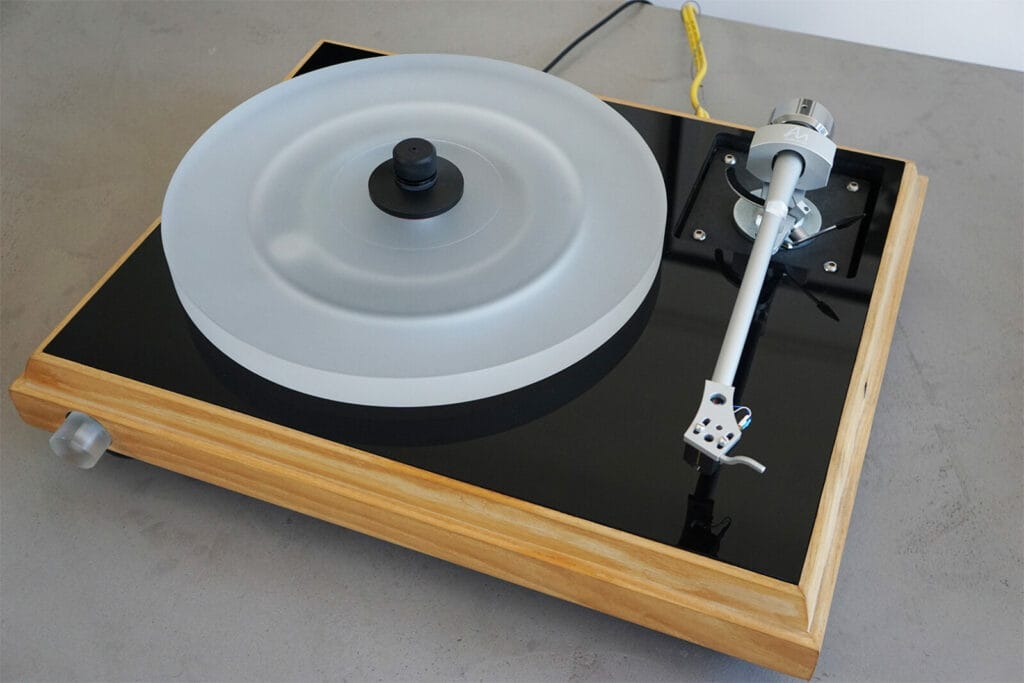
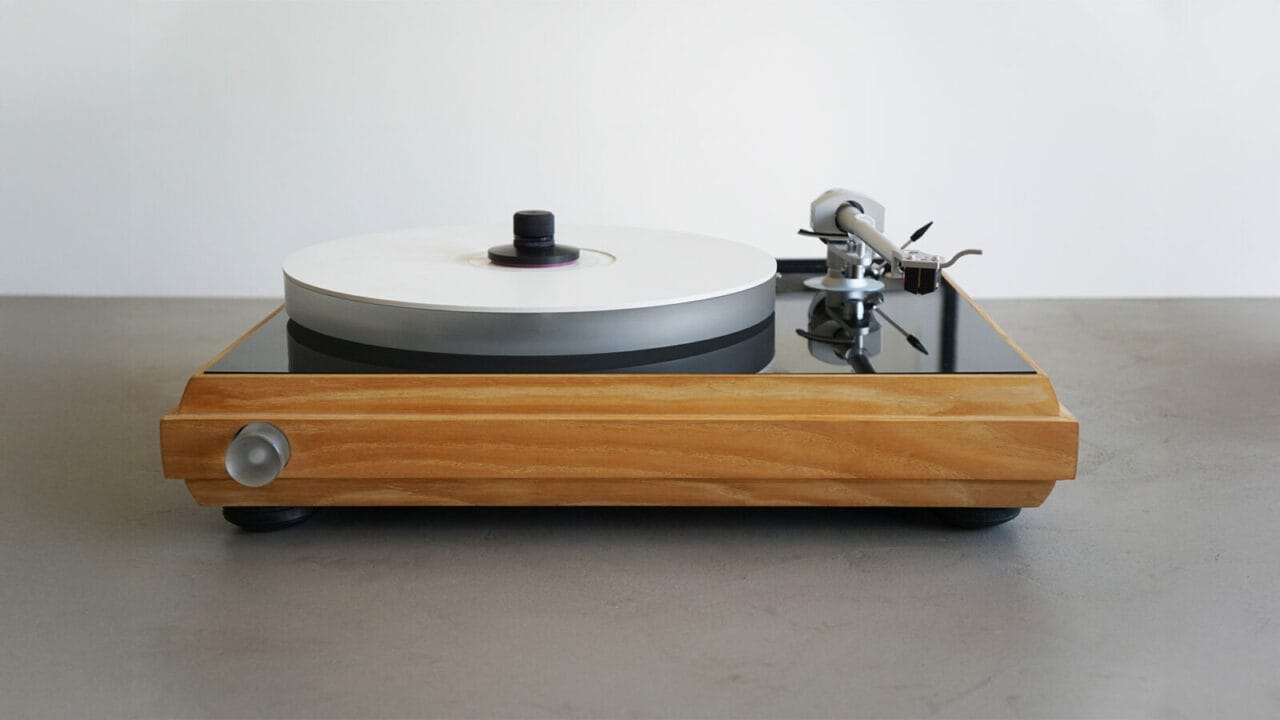
It may be over 30 years old, but Pink’s designs look just as fresh today and command quite a following. Note the complete lack of branding, which flew in the face of the loud logos of the age
Way of the Pink
But we’re here to celebrate the Pink as it was, with a spotlight on Pink Triangle’s Export GTi, a mid-model example from the early ’90s, which followed in the original Pink Triangle’s footsteps as it evolved through PT1 and then PT Too iterations.
By the Export’s time, Pink was offering three turntables, with clearly defined improvements between them. Entry level was the Little Pink Thing (or LPT as it became known), which eschewed the Export’s three-point hanging suspension system. Above the Export was the now legendary Anniversary model, which sported an upgraded DC motor over the Export’s AC, mounted directly on its floating sub-chassis, plus external (sometimes battery powered) PSU.
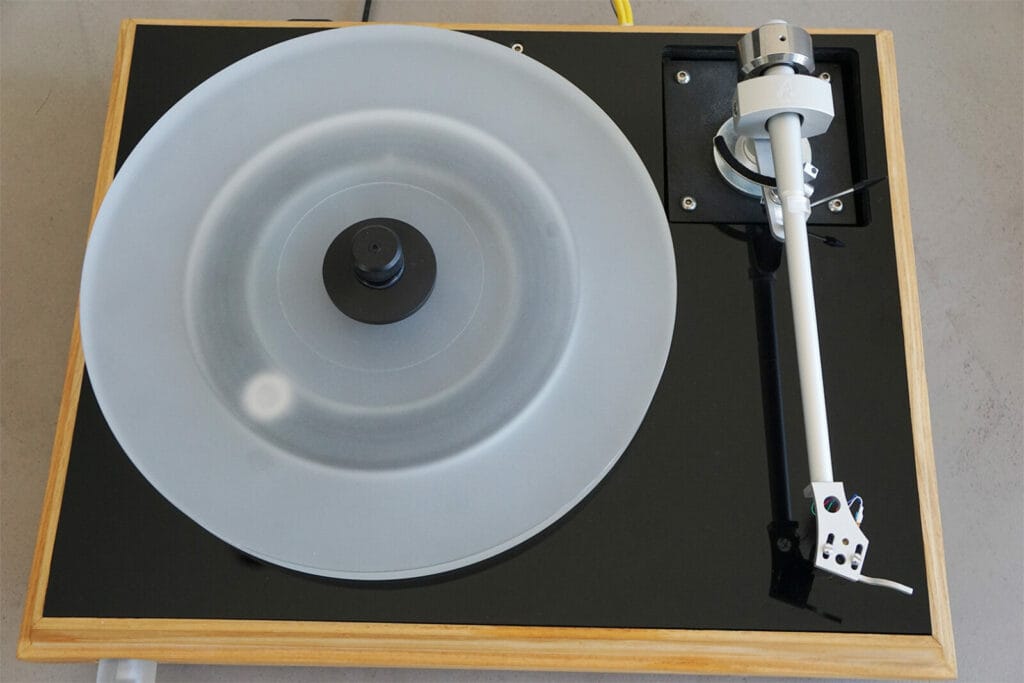
From above, note the motor pulley that’s visible at the seven o’clock position through the acrylic platter
The Export sat squarely between the two, being derived from the PT Too but with its PSU housed within its solid ash wood surround chassis, instead of externally (making it easier to sell in export markets, hence the name), while still offering Pink’s trademark suspension system. And this system is what makes a Pink a Pink, thanks to how this differs from the suspended decks of the day, by hanging its internal sub-chassis (on to which the main bearing and arm are mounted) from three narrow diameter coil extension springs, rather than sitting on them vertically ala Linn and others. The thinking being that for the latter these springs are always compressed to a degree, whereby Pink’s approach meant less stress, resulting in less resonance.
The sub-chassis itself followed Pink’s philosophy of low-mass, lossy, non-resonant materials, being made from aluminium aerolam, aka aeroplane skin, for its stiffness to weight ratio.
The Export’s AC synchronous motor is positioned at the seven o’clock position, placing it in line with platter bearing and tonearm pillar, to minimise the belt’s ‘sideways’ effect on the stylus. And for the GTi, this motor got a twin phase crystal controlled PSU, which can be instantly recognised by its acrylic power and speed control knob over the earlier black plastic one that was fitted to the standard Export model. Hawk-eyed Pink fans may have also spotted this control knob on some LPTs, which for a time also had the option of the GTi PSU.
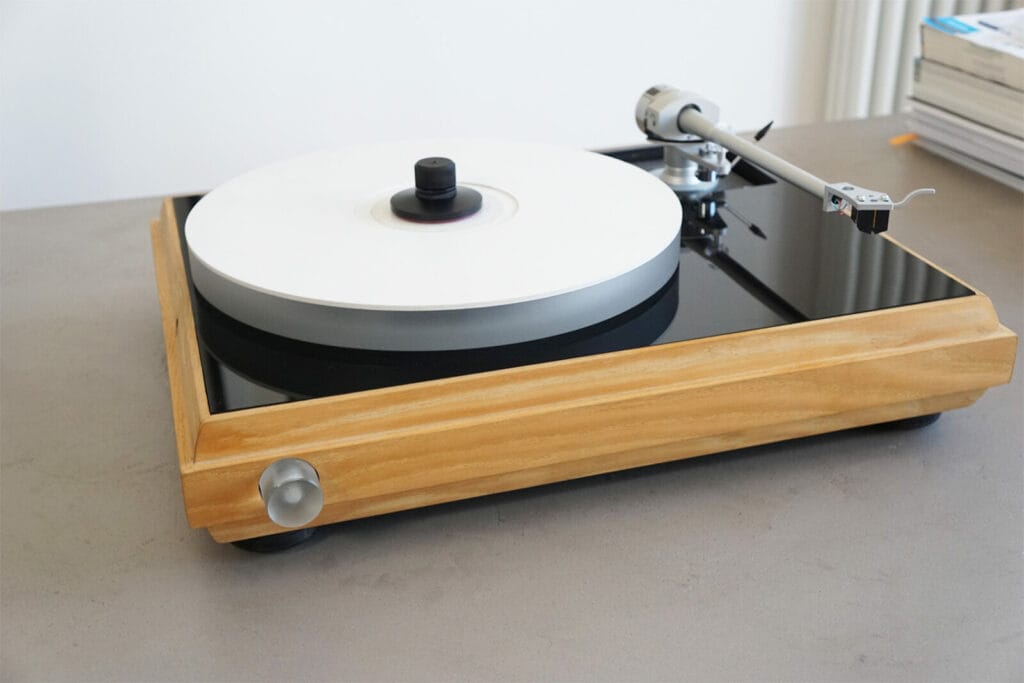
Large acrylic rotary knob keeps things simple with positions for 33rpm/45rpm/off, and glows green or red to denote selected speed. Note the Funk Achromat and aftermarket threaded clamp from True Point Audio, which offers a range of spares
One of the family
The model on our test bench today is actually my own, which I’ve owned for twenty happy and musically filled years.
It started life black and blue (literally), but thanks to a solid ash plinth under its black paint (some were MDF, easily identified by not having an obvious wood grain, through the paint) getting it back to a natural wood finish was straight forward enough, which I detailed some years ago on Vinyl Engine, alongside homemade tweaks to its baseboard and suspension.
Those acrylic platters are also ripe for a little illumination, hence I couldn’t resist fitting an LED into the top plate that sits inside the platter’s belt groove for added evening eye candy.
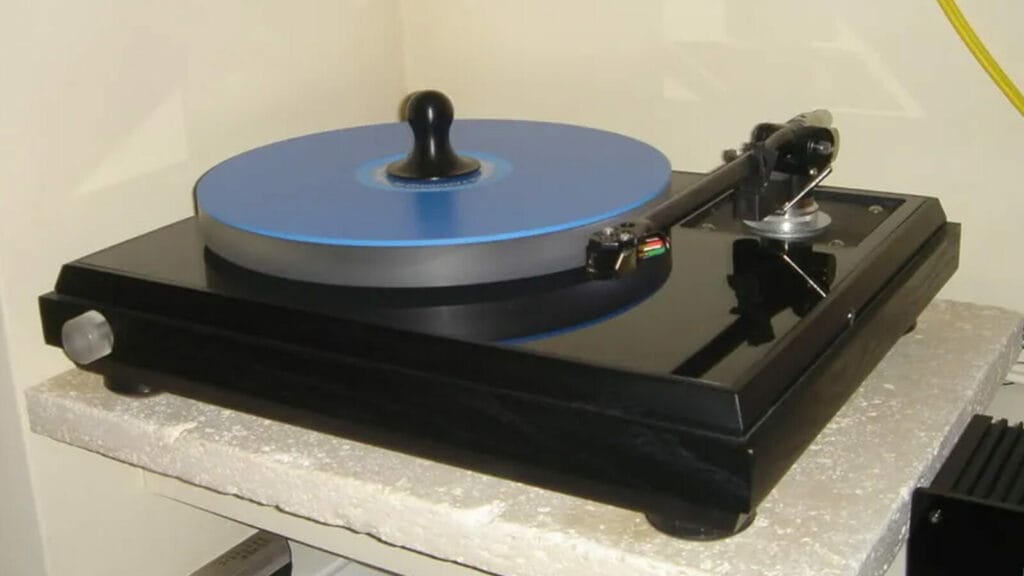
Circa 2007 before its rebuild, sporting a modded Rega arm, Funk clamp and blue Achromat
Pink didn’t offer its own tonearms back then as Funk does now, but its decks’ medite armboards could be specified with SME or Rega cutouts, and are easily swapped out thanks to four allen headed bolts. Affordable arms of the day usually found on these decks ranged from Rega’s to Roksan’s, with the odd Mission thrown in. I opted for Audio Note’s current Arm One/II, which bears more than a passing resemblance to a Helius Scorpio MkI from the Export’s era and suits the style of the deck.
More importantly, because Audio Note specialises in suspended turntables, its arms are a good match, although one of Funk’s latest arms (when funds permit) would keep the Pink’s components in-house.
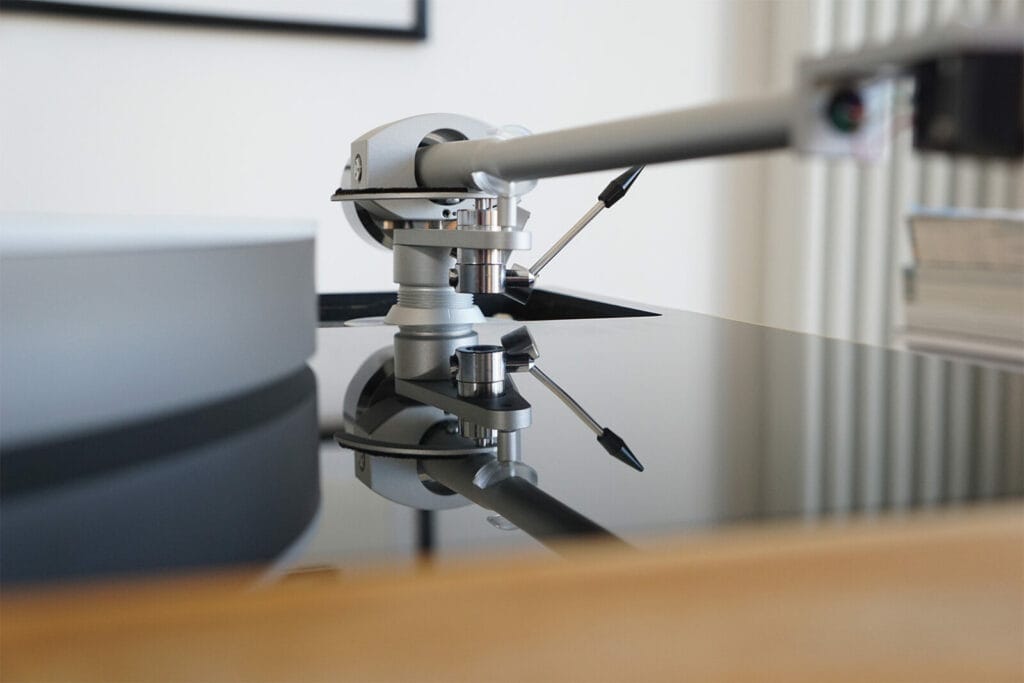
Audio Note Arm One/II offers plenty of adjustment and is a good match for the Pink, with a tapered main tube that’s machined from a single billet of high-grade aluminium and ‘captured unipivot’ bearing
Collywobbles
For anyone whose grown up on a diet of rigid-chassis turntables, switching to a suspended model can be a daunting experience with worries of endless tweakery. They also feel frankly odd when you first experience a jelly-like bouncy platter, but you soon get used to it.
Once unboxed you need to make sure your Pink has its transit bolt removed from the top plate (a bit like you would with a washing machine). You then need to slide the upper bearing sleeve on and carefully seat the platter around it. (A word of warning here, it’s advisable not to fit the bearing into the platter first and site both together in case the upper bearing drops, as the sapphire bearing cup is easily chipped.)
To fit the platter, you’ll need to pop the belt in its underside-groove and hold it firm using either the supplied length of pink string or your own, that you then use to carefully lift the belt over the pulley. This is made easier on the Export than earlier models, thanks to its larger diameter pulley wheel.
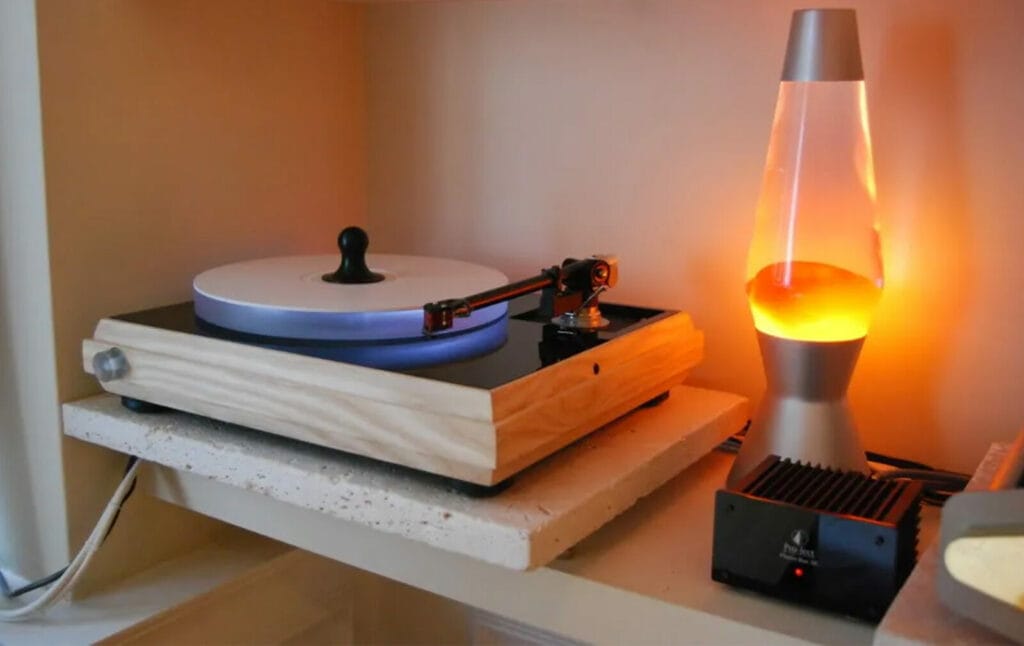
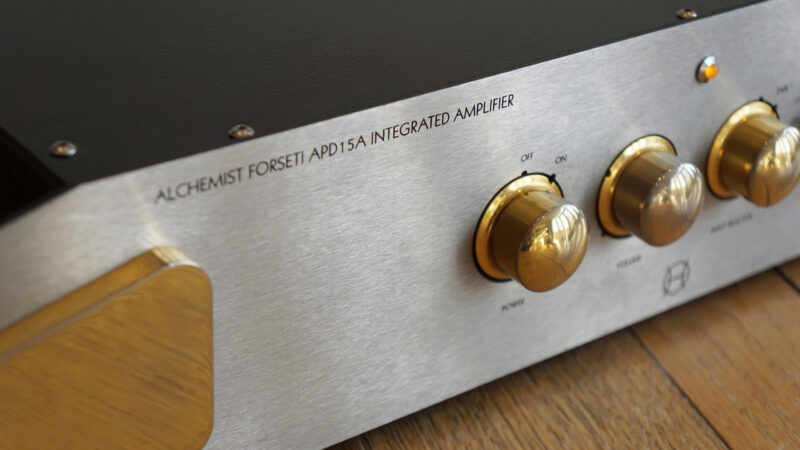
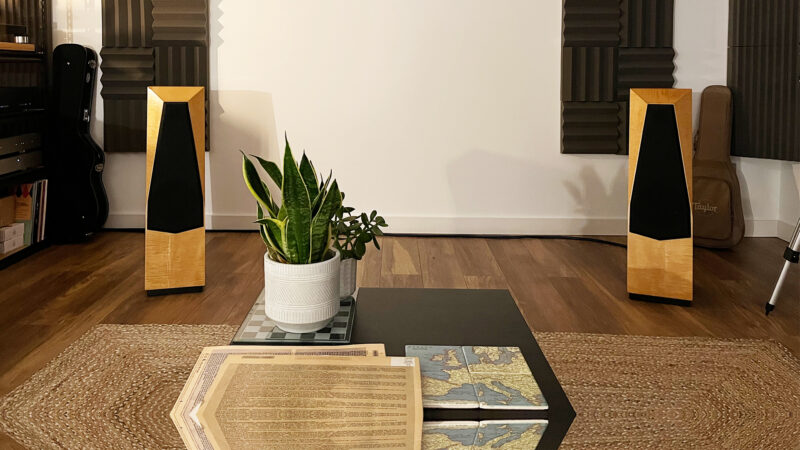
Circa 2008 post rebuild, feeding a Pro-Ject phono stage and Alchemist amp. Note the recessed suspension adjustment screw hole midway on the chassis’s right flank
Once sited on a level surface, you then need to get the platter level using its three recessed suspension bolts, two within each side panel and one at the back on the top plate. Where the Pink beats its rivals is in how accessible these are. There’s no fiddling around underneath or at the back which means you can also do this on the fly (and with it running) to keep the suspension bang on. My approach is to get the platter level riding just above the motor pulley with a heavy weight record on (ie 180g) to ensure the belt is riding well within its groove. For extremely light pressings you may need to tweak the platter height a tiny bit to stop it riding too high, but it’s easy enough thanks to the above.
The only other adjustment I have to make from time to time is to the motor screw on its underside to keep it running silently. It usually takes a tiny turn while running to find its sweet spot, hence having an access hole to reach through without having to take off the baseboard helps (see my modded board via the vinyl engine link).
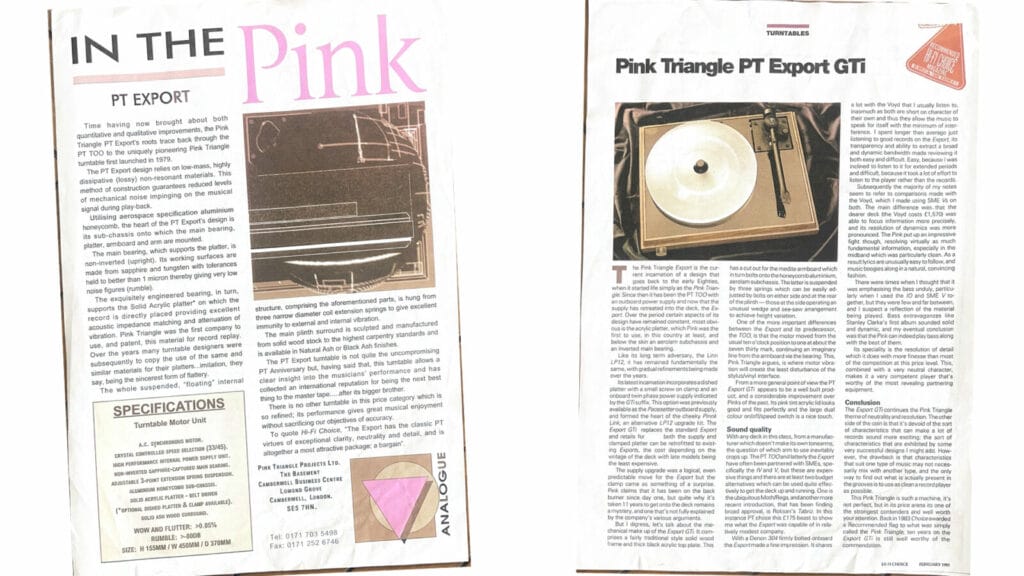
Original spec sheet and a review from 1993 provide vital information and insight into the hifi of the day
Performance
Alongside the myth around Pink’s being complex to set up or own (which they’re not, being relatively simple once you know you’re way around one) is reliability issues.
Over 30 years mine has had the odd repair, mainly for dry joints on the PCB, but this is to be expected on any circuit board that’s three decades old and other than that it’s not missed a beat, despite almost daily use. And judging by the amount of Pink Triangle turntables on ebay and via the forums, there’s still plenty of decks going strong, and commanding strong prices too!
With my legacy Pink feeding a Primare R35 phono stage and Rotel Michi X5 amp, it only takes a few spins of Nick Drake’s Bryter Layter to remind me just how transparent this machine sounds. So much so it puts many a sub £1k deck on today’s market to shame.
I’m lucky/skint enough to have an SME 20/2 close by for comparison, which makes for easy A-B testing. And when doing so, what’s obvious is when set up well, the Pink gives little away to the SME – which is quite something given the price and age gap between them.
Sure the SME commands a deeper and more solidly configured soundstage with a bass texture that’s denser and more confident, but in terms of imaging, instrument separation and lack of colouration, the Pink is up there.
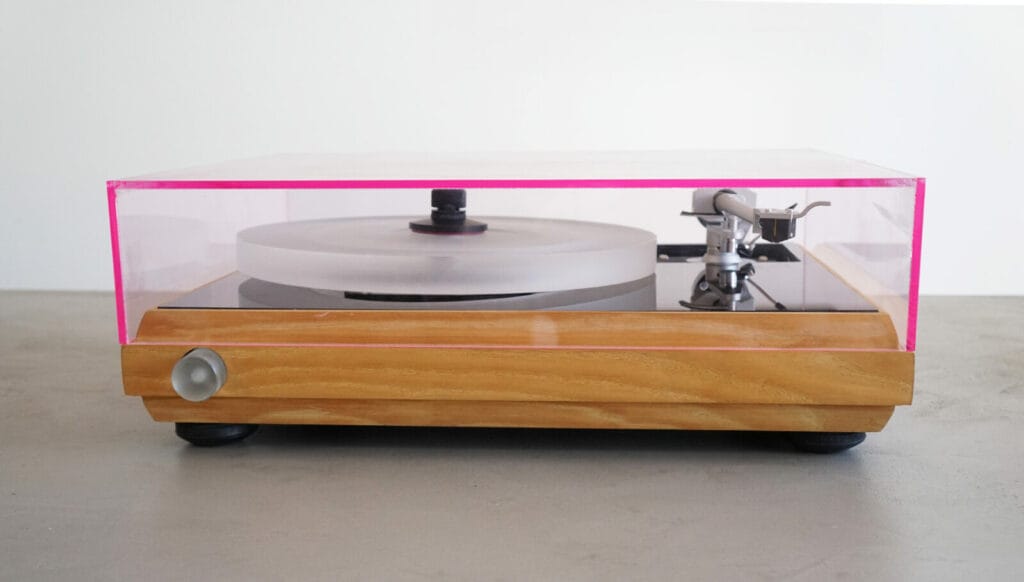
With its original pink lid. Replacements are still available via Funk, although original hinges are rare
‘Closer to the master tape’ is Arthur’s life’s work in hifi, and the Pink sounds exactly that. If you want a warm and cuddly coating on your vinyl, look elsewhere, unless of course the music you’re playing was recorded with this tonality in mind in the first place. Spin Neil Young’s Harvest or Fleetwood Mac’s Rumours for example and you’ll get so much ’70s sweetness, you’ll be craving an Austin Allegro quicker than you can say “medallion man”.
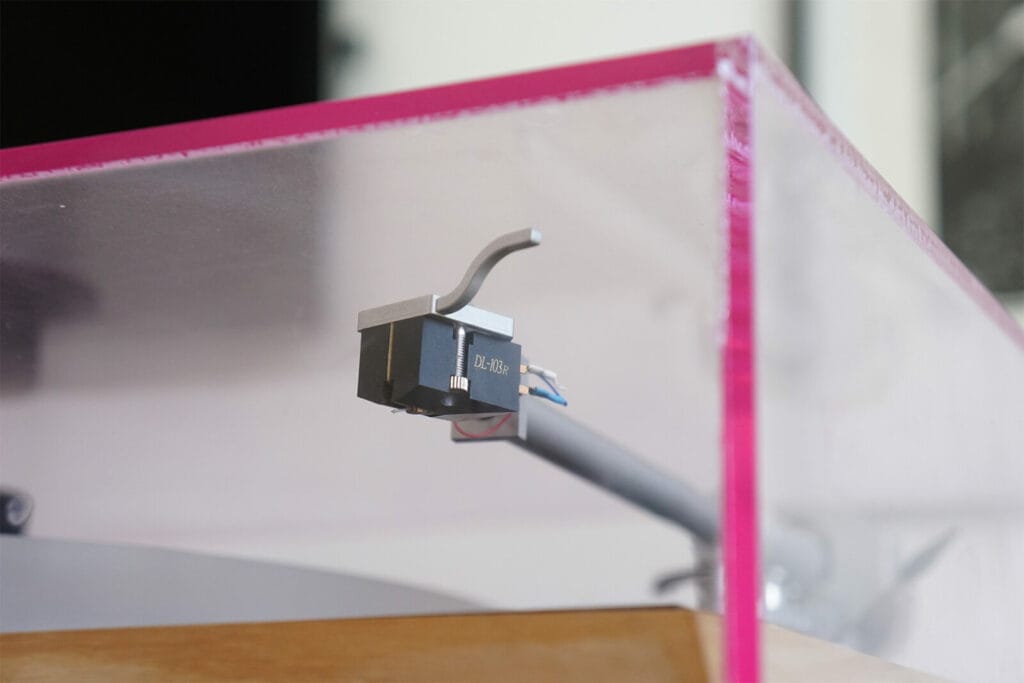
Denon’s DL-103R is a classic cart, although at a push I’d say the DL-110 is an even better match on the AN arm
Bur serve it a clinical pressing such as Peter Gabriel’s So LP and you’re in for a studio like treat of a performance that’s glass shatteringly clear. Arm and cartridge choice are also key on a Pink as it will make it’s response to them (good or bad) obvious with each. On the Export I’ve tended to fit longstanding models that keep it era specific. Denon’s are a good option and the DL-103R is an obvious stalwart, with slightly soft edges that will offset the Pink perhaps sounding too revealing. That said, its low compliance demands a heavyweight arm, otherwise its upper bass can sound a little light. Therefore if you can find one, Denon’s DL-110 is a better match to my ears on the AN arm and just sings on this deck, as do most mid-market models from Audio-Technica.
With something of this ilk on its platter, detail retrieval and resolution is exceptional for a deck of this age. Hearing The Weather Station’s self titled LP for example on the Pink rig lets instruments and vocal nuances shine through that had previously passed me by. As classic hifi goes the Export GTi epitomises it, being both of its era and more than capable of holding its own today.
In summary
The Export GTi serves as a window into the unique furrow Pink Triangle ploughed four decades ago, before its demise and funky rebirth at the turn of the century.
But with such a respected reputation and cult following, good ones can still be had for sensible money, with a range of models to choose from. The trick though is to wait for the right one (and not tatty examples with over-inflated price tags), preferably with minimal homemade mods and from someone who knows what these are. You’ll also need to be sympathetic to its upkeep.
While they’re not the plug and play machines of today and need regular finessing, once set up you’ll be surprised (or perhaps not) by just how good they sound with partnering kit of equal quality. The future’s bright? It was once pink.
____________________________________
Do you have a Pink Triangle deck or comments on this article? If so we’d love to hear from you and see your deck. You can get in touch with us at contact@audiograde.uk.