

I still remember the first CD I bought. It was R.E.M.’s Automatic For the People, with ‘limited edition’ yellow spine, since you ask. It wasn’t new of course, as this was 1992 and aged fourteen with only a paper round to fill my pockets, a quid off what my best mate paid for it in HMV seemed a sweet deal at the time.
I still have that CD, and still listen to it. The point being that I, like many hifi fans, have burgeoning CD collections with plenty to offer in terms of music (and memories in my case). And we’re not alone either, as with over 200 billion of them sold across the format’s lifetime there’s still a wide audience to serve. Then there’s the convenience thing, as they’re easier to store and maintain than vinyl, and I would argue more user friendly than streaming in many respects. Don’t get me wrong, I’m a fan of all three mediums, but I’m sure I’m not alone in getting all tangled up in apps when searching for virtual music, or finding myself distracted with my phone when I reach for it to sort some tunes out. It makes you wonder why CD is perhaps the least cool format in the eyes of today’s yoof. But like vinyl and cassette, it’s due a retro resurgence, you mark my words.

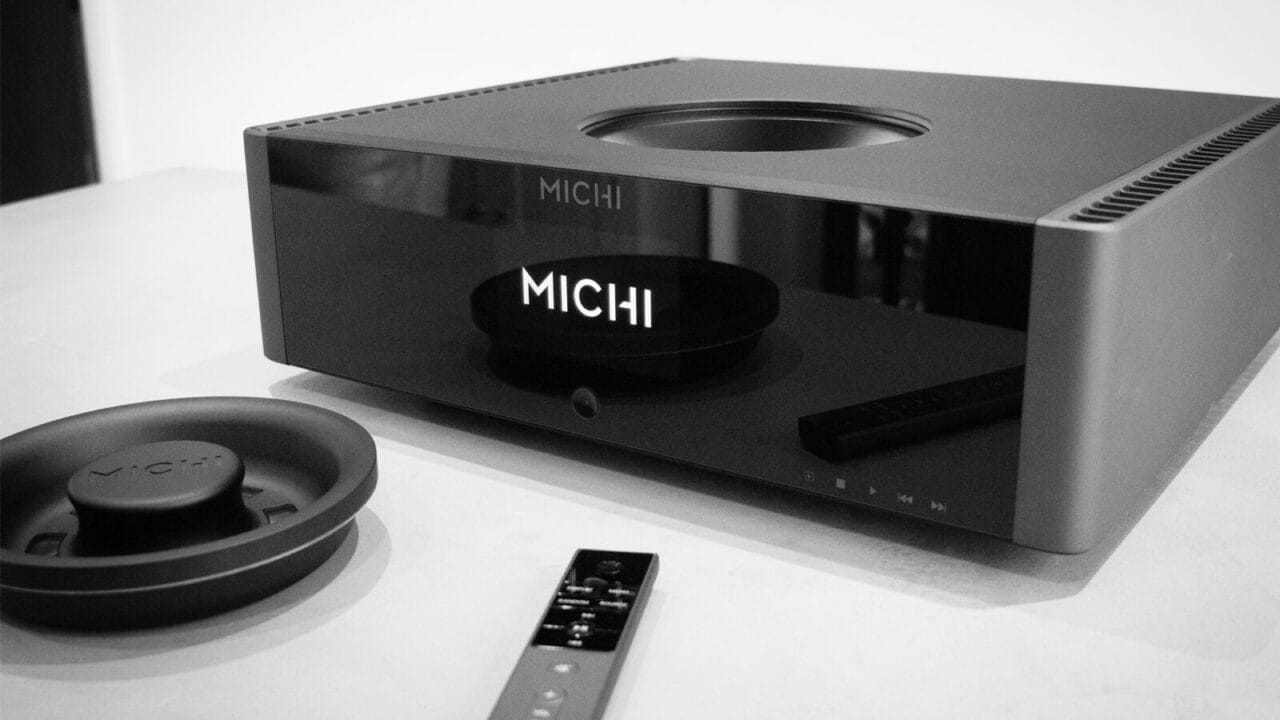
The Q5, in Rotel’s familiar full-width understated Michi design language
And that’s why it’s pleasing to see Rotel signalling its love for the format when it launched the Q5 late last year. As the 47th CD player in the brand’s long-standing history, this isn’t the only silver disc spinner in Rotel’s current stable, with a trio of models available across its cheaper ranges. But adding one to its reference Michi series, where it rubs shoulders with flagship integrated, pre, stereo and mono power amps is a statement of intent, underlining that Rotel still considers CD a vertiable hi-end format.
Laser focus
That said like most CD players hitting the market these days, it needs to do a lot more than just spin and decode compact disc data to earn its place in modern hifi, and this is where the Q5 gets really interesting (and also why Rotel billed it as a ‘CD Transport DAC’ at launch).
Its main meat and spuds is of course CD replay, with a top loading mechanism (more on this later) to accept and decode your good old 12cm Redbook standard (16-bit/44kHz) digital discs. And on the physical format side that’s it, as there’s no SACD support. But this is intentional, as with so much tech muscle at its elbow, Rotel could have easily added whatever functionality it felt like, but to instead focus on just making standard CD replay as good as it can be is what the Q5 is all about (as adding SACD means a drive that’s likely to be a DVD-drive derived compromise rather than purely audio focussed).

Elegant solid alloy casework includes side panels that double up as heatsinks
But before hi-res fans click away in disappointment you’re still more than well catered for, as you can hardwire into the Q5’s onboard DAC via a range of digital inputs (USB, coaxial and optical) with all manner of file formats, including PCM up to 384kHz and DSD up to 11.2MHz, with MQA also on the spec sheet. And with these plug-in options to play with, the onboard purist CD approach starts to make more sense. If you do own a bunch of SACDs and still fancy the Q5, the obvious workaround is to rip them to a NAS drive or similar and pipe them back in to the Q5’s DAC which will require some leg work, but is arguably worth it. And it lives up to its ‘Transport’ title too, thanks to coaxial and optical outputs, should you want to bypass it’s ESS DAC chip and send that data someplace else.
The Q5’s musical data decoding is handled via an internal ESS ES9028PRO 8-channel (32-bit/768kHz) based DAC chip, which is the same model used in the range’s partnering P5 S2 preamp. But whereas the latter gets two of them configured in dual mono, the Q5 runs one operating in bypass mode, with four channels serving each stereo side and Rotel’s own digital upsampling algorithm doing the thinking. And being a fully balanced differential circuit, XLR outputs are on offer on the rear panel, alongside RCA sockets.

Like the rest of the Michi range, the Q5’s internals mirror the quality of its casework, with CD drive and DAC board served by dedicated transformers
Lifting the lid
This being Rotel, and Michi for that matter, the Q5’s internals are top spec, including twin in-house screened toroidal transformers seperately serving its digital and analogue voltage supplies.
And then there’s the actual loading mechanism. Whereas many hi-end designers would have plumped for a front facing drawer or slot mechanism, Rotel has specified a top loading option complete with bespoke cover plate, which eliminates the need for drawer motors (and the noise they can add) in a stroke. And I for one am glad it did, as it’s a work of art, and distinguishes the Q5 from its contemporaries, while making playing a CD more of an event, akin to vinyl replay.

Q5 with its internally lit CD loading bay on full display. If Darth Vadar was a hifi fan you’d bet your lightsabre this’d be top of his wishlist
There are of course motors at work to get your discs rotating, and this is where the performance benefits of the Q5’s approach come to the fore. Its high-precision CNC-machined aluminium holder sports a dual isolated custom damped transport and when you remember that a CD gets up to 500rpm when in full flow and generates a lot of vibration, that massive Michi chassis and top spec transport is there to help absorb. This is also aided by a dedicated heavy-weight (1.1kg) top plate to hold your CDs down that’s 40mm deep, with clear windows so you can see what spins below.
And to underline its build quality, the only plastic moving part in the Q5 is the white centre section in the pic below, that sits above the motor spindle, underlining the Q5’s intention for longevity.

Elevated expectations indeed, the Q5 CD puck’s underside, showing its inner clamp and outer blue mating ring
Family values
Weighing in at a considerable 23.5kg all in, while the Michi Q5 is a chunk, it’s not as hernia teasing as its partnering integrated and power amps, which are all north of 29kg (my X5 amp tips the scales at 44kg).
And having the X5 as my reference integrated means I’m more than familiar with the Michi range’s menu system and slimline remote. What I’m less familiar with though is the Q5’s front panel buttons, which actually reside under said panel on its front right edge, with pictorial icons on the glass above telling you what does what. While this keeps the front panel clutter free, would I have preferred the rotary knob approach of the Michi amps? Perhaps in practical terms (maybe because I was expecting them), but you soon get used to the Q5’s controls and it does look sleek. That said the clumsy fingered or indoor glove wearers amongst you may want to default to the supplied remote, as you’ve only a 19mm gap to reach under, and the buttons are found by feel.

Nope, not touch buttons, these are icons denoting buttons hidden under the front panel
Menu and sub menu items include naming inputs or disabling those not in use, network options (for firmware updates and to pull/display CD artwork from the internet), audio decoding options, display brightness settings and switching off the CD port’s halo light (why would you?), alongside auto power down intervals and restoring the unit to its factory default.

Supplied remote is the slickest way to access the Q5’s menu, which hosts a sensible and not overly complex options list
The Michi range’s remote has also been tweaked and tailored to CD duties for the Q5, with the amp version’s ‘AUDIO’ swapped out for a ‘RANDOM’ feature. The up/down arrow icons have been edited to track skip/rewind icons, although the buttons serve both (skipping tracks when playing a CD and scrolling up/down when in the main menu). Personally I’d have separated these out by re-purposing the volume buttons which are largely redundant, as while these will operate a Michi preamp, if you have the partnering preamp then you’d have its own remote anyway.

Michi Q5 remote gains a random feature and track skip/rewind buttons over the standard one
At a glance the Q5 remote also seems to be missing a ‘stop’ button (it doesn’t need an ‘eject’ button, given the manually removed puck), with ‘stop’ actually activated with a few second’s press on the ‘play/pause’ button. And you need to get into the habit of doing this, as the CD puck is simply placed into position and can be lifted off at any time, including with the unit still playing – something you’ll want to avoid.

Rear panel connections include analogue and digital outs spread over XLR, RCA, coaxial and optical. Inputs offer USB alongside S/PDIFs, while an Ethernet port serves album artwork data and updates
Performance
Having heard the onboard DACs across the Michi range, including within the P5 preamp, X5 and X3 S2 that we reviewed in 2024, it’s clear from the outset that Rotel has engineered the Q5 to have a sonic flavour all of its own. It would have been all too easy to simply lift the P5’s DAC as is and repackage it with a transport as a standalone unit (which many brands would have done), but that’s not the Rotel way. And for this Rotel should be praised, because this means what you get with the Q5 is a sound that while clearly cut from Michi’s refined cloth, is also unique to the Q5. It’s subtly different, but different nonetheless.
To my ears (feeding a partnering aforementioned Michi X5 amp, driving MoFi’s flagship SourcePoint V10 Master Edition loudspeakers via Nordost cables) the Q5 is that bit more analogue sounding in its presentation than its Michi DAC’d brethren.
Revisiting my aforementioned Automatic For the People Automatic album underlines this point, being some three decades old, yet sounding fresher than the day I did my schoolyard deal all those years ago. Instrumental sections are presented with an authoritative blend of clarity and ‘organicness’ that reveals the sophisticated thinking which the boffins at Rotel have applied to the ESS Dac, giving it an edge all of Rotel’s own.

Michi Q5 next to my partnering X5 amp. Note how each CD’s album artwork is nicely displayed on the former’s screen
Tracks including Nightswimming and New Orleans Instrumental No. 1, have degrees of instrument separation with a sense of flow I can’t recall hearing to this degree from this album in this format.
And on the grander performances such as Find The River it’s all about scale, with the soundstage seeming like a grandstand in my listening room as the song’s opening acoustic guitars strums swing from left to right across the intro with a way-wider expanse than I’m used to from a ‘humble’ CD, because with the Q5 in play, CD sounds anything but humble.

Rotel’s CTO Daren Orth and Business Development Manager Stephen Baker presenting the Q5 to yours truly. Underneath it reside twin Michi M8 monoblocs driven by a P5 Series 2 preamp…no wonder they’re smiling
Back in the nineties
Sticking with the ’90s vibe (as this machine has had me revisiting my CD collection at length in the time I’ve had it, with every one sounding that but more ‘hi-res’ than it should at 16-bit/44kHz) unearths some timeless classics. What a decade it was for music, and Counting Crow’s August And Everything After [Deluxe Edition, Geffen 1743031] is up there with the best of the era, with layers of detail for the Q5 to uncover that’s passed me by on lesser players.
The pure wallop of Omaha (track 2)’s bassline for example sounds as laden with texture as it does power via the Michi, whereas with lesser players it’s been more about the punch without the poise, making it sound less convincing. And this goes back to my earlier point about this player’s organic nature, which gives CDs an overall greater sense of realism vs much of the competition.

Michi Q5’s alloy wheel style puck, takes the prize for the coolest CD clamp in existence
Of course what’s at play here alongside the Q5’s uncompromising transport is that all important DAC circuitry, and it would be churlish to not feed it some bigger data.
Piping a brand spanking download of Jesse Sykes & The Sweet Hereafter’s Forever, I’ve Been Being Born album at 24-bit/96kHz into the Michi’s USB port shows just how much Rotel has pushed the ESS ES9028PRO’s envelope. Vocals sound simple gorgeous, while the nuance of how each performance hangs together is perfectly captured, reminding you that this is what real music sounds like, not a polished reinterpretation of it.
Sitting back to let album opener Feather Treasure wash over you and if this was a blind listening test, I could have easily been persuaded that I was hearing a flagship vinyl spinner in fine fettle, such is the natural sounding nature of the Q5 because while it has a digital heart, it’s soul sounds steeped in analogue.
In summary
It’s CD Jim, but not as we know it. Because while the Michi Q5 would look right at home on the Starship Enterprise, it also sounds out of this world.
If you’ve a CD collection you’re looking to retain and grow for years to come then this is a sound investment. It’s a real statement for the format, and with a DAC that can be accessed via a variety of plug-in options plus Rotel’s longstanding brand behind it, there’s longterm piece of mind here too. As a hi-end CD player and DAC, it sets the standard.