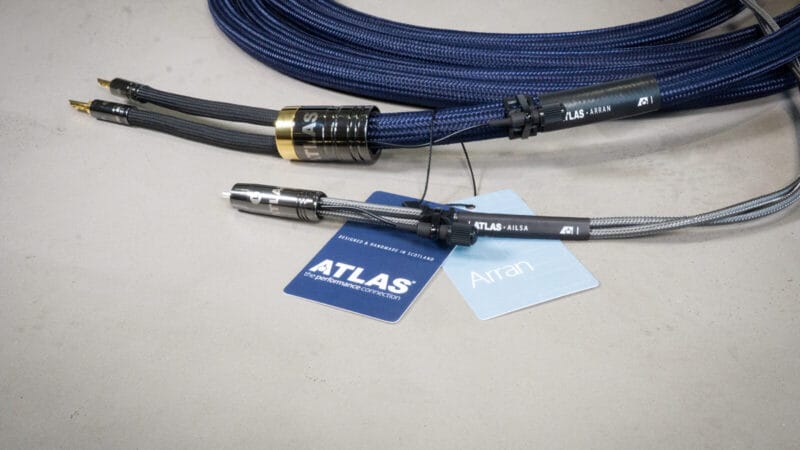



Atlas seems to be on a roll of late. As no sooner had we given its flagship Arran and Ailsa speaker and RCA cables a good going over, did its new Hyper interconnects land on our doorstep.
You’ll recall we were big fans of the aforementioned models. Their fit and finish is first class, as was the sound they contributed to, with the brand’s ‘grun’ grounding system also setting them apart from many rivals.
But they’re also more endgame components than everyday, with the interconnects costing £1,650 for a 1m length, and extra if you want to take full advantage of their mains earthing system.
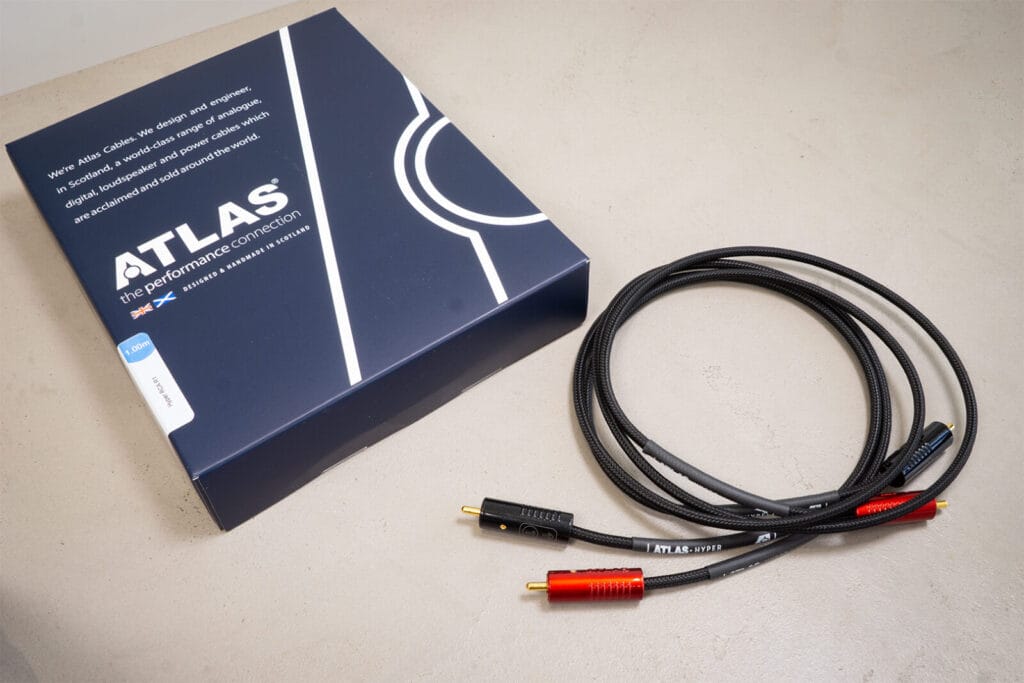
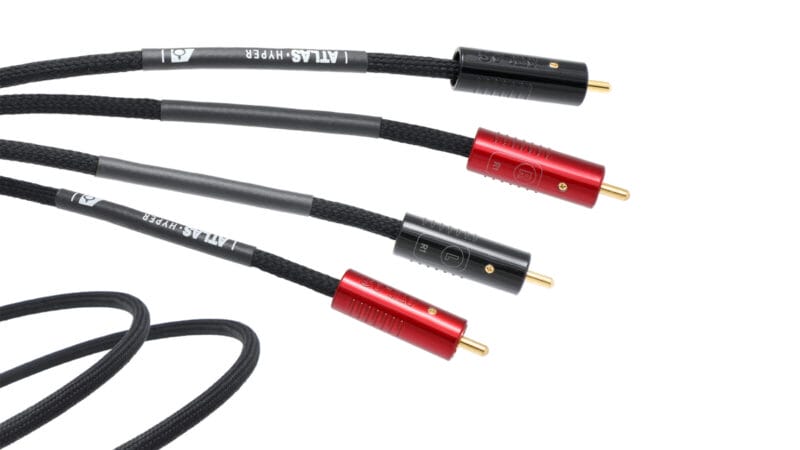
No nonsense packaging reveals a well made, slender and easy to live with cable in the Hyper RCA R1
Launched in March, the new Hyper RCA models are much more affordable, starting at £325 for the R1 model in a half metre length, moving up to £395 for the 1m length variant (under review), £465 for 1.5m and £535 for 2m (with longer lengths available as needed).
Hyped-up
As a reminder, the Hyper range sits below the Ailsa models within Atlas’s ‘Aspire’ grouping of cables, sandwiched between its ‘Upgrade’ and ‘High End’ ensembles. It’s also the cheaper of two types of Hyper models on offer, with the Duo option costing more than double that of their R1 equivalents, thanks to twin individually woven and twisted conductors (and supporting upgraded plugs) per channel, as opposed to the R1’s single set-up.
Despite the lower price point and spec vs its more pricey brethren, the Hyper RCA R1 still adheres to Atlas’s five principles of quality with its conductor, dielectric, connector, screening and manufacturing all being taken into account for performance. For the conductor, the R1 gets OCC (Ohno Continous Casting) high purity copper strands with a PEF (Foamed Polyethylene) dielectric that claims 0.859 ohms/m resistance and 48.86 pF/m capacitance.
Both the RCA and Duo models are billed as ‘pseudo-balanced’ designs featuring two identical internal OCC conductors enclosed in a double-layer metalised/woven OFC (Oxygen Free Copper) screen.
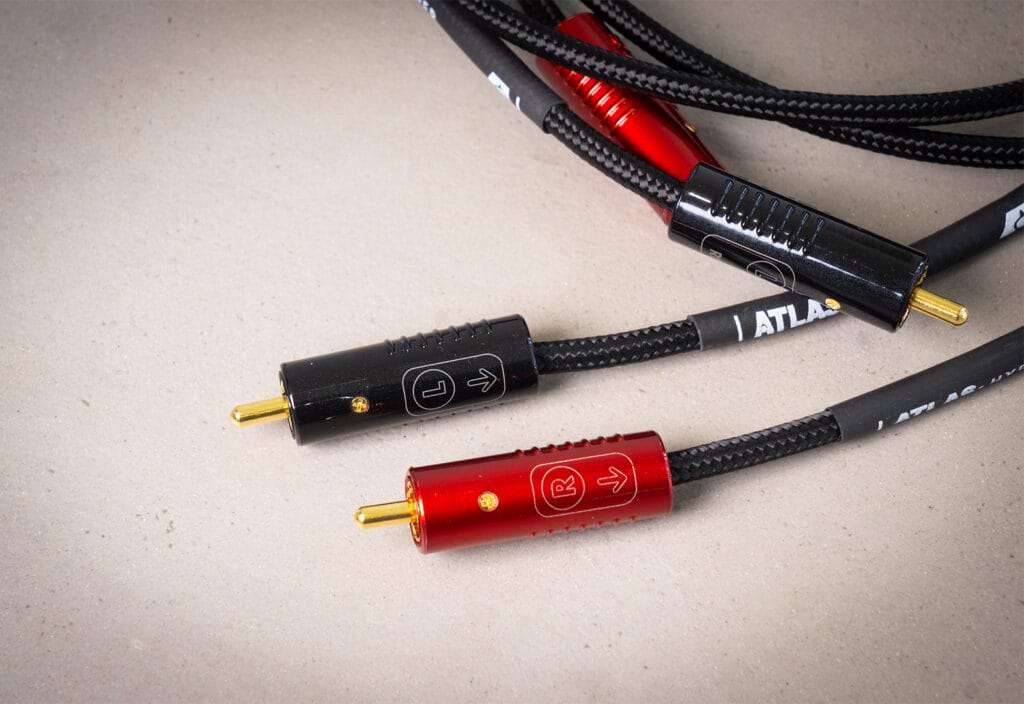
Non-magnetic Achromatic X RCA connectors are a low mass, high bandwidth design
On to the connector, and we get the brand’s Achromatic X RCA plugs (as opposed to the Duo type plugs), installed via Atlas’s trademark cold-weld (solderless) approach for better conductivity, thanks to less materials in the signal path. Inside the quality components continue with gold-plated conjugate brackets sporting twin asymmetrical leaves which spring open on insertion for grip, forming a sturdy connection for the return signal.
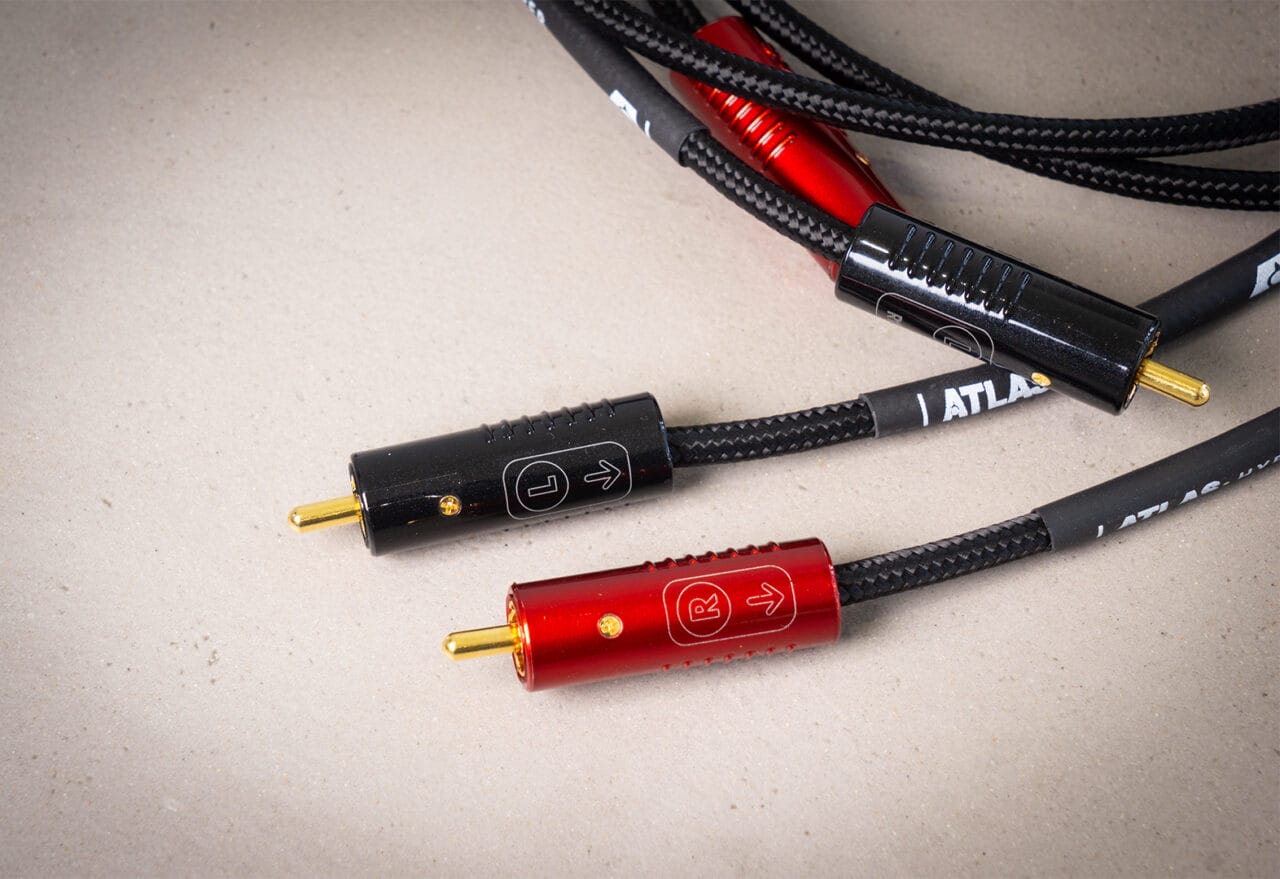
The plug’s centre pin is a made from solid OFC with a ‘rifled’ pin profile to aid a more consistent alignment during the crimping process. They’re directional too, but unlike most cables which use arrows to denote signal flow in to the amplifier, these point away from the amp.
In the hand, perhaps thanks to its multi-stand construction, the RCA R1 is very compliant. In fact its woven outer feels more like a refined length of rope than an electrical cable in some respects.
And the quality of its jacket feels much more upmarket than the R1’s price tag would suggest, with most rivals opting for plastics and the like at this level. Instead the R1, like many of Atlas’s upmarket cables, flies the flag for British/Scottish craftsmanship, which I applaud.
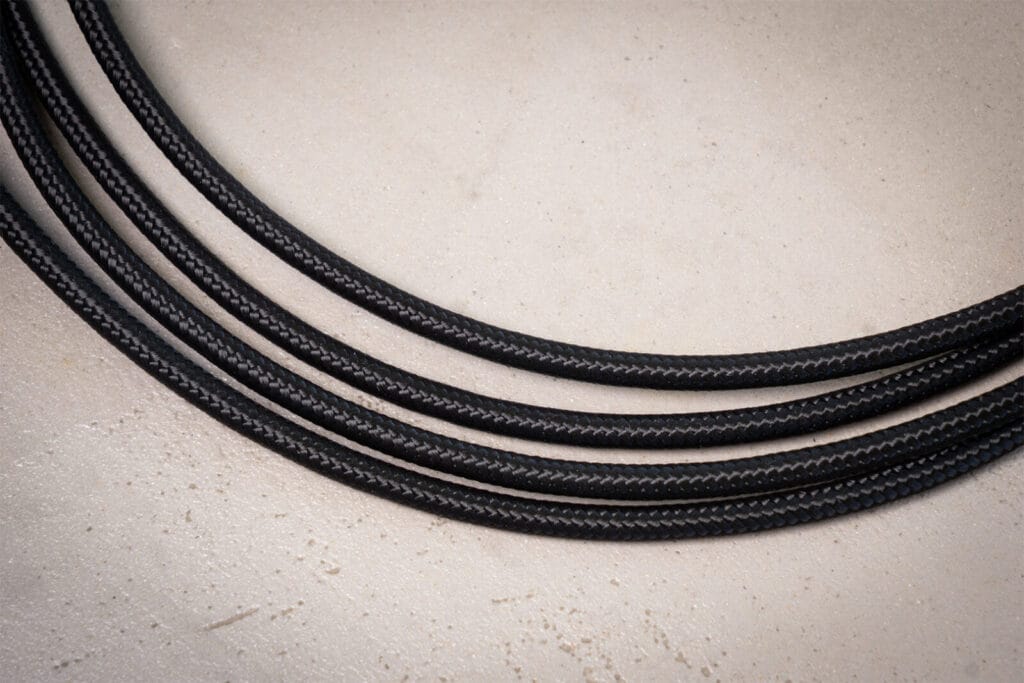
Black woven outer jacket makes for a slimline and flexible cable that sets it apart from thick plastic coated rivals
Performance
Installing the RCA R1 between my Primare CD15 Prisma media player and Rotel Michi X5 integrated amp (feeding MoFi SourcePoint V10 Master Edition speakers) is a doddle, thanks to the cable’s flexible nature and sensibly sized plugs that afford plenty of fingertip purchase.
First impressions? I’m instantly reminded of its Arran and Ailsa stablemates that lived in my system a few months back, because the RCA R1 is blessed with those same underlying attributes of transparency within a smooth-on-the-ear package.
Take Jeff Buckleys Everybody Here Wants You (16-bit/44kHz FLAC over Tidal), which is arguably the best produced (and most completed) track on his posthumous Sketches For My Sweetheart The Drunk album, and the initial punch of the kick drum combined with simple ringing guitar chords sounds superbly separated. But what piques my attention more is how Buckley’s vocals are handled. With some cables (including many costing more than the RCA R1) there can be a tendency for over-polishing here, leading to unwanted sibilance being applied to Buckley’s voice. And once you notice it, it becomes a real distraction from the track’s otherwise mellow and stripped back nature.
But thanks to how the Atlas cable handles things, this was kept in check, making Buckley’s masterful lyrics sound much more enjoyable and while also ensuring the rest of the track’s high frequencies were still delivered with clarity aplenty.
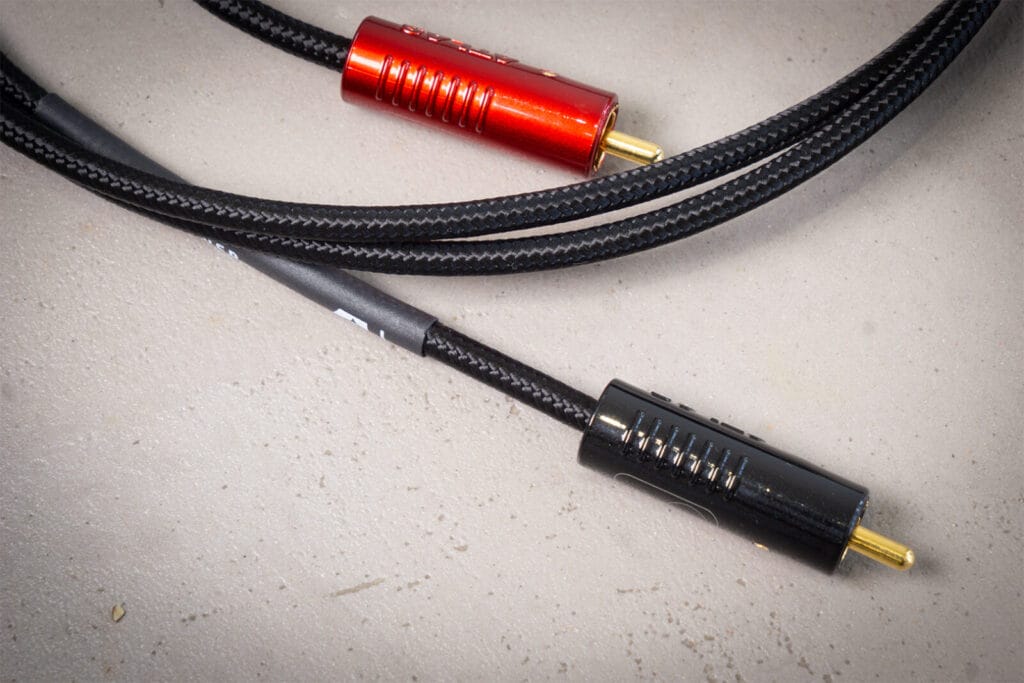
Colour coded plugs make for easy identification (much more so than Atlas’s silver polished Duo variants). The plugs’ raised profiles also give you something to grab on when fitting
In deep water
The other element that this Atlas cable brings to the music, perhaps surprisingly given its slender nature, is a full bodied sound. Pipe James Blake’s latest Trying Time album through its copper wires at 24-bit/44kHz (FLAC via Qobuz) and there’s a richness and density to the music that affords it satisfying levels of scale and weight, while also not losing sight of the detail within.
And it’s this sense of evenness in its delivery that elevates the RCA R1 over other entry to mid level cables. Sure, many of its rivals will do most things right, while perhaps excelling in one area over an other (often aiding system tuning), but the R1’s skill is in how it allows all elements within the soundstage to be delivered consistency. If you want a cable that may add more sparkle, excite or suppress your midrange to taste then look elsewhere. But if you want a cable that is measured across the piece and instead will let its partnering components do their thing without undue influence then the Atlas is ideal. And then there’s the noise floor, which seems impressively low. Not quite on the scale of the Ailsa Duo models we tested (which also had Atlas’s grun sounding system in full swing) but lower than many interconnects at this price nonetheless, showing why Atlas invests so much of its R&D in grounding tech.
To illustrate this point, I Am Kloot’s career defining Same Deep Water As Me from their self-titled second album (on CD) has a luscious mix of horns, strings, percussion and lyrics, drenched with atmospheric reverb. With the RCA R1 I get to appreciate every element of the track in equal measures, just as the studio engineer intended. What more can you ask for at this price?
In summary
If I were to sum up Atlas cables to a hifi newbie there’d be no need for audiophile jargon or tech science that could raise an eyebrow. Instead what I’d say is that they are just good quality cables that are well built with no-nonsense spec sheets and a finely crafted finish. And the higher you climb Atlas’s ladder, the more refined each element gets. Or in other words, Atlas gets the basics right, providing a solid foundation to build on.
The RCA R1 epitomises this mantra, being a well made cable with highly considered connections in an understated premium package that’s so easy to accommodate in real-world systems. This makes it such a good sonic allrounder while helping to smooth things out without detriment to musical detail. Highly recommended.