



I do love IItalian hifi, as it tends to be well designed, with looks to match, making it stand out from the usual dull-box crowd. And when it has valves inside that’s even better!
Priced at £6,990, Synthesis’s A50 Taurus integrated amp ticks all these boxes. Founded in 1992 by Luigi Lorenzon with its products (spanning amps and DACS) handmade in Morrovalle, Italy, the company was a natural family progression, as Luigi’s father made output transformers and other components back in the day.
Synthesis has earned an enviable reputation for its beautifully engineered valve amplifiers, and the Action range reinforces this. Alongside the A50 under scrutiny here, there’s also the Titan A100 and Virtus A40, with each model’s name reflecting its power output in Watts.
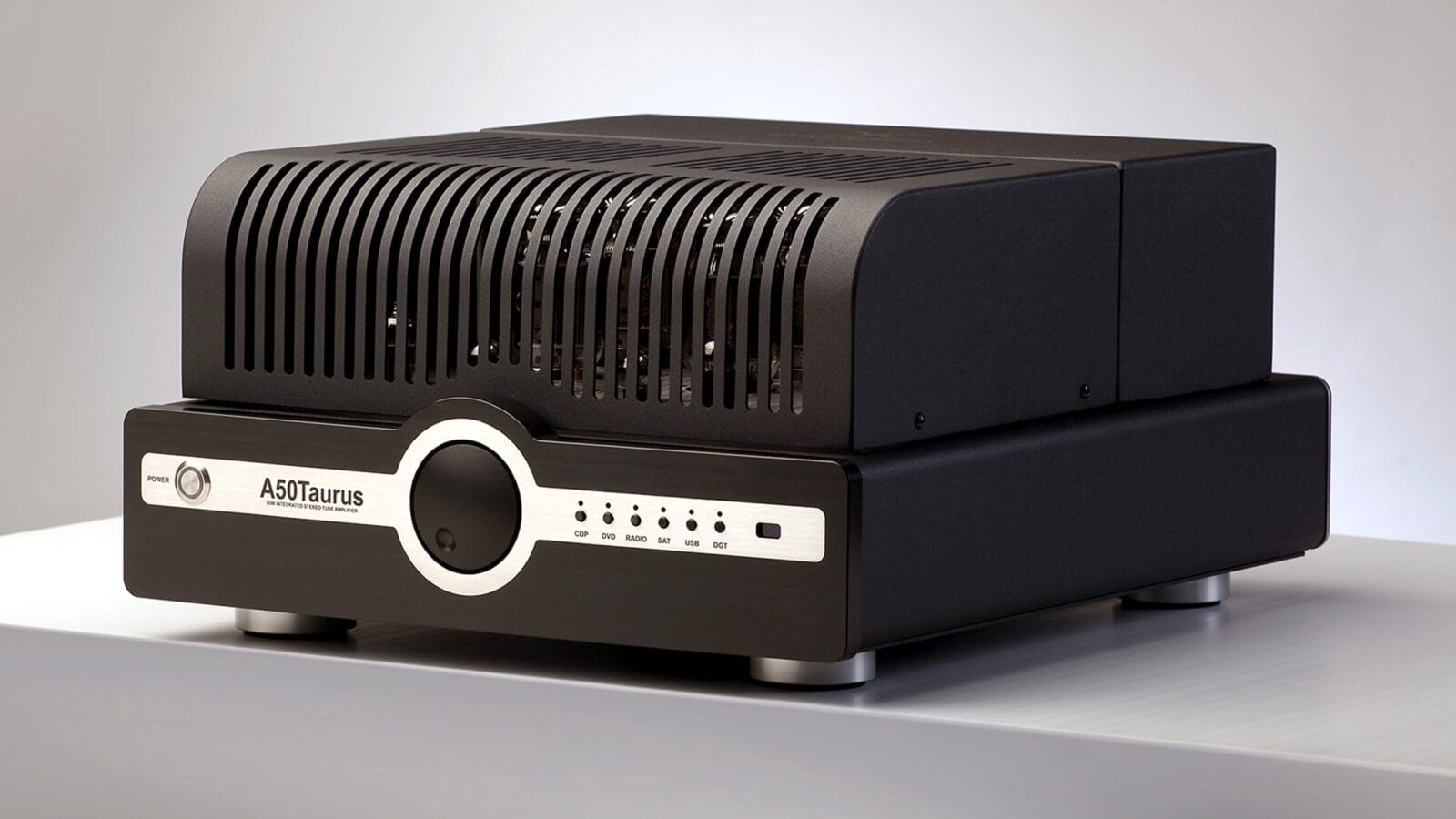
Getting A50’s vitals out of the way, its overall dimensions are 410/235/503mm (WHD), weighing in at 35kg – in other words it’s quite a unit. And as is de rigueur nowadays, the amp comes sporting a protective cage on its upper panel, to keep children, pets and plonkers away from hot valves, which, as these things go, is more nicely styled than most.
But if you want the amplifier to be a real looker, then using the supplied small allen key to remove the cover’s four securing screws will let you see the all-important glass bottles in their glowing glory. And when the sun goes down, you can enjoy the music with the reflection of the valves in the amp’s polished metal base for added visuals. Bellisima.
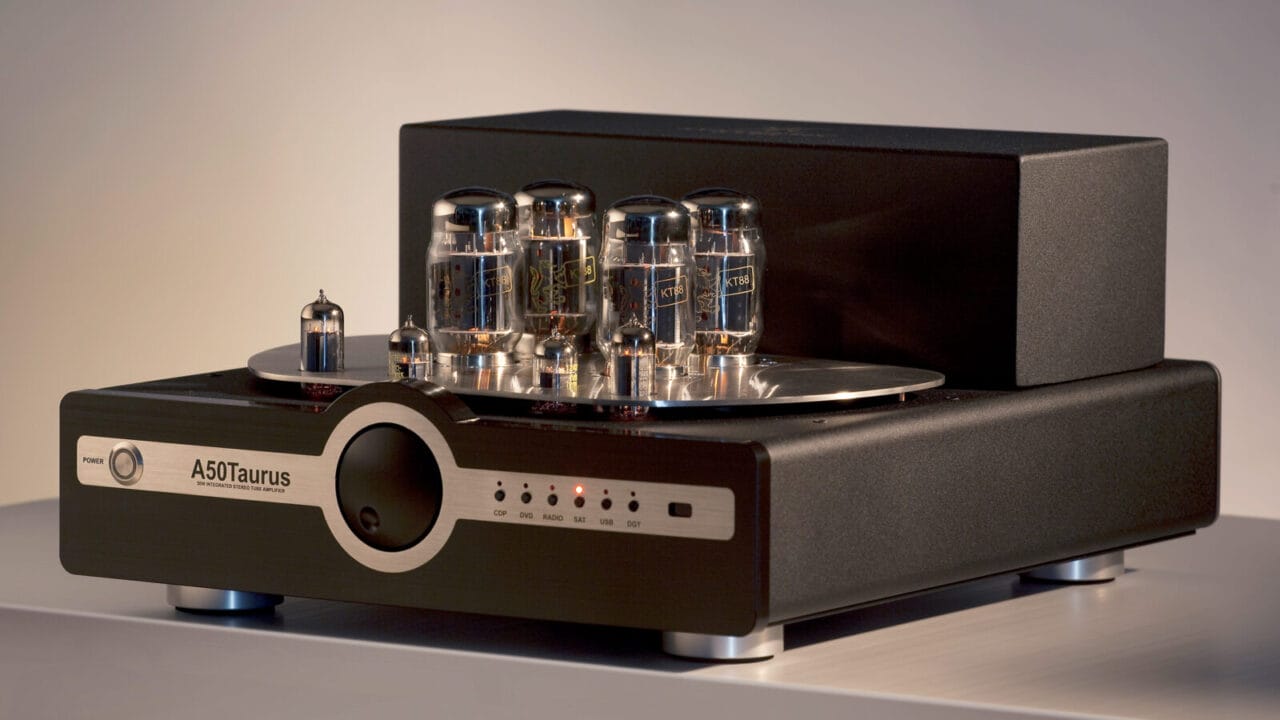
Black / aluminium casework looks both retro and modern
The Synthesis is a push/pull Class AB design, so far so standard. But instead of the usual KT150 power valves and 6H30 input valves, the A50 uses KT88s (or 6550s) for power, EC99s as the drivers and ECC83s for the input.
Break from tradition
The amp’s front panel is dominated by a large, smooth action volume control that’s a real pleasure to use. There’s also a supplied solid metal remote, if you’re less inclined to leave your listening seat. While we’re discussing the remote, it’s nice enough but personally I would have rounded its edges, making it nicer in the hand. And when changing volume, it’s not the most responsive, but worked when I took my time. I am not sure if this is down to my supplied unit, but it’s a minor observation, and patience is of course a virtue.
To the volume dial’s right are six red LED buttons, pressed to select the amp’s inputs which span four analogue (over RCA) and, perhaps unusually for a valve amp, two digital (via USB and coaxial), thanks to an inbuilt dual-mono Wolfson WM8740 based DAC.
An oddity perhaps is the power on/off button that’s lit when in standby, and off when the amp is in use, which seems the wrong way around to me.
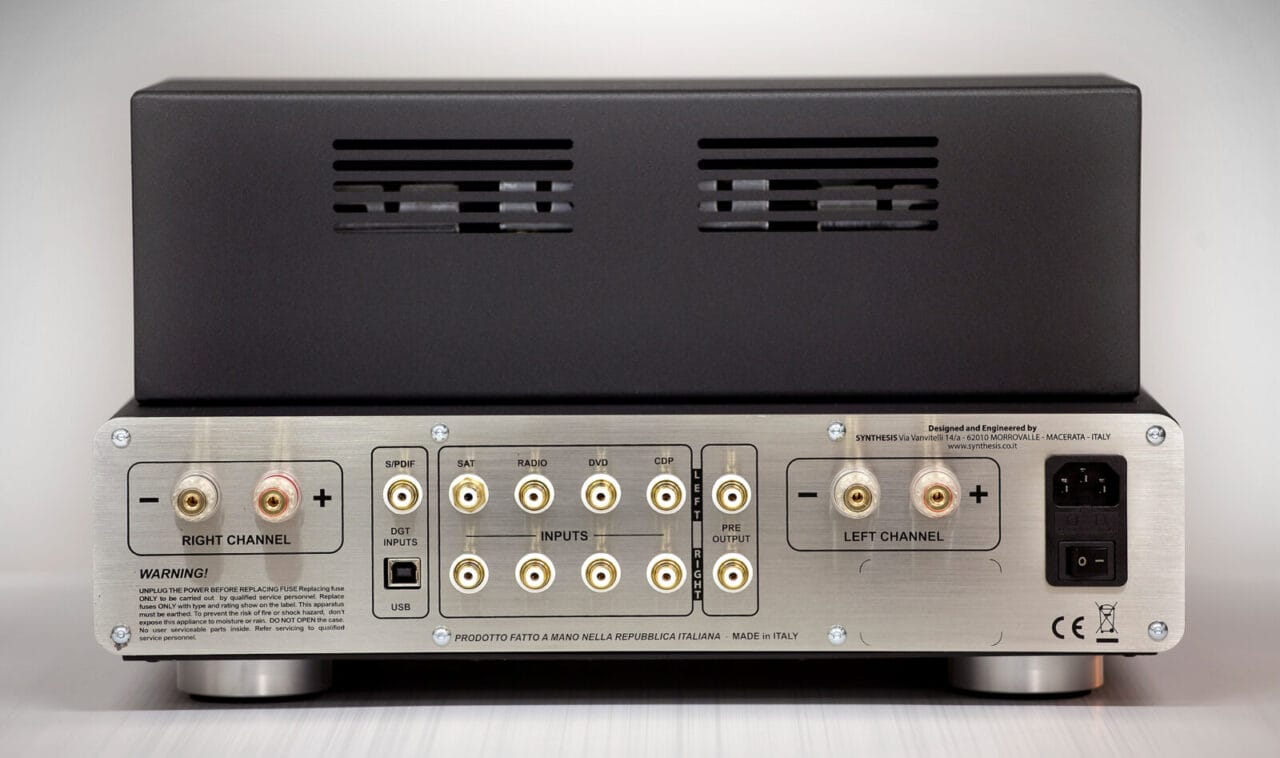
Rear panel connections include left/right multiway speaker binding posts flanking digital and analogue inputs. There’s also a pre-out for adding a separate power amp
If you are looking to take advantage of the amp’s DAC, it’s worth noting that the coax input decodes up to 24-bit/192kHz data, but USB is limited to 16-bit/48kHz (and files beyond this get downsampled).
Despite being a handmade artisan product, Synthesis has opted to use flow-soldered PCBs for their reliability and consistency, as opposed to hand soldered point-to-point wiring, which can introduce differences and dry joints over time.
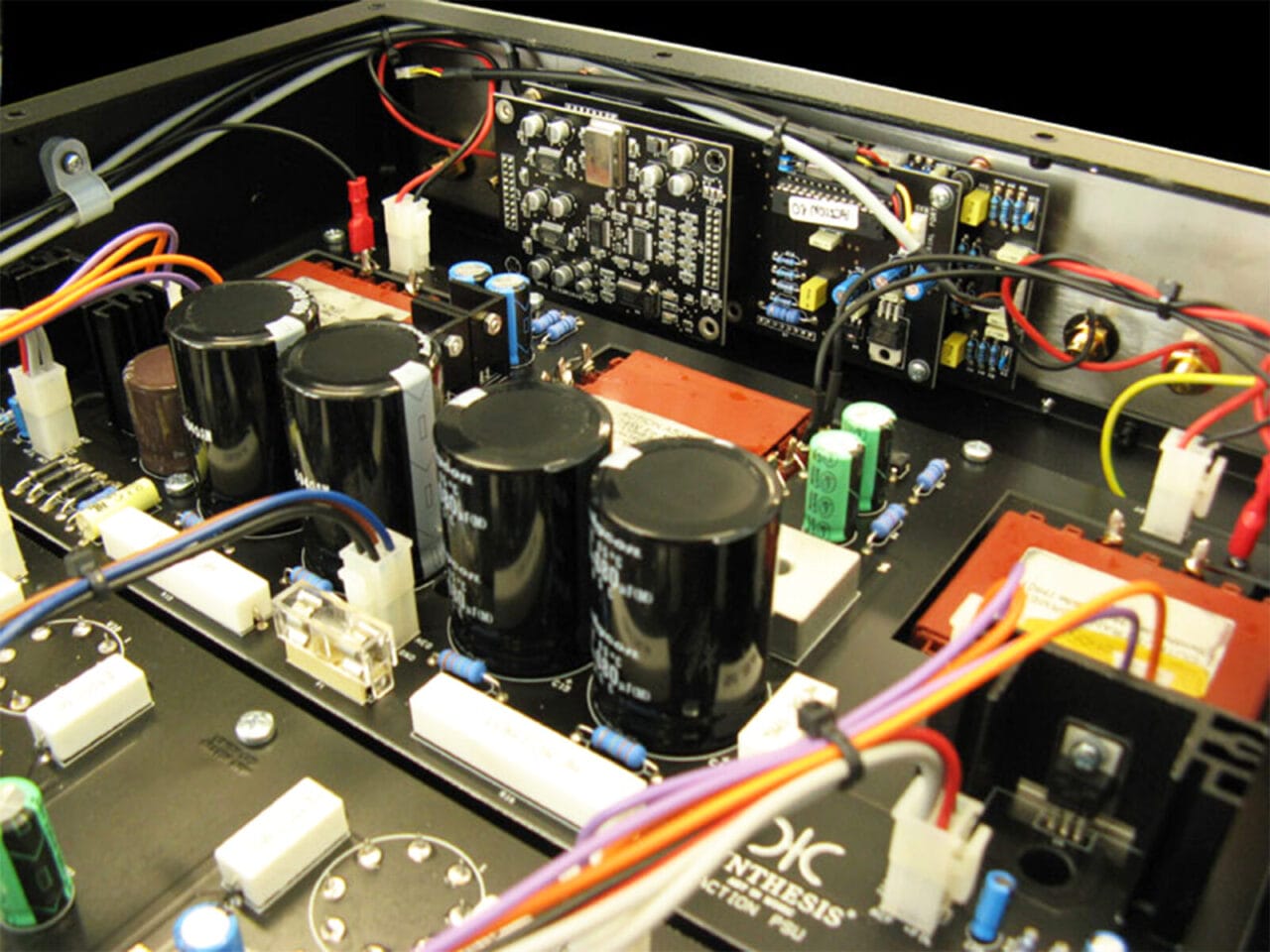
A50 internals host a trio of heavy Italian-made transformers, ceramic valve sockets and flow-soldered PCBs
Performance
Like most beefy valve amps, not only is the Taurus heavy, its weight isn’t evenly distributed (due to its triple transformers positioned at its rear), hence you’ll need to take extra care when installing.
After warming the amp up, I kicked off listening proceedings via the A50’s inbuilt DAC fed from my Room Nucleus One server’s USB into an SMSL converter to provide an S/PDIF signal, allowing 24-bit/192kHz files to be piped natively into the Synthesis’s DAC.
Speakers are my Wilson Sophia IIIs while for DAC comparisons with the Synthesis’s internal offering, I used a dCS Bartok APEX streamer, Audio Research Ref CD9 and Luxman D-10X CD players, plus a Chord Qutest DAC, with cables from Cut Loose Audio.
Playing my usual test tracks, this amplifier immediately sets its stall out as a top-quality valve based model with a dash of its own flavour. Its overall character is very natural sounding, with a well-balanced frequency response. The dynamics are very good too, and there were plenty of surprises on well-recorded music.
That said, if you are expecting all out fireworks all of the time with an upfront and in-your-face attitude that accentuates details, then this amplifier may not be for you, because it’s far more sophisticated than that. This isn’t the type of amp for example that will blow your socks off in a short demo, but once home becomes hard work. Instead it’s an amp to live with longer term and you need to hear it with a wide range of music over an extended period (as I did) to appreciate all that it does, without the hyper focus that many modern amps favour.
Mike Valentine’s CD recording of Rimsky Korakov’s Capriccio Espagnol with the National Symphony Orchestra sounds delightful on the A50, with the Luxman feeding the amp’s analogue inputs, as it allows Conductor Debbie Wiseman to let the music flow with tight timing plus great build-up and release. This recording took place in the big hall at Air Studios (originally a church) and the sheer impact of the large orchestra in full flow sounds mesmerising. As well as handling the dynamics in an authentic way, the amplifier lets details be easily heard, and there was no mistaking this was delightful Spanish music. It left me with a big smile on my face as I conducted along with Debbie (having met her a few years ago, I’m sure she wouldn’t mind).
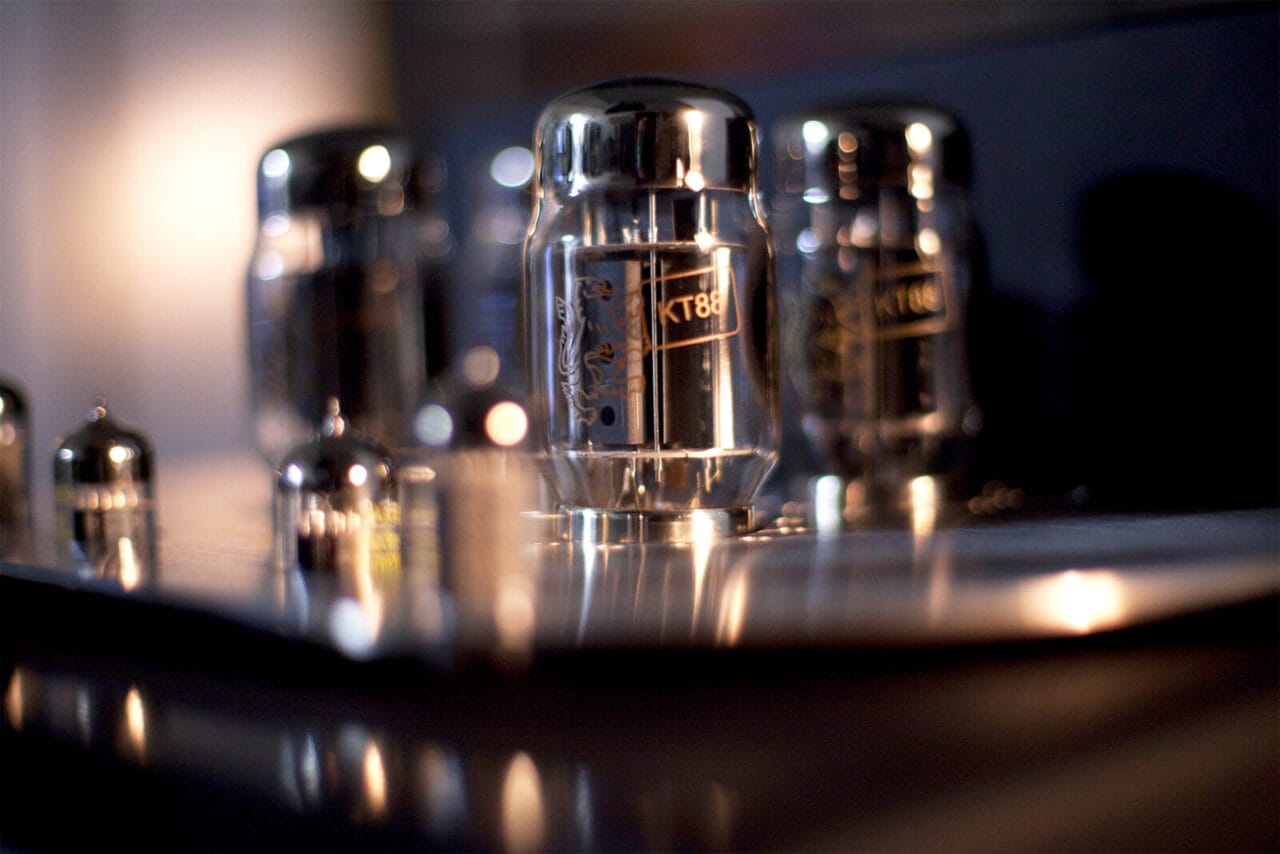
Got the bottle? Make mine an 88
Join the circus
In complete contrast, Bruce Springsteen’s The Last Carnival and The Wrestler from his Working On A Dream album (Qobuz at 24-bit/44kHz through the Bartok’s analogue out), have him singing simple, straightforward songs about lost love and an old soak lamenting his fighting days. And here’s where the amp’s valves really work their magic, allowing the pathos, heartbreak and regret to shine through.
Another surprise came via Dogs Of War from Pink Floyd’s A Momentary Lapse Of Reason, this time fed into the amp’s coaxial input at 24-bit/192kHz via the Roon/SMSL combo, which allows Tony Levin (bass) and Jim Keltner (drums) to build-up the tension in the music with some menacing electronic low frequencies. Because whereas some valves have a tendency to slow things down and alter the timing, the Taurus scores well in that the bass remains fast, powerful and mean.
For sheer lambast is there anything better than Beethoven’s 9th Finale by the Pittsburgh Symphony Orchestra, directed by Manfred Honeck? This is a brilliant reference recording, with over 100 musicians contributing (recorded on a DSD 256 Pyramix recorder I’ll have you know). Playing the SACD through my Luxman and going heavy with the Taurus’s volume control has the amp taking everything in its stride, with no dilution of the dynamics, despite the amp’s modest power on paper. After the track’s grand opening, in comes the baritone with a big powerful voice that fills my room with the orchestra gifted a huge soundscape that pins me to my chair, while female choir vocals float in the air with real delicacy. Enjoyable? It’s so good I just had to start again and play the entire (hour long) disc again, leaving me emotionally drained, yet satisfied.
Cross comparing the amp’s internal DAC to my standalones and I have to confess that the Wolfson chips do a fantastic job. As an added extra, I’d presumed it would sound okay as internal DACs go, and I’m pleasantly surprised to report that it exceeded my expectations by some margin. Is it as good as the dCS Bartok, Luxman D10X or ARC Ref 9? Come on, they are all more than twice as expensive as the A50, but the latter still delivers. And for many, it’ll be more than what they need without the added expense.
In summary
This is one cracking integrated valve amplifier. It looks the part, especially sans cage, and is a delight to operate (even if the remote is a little sluggish).
Sonically, having not heard KT88s before, I found them to offer all the goodies of valves with surprisingly accomplished bass to boot, alongside a grand soundstage (when the music offers it).
And when you factor in the worthwhile DAC that’s part of the package, as a high-end do it all valve amp, the Synthesis A50 Taurus starts to really make sense value wise.