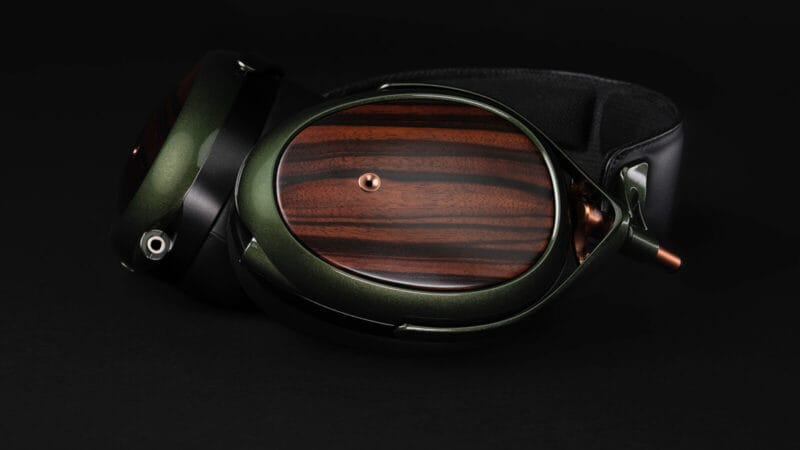



Luxury. This is the word that keeps popping into my head when I think of the Meze Empyrean II. What does luxury mean? In the case of a piece of hifi it should encompass presentation, design and quality. In particular sound quality.
Another aspect of luxury is price, and the Empyrean II certainly meet the expectation, as at £2,749 these are expensive headphones. You will therefore understand why I did not wear these while out and about, or in bed.
Meze is based in Romania, founded in 2011 by Antonio Meze (read more about its history in our Spotlight feature). In 2015 Meze partnered with Rinaro Isodynamics, a Ukrainian brand formed during the cold-war. Rinaro specialises in planar tech and together with Meze they introduced the original Empyrean headphones back in 2018.
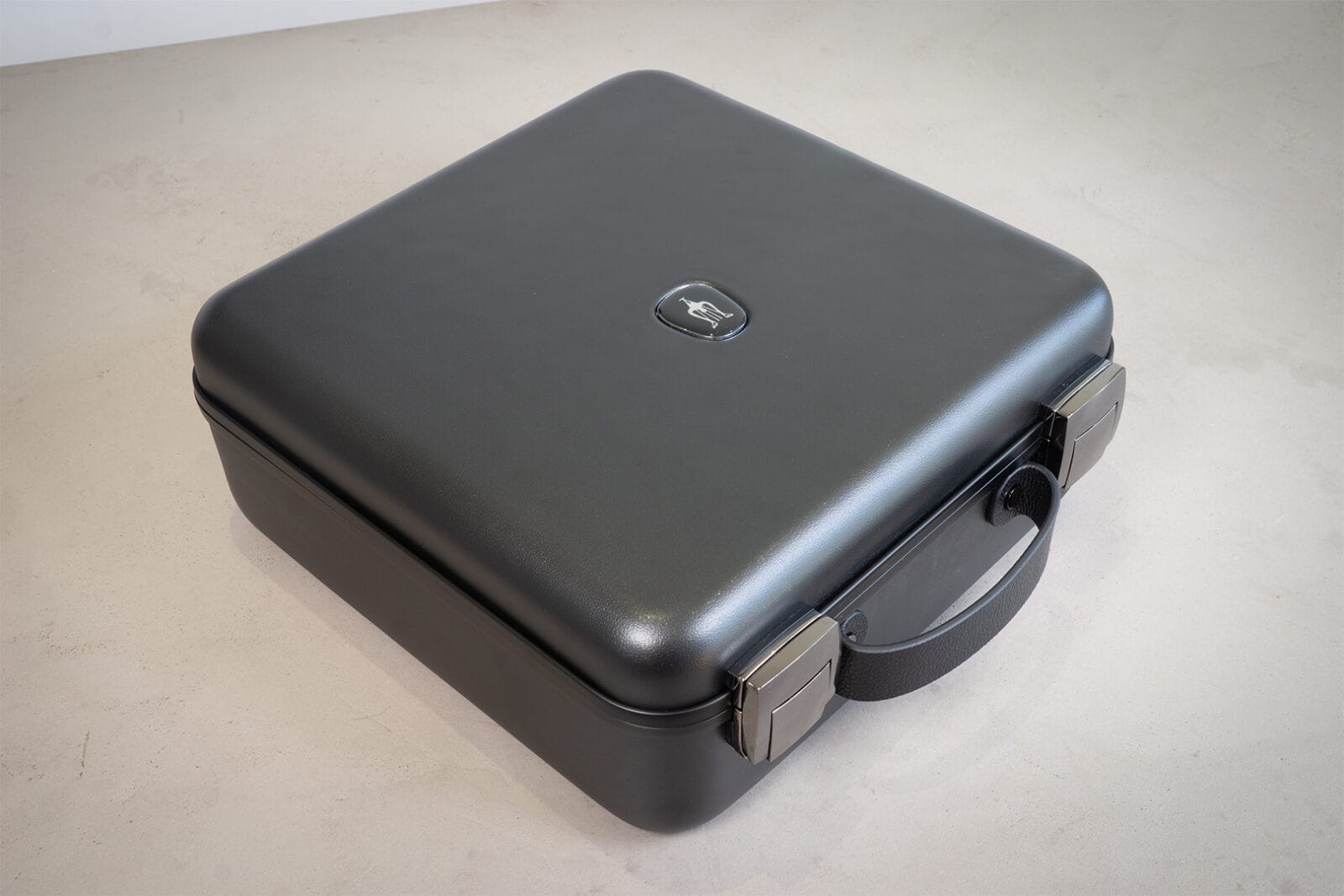
There are headphone cases, and then there are Meze headphone cases, which are on another level
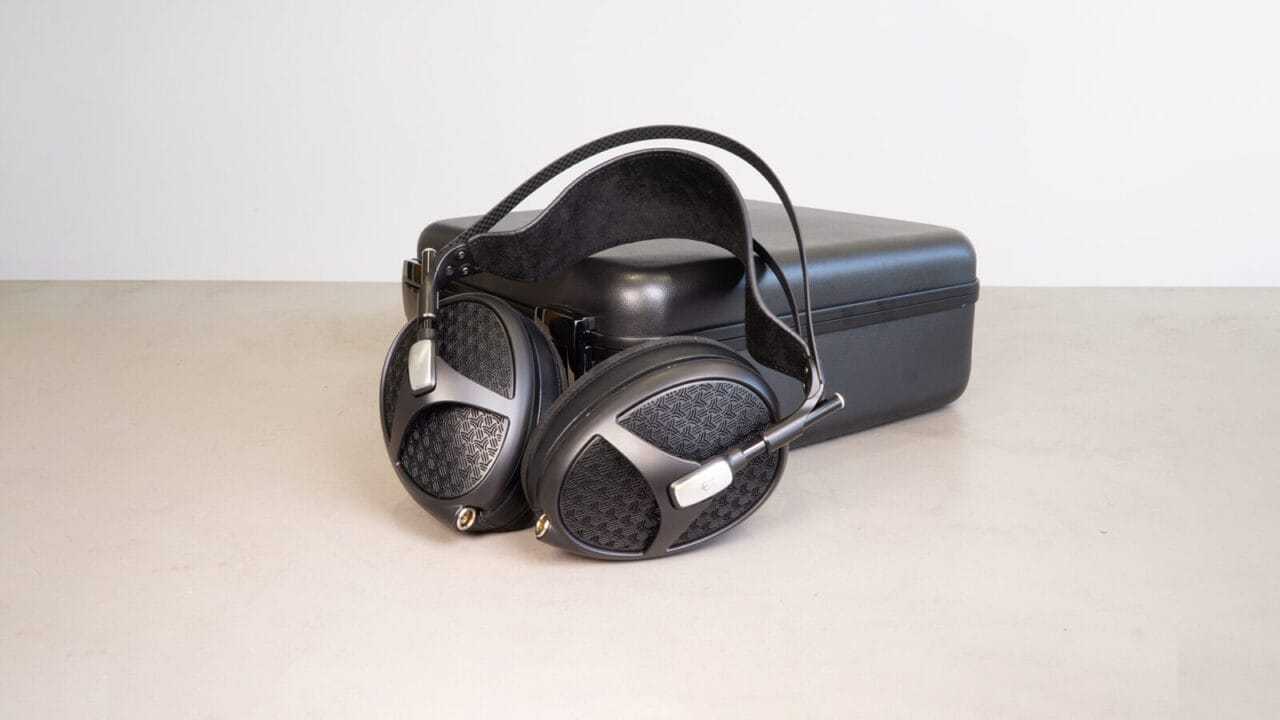
The Meze Empyrean II are the latest iteration of the Empyrean line. They arrived double boxed and air-cushioned – which shows the efforts Meze goes to, to get them to you unharmed. Opening the outer box reveals a Samsonite-esque carry case. Flipping its catches and lifting the lid then reveals the headphones in all their glory, complete with an alternative set of earpads and leatherette bag containing two sets of cables. Luxury presentation? Yes.
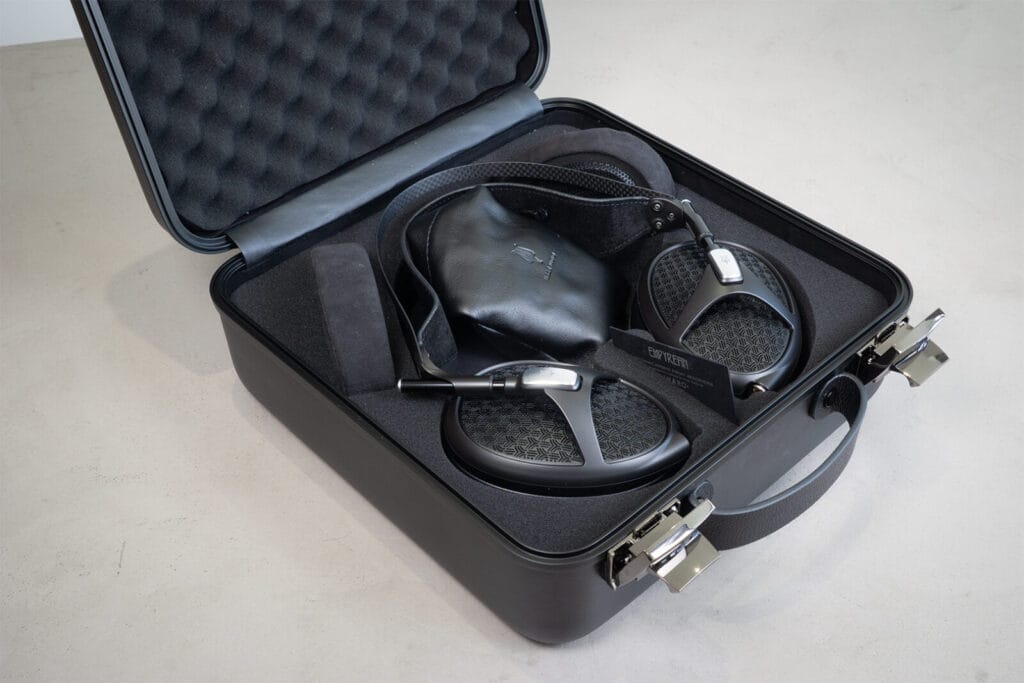
The meticulously designed carry case is very professional looking, with its carefully contained goods inside
My daily headphones are Meze’s 109 Pro and I can’t resist comparing these to the Empyrean II. The 109 have an oval sprung steel cage that holds the headband. In the Empyreans, the cage is made of carbon fibre. This is not a simple oval either, as it arches over the top of one’s head and then curves outward over the top of your ears. Elegant, and I have no doubt far from simple to achieve.
The cage ends on each side with a pole that attaches to the two earcups via a bifurcated extrusion, a sprung dual winged arrangement. This is also where the headband attaches. All of which looks deceptively simple, but I can imagine the careful engineering that went into developing such a well realised design.
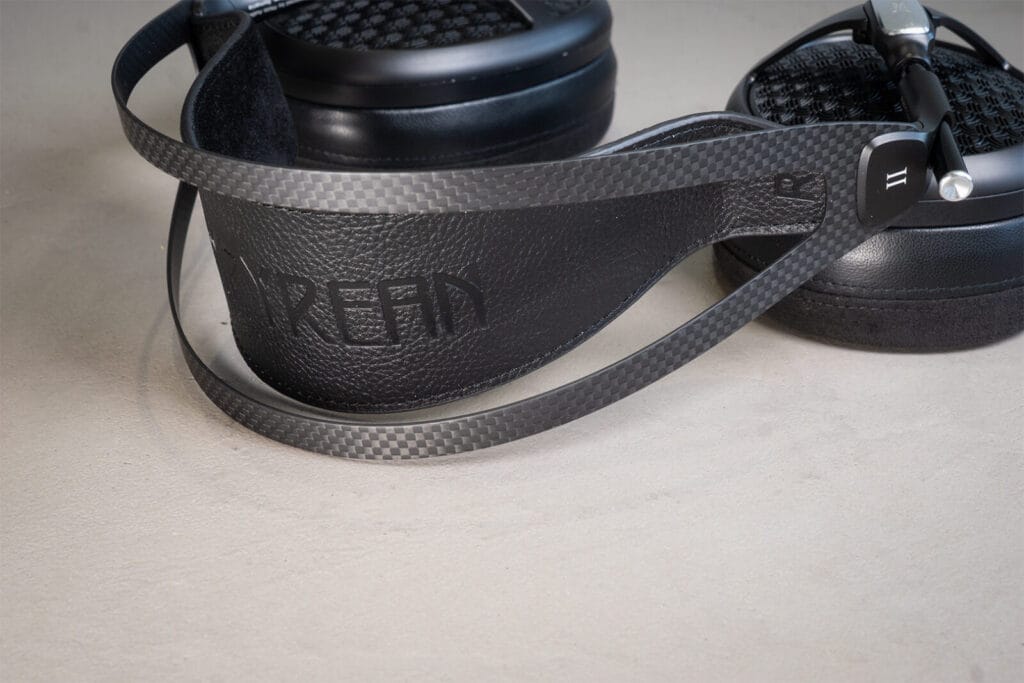
Sculptured headband is formed form a carefully shaped carbon fibre cage, with embossed model name and left/right ear denotations on the headband
Another cup?
The Meze Empyrean II’s flexibility when in use just makes me smile, being so limber. This results in a pair of headphones that sit very comfortably on your head. The ovoid earcups are open-backed, with an embossed pattern, echoing the feel of the carbon-fibre cage
The two sets of supplied earpads are described as ‘Duo’ (leather and Alcantara) and ‘Angled Alcantara’ (soft foam coated with Alcantara) and are magnetically affixed to the Empyrean II’s cage, making them extremely easy to change, bravo!
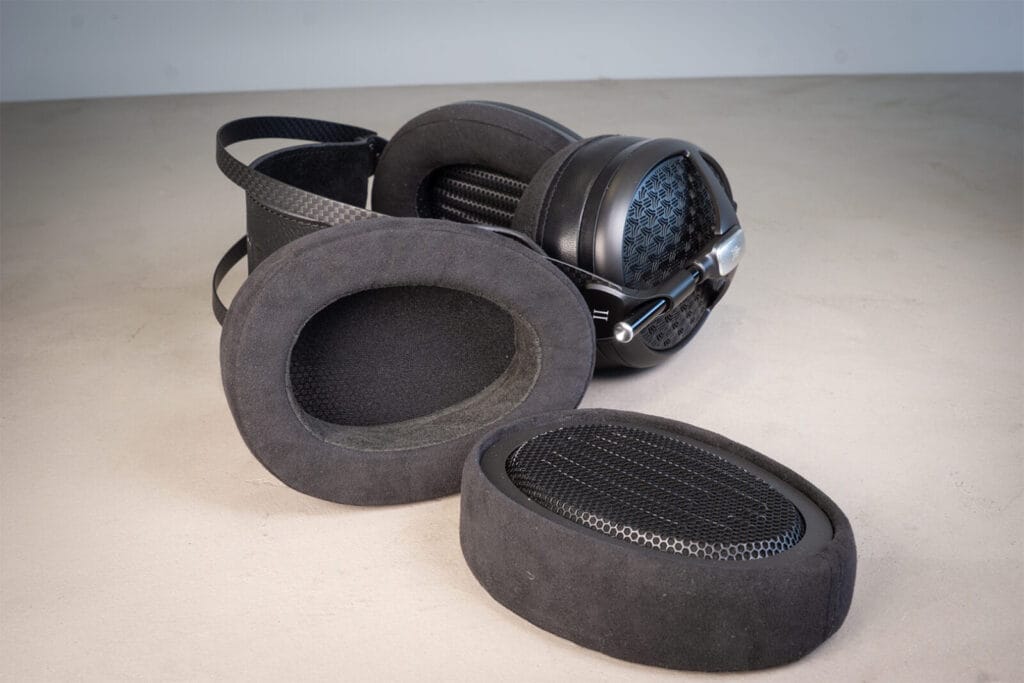
Included twin sets of earpads offer alternative spacing from a user’s head, with the angled variant voiced to generate an airier sound signature
The drive units are Isoplanar types, that is one plane, or in the vernacular, they are flat, and here is where Rinaro’s expertise is brought to the fore, using its ‘Isodynamic Hybrid Array Driver’. My personal reading of this is that Meze uses neodymium magnets to control a spiral drive that covers the entire audio spectrum. It certainly looks simple in presentation, but I suspect damned difficult to design and construct.
The headphones themselves weigh 449g, and never felt heavy or uncomfortable on my noggin. Their reported frequency range extends from 8Hz to 110kHz, with a 32 ohm impedance.
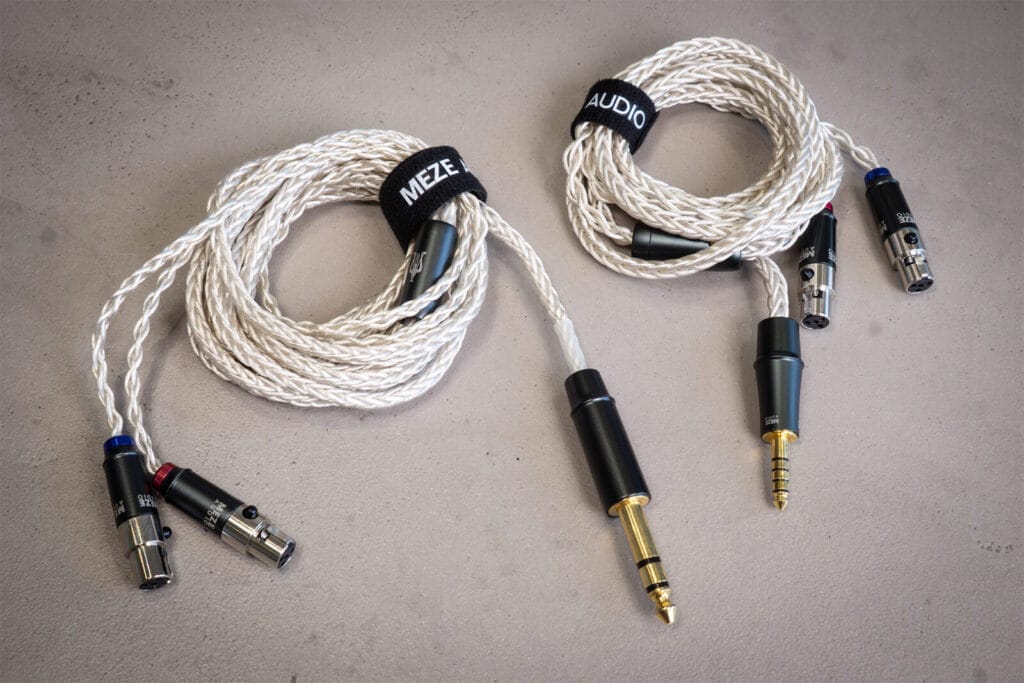
Silver cables are a £249 upgrade option and sport mini-XLR sockets for connecting to each of the Empyrean II’s earcups. Being plug-in types means you can swap them out as you see fit
Meze has also considered how you’ll be connecting the Empyrean II to your hifi without compromise, by including a copper Furukawa 6.35mm cable as standard.
However we were keen to test them with a range of audio gear (including Chord’s new Alto, which we’ll be reviewing soon) and therefore specified both 4.3mm and 6.35mm variants in upgraded silver-plated PCUHD (Pure Copper Ultra High Drawability).
Luxury Design? Check.
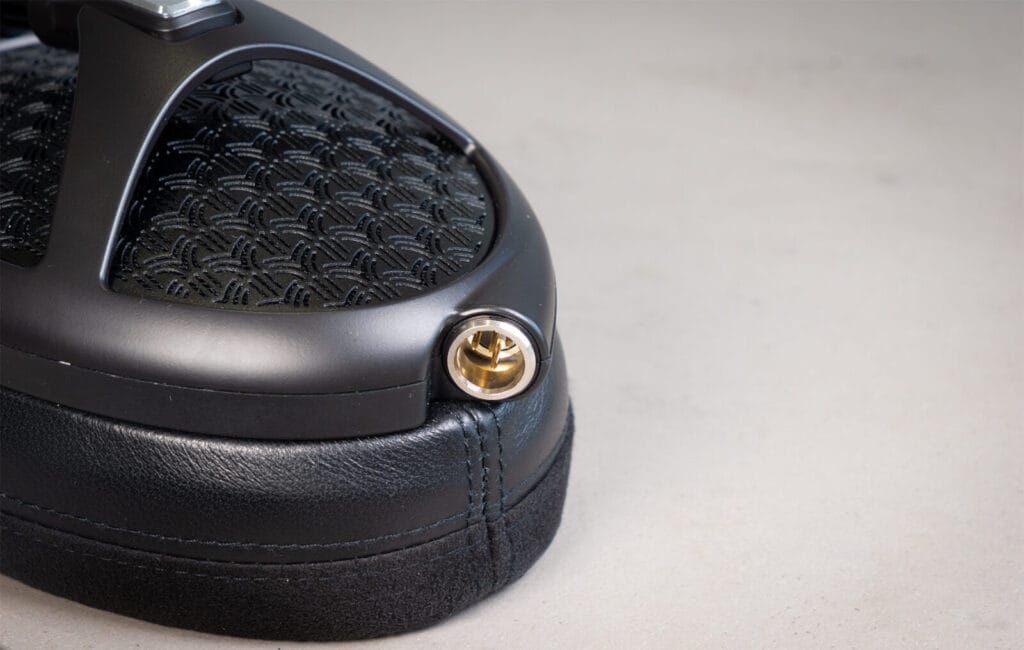
Earcup socket up close, ready to receive its mini-XLR input
Performance
Now to the main event, audio quality. I used Chord’s 2go/2yu streamer/network bridge combo via a coaxial connection into a partnering Chord Hugo TT preamp/DAC. Source music is from my dedicated headphones playlist via Qobuz and Roon, with no signal processing.
As we know if in hifi terms, quality is a difficult word to define, we would all claim to know it when we see it, but trying to specify what quality is is a different matter entirely, with books such as Zen and the Art of Motorcycle Maintenance taking this notion to another level!
To my mind audio quality connotes audio fidelity, precision and emotional connection. After all, anyone can spend a wad of cash on something pretty that gives a second rate performance. But at this price the purchaser should demand excellence.
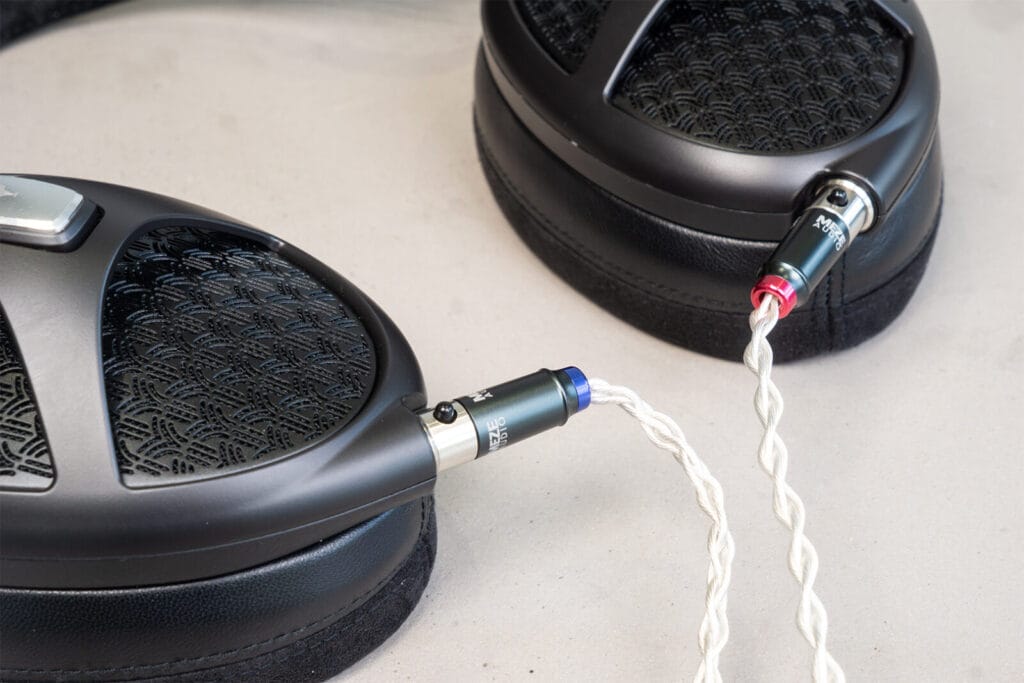
All plugged in and ready to rock
First question – which pair of earpads to use? It was only fair to spend some time with each, at least this was one of my many excuses to our editor to hold on to the Meze’s even longer “just another fortnight…honest” [thinks I’m daft – Ed].
Eric Clapton’s Signe (Acoustic Live) at 16-bit/44kHz is an excellent track for demonstrating the difference between these pads. The Angled Alcantara variants sound more spacious, while revealing a bit more top end detail and sparkle. The Duo earpads on the other hand allow you to hear a tad more bass resonance, dynamics and detail.
Whichever pads you choose though, rest assured that what the Meze Empyrean II gives you is even-handed control. Transducers can centre on certain frequencies, emphasising certain instruments and resonances. While this can be pleasing, it masks detail elsewhere. Not here, as the Empyrean II allows notes to start and stop, without killing the tailing reverb that brings verisimilitude to all of the performers in a piece. Whether headphones or speakers, this is the hallmark of quality.
While I had no overwhelming preference for one pad type over the other, I chose to do my main listening with the Duo option fitted.
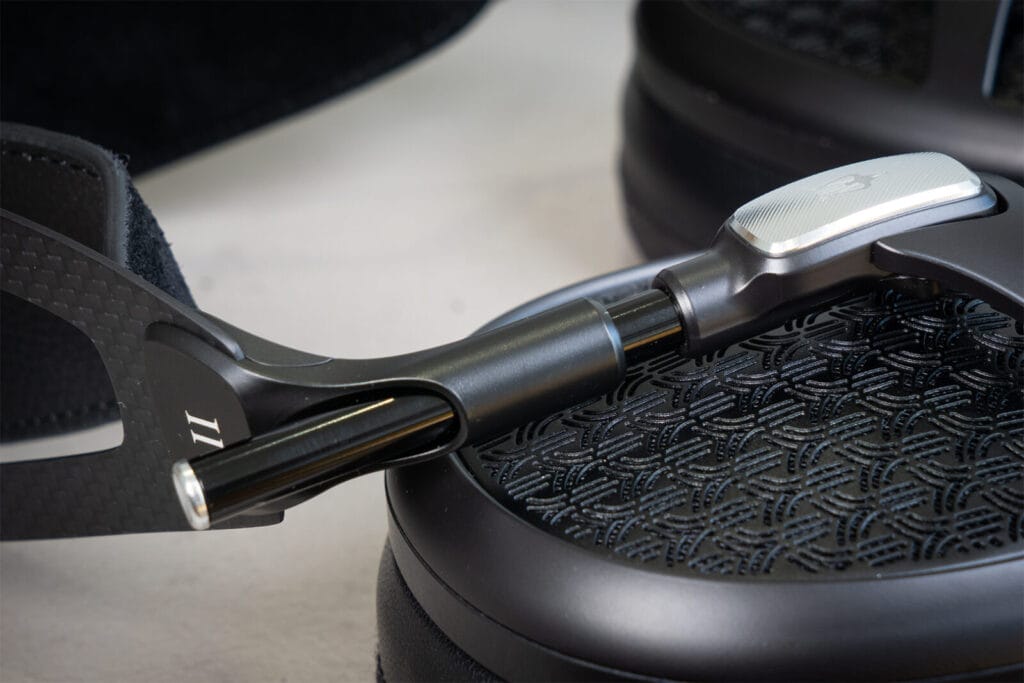
Friction sliding arm enables fine tuning for fit with ease
Going the extra mile
Lining up Miles Davis’s 1959 recording of Concierto de Aranjuez: Adagio (Remastered) from Sketches Of Spain (24-bit/44kHz) affords a further test of the Empyrean II’s handling of upper frequencies. Understandably the trumpet takes centre-stage with the orchestra aided by a jazz band, whose contributions to Gil Evans’s arrangement are very clearly rendered by the Meze’s. The brass shines, the drums roll and the space adds tension.
Vocal issues in terms of sharpness or poor intonation is a music killer for me. Diana Damrau is a superb soprano (if you’ve not watched her singing the Queen Of The Night aria from The Magic Flute on YouTube, I implor you to do so).
The way she shapes her mouth and throat to hit punishing notes is an object lesson in singing, and all this while delivering a dramatic performance. Her album, Arie di Bravura (16-bit/44kHz) is aptly named. The recording here demonstrates her precision, passion and vocal virtuosity, as she seeks to cajole her daughter into murdering her father.
On to something more popular and perhaps less morose, a true barnstorming number, Goldfinger from The Best of Shirley Bassey (16-bit/44kHz). I am not convinced that any recording has ever truly captured Shirley’s voice, but this is a good version. The Meze Empyrean II not only renders her soaring vocals well, but pulse the bass drum while delivering the rasp of the supporting trumpets with plenty of realism.
The 2022 mix of The Beatles’ Eleanor Rigby from Revolver (24-bit/96kHz) is a good test of midrange clarity for these cans, being both a great piece of music and very revealing. Cellos are placed left and right. As the strings are attacked the bows sometimes act as one, at other times in opposition, almost shimmering between the ears. The different vocal acoustics and treatments are apparent. However, the music is very cohesive via the Empyrean II, with its separate elements coming together in a very musically satisfying way.
Although my favourite version of St. James Infirmary is Old Satchel Mouth’s, Hugh Laurie gets damned close on his album, Let Them Talk (16-bit/44kHz). The opening is a tour-de-force with buckets of musical colour, reverb and delicacy and the Empyrean II reveal a range of instruments doing a wonderful weave to produce a musical whole.
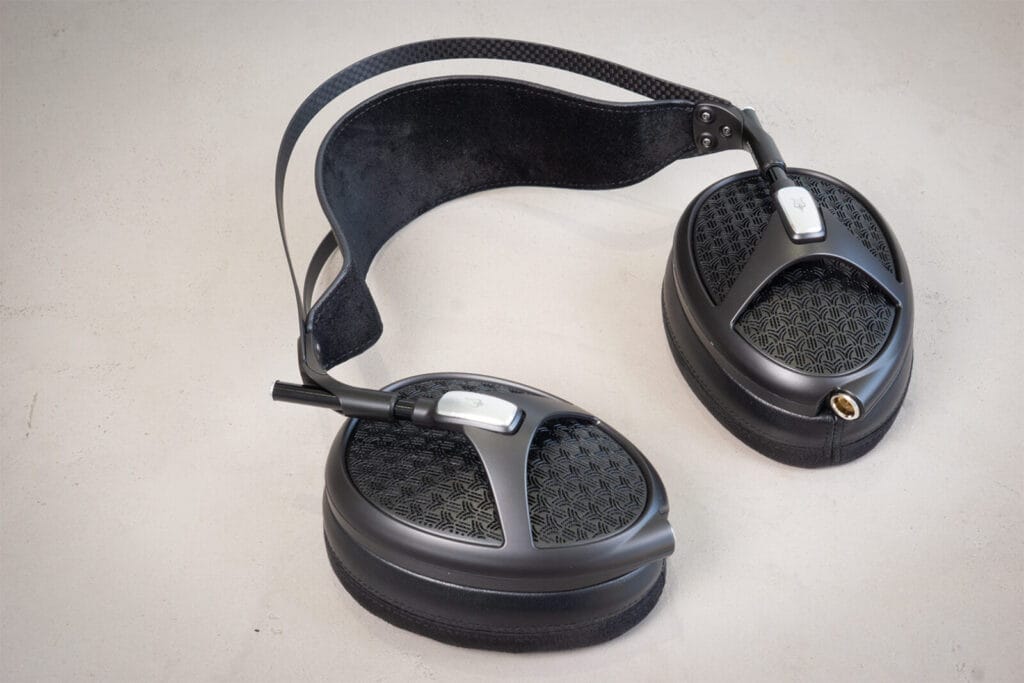
Meze Empyrean II – hard to put down with any music
Time to test problematic recordings. Son of Man, sung and written by Phil Collins for Tarzan (16-bit/44kHz), is an upbeat track that when streamed from Qobuz can easily become vocally sharp through a lot of equipment. The Meze Empyrean II are very satisfying in their handling of this recording, transmitting the infectious enthusiasm of the music, without emphasising the less than stellar recording of Collins’ voice.
Switching to Jospehine Onlyama’s Act Like You’re In Love (24-bit/44kHz) with its propulsive bass line sends things in another direction. Here the vocals can often spit, but not via the Meze’s. As again, the music sounds well resolved and presented very harmoniously. No problem, and good bass.
I love the Telarc Cincinatti Pops Orchestra soundtrack recordings, under Kunzel, they have a bass that pops, and the Suite from Batman Forever, arranged by D. Snyder (from the Big Picture album at 16-bit/44kHz), is a great example of what the Meze’s can do with lower frequencies, with the bass drum being afforded a very satisfying kick.
I then spent time listening to a wiiiiide range of music and genres. One group is The Kills, not what one might call refined (raw is far nearer the mark), and No Wow, from their eponymous album at 24-bit/44kHz, which is demonstrative of their style. The Meze Empyreans II does bass punch well here too, and what this track lacks in subtlety and colour these headphone make up for with dynamics in spades.
Luxury Quality? Oh yes.
In summary
I could go on writing about these headphones at some length, as they are a music lover’s joy. And, luxury they are, with a price tag to match.
Like so much quality equipment, you only know what you are missing when you hear it. I have several pairs of headphones that represent good value for money. Each has its strengths. The Meze Empyrean II manages to bring each’s performance facets into one balanced whole.
They do that wonderful trick of allowing the music to shine, on both a macro and a micro level. Overall dynamics are there in abundance, but inner musical detail is present and correct, and easily followed, if that is your wish.
These headphones pull off a bit of a magic trick, by combining the best of open and closed back passive headphone designs in a single package.