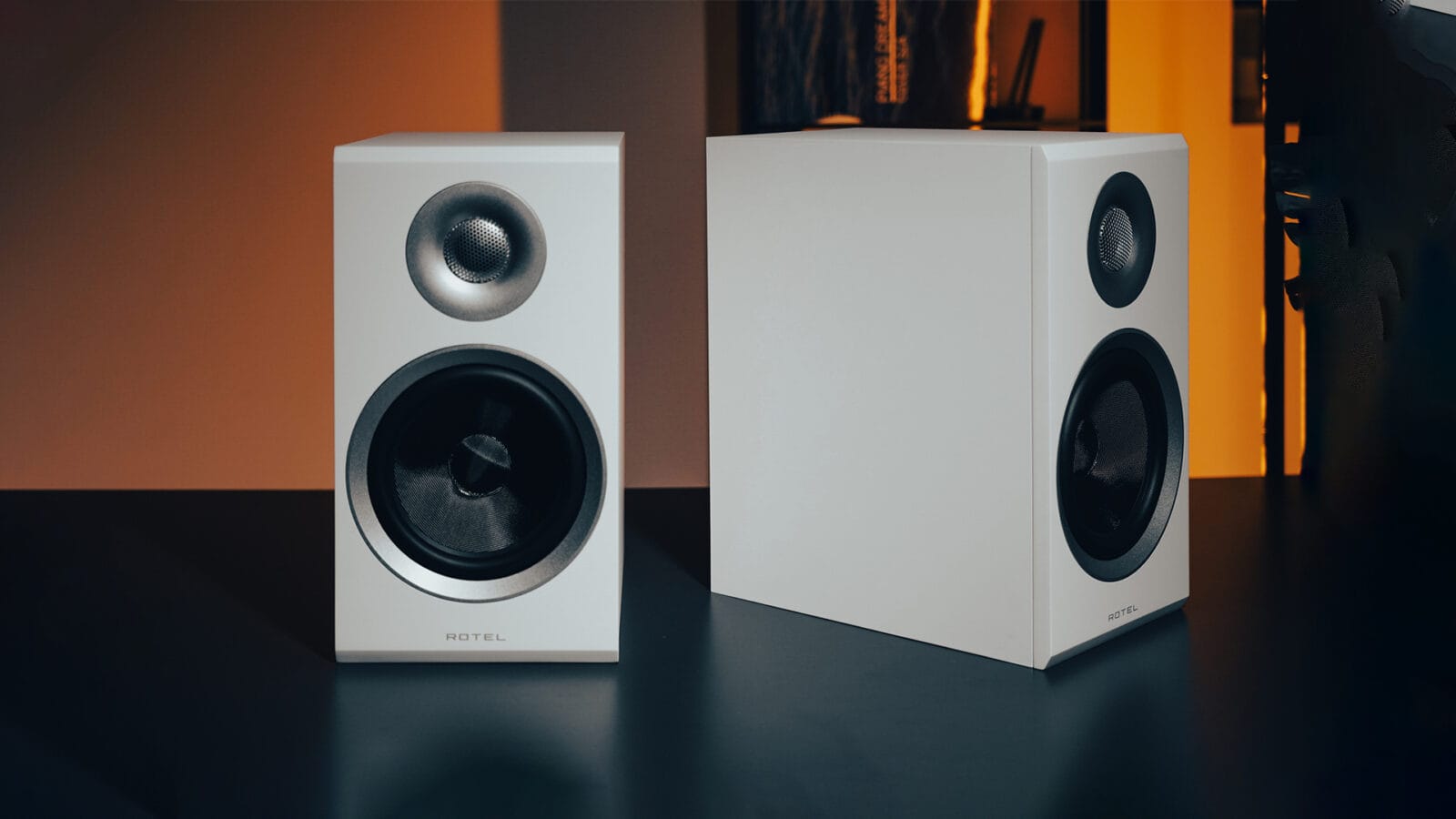


Following a hiatus that stretches back decades, Rotel is back with a bang in the loudspeaker business and this is the result – the all new Amora 5 standmount model, which, Rotel says, has been engineered to deliver energy, resolution and accuracy.
It’s worth reminding ourselves that with its 60+ year history, Rotel is no newbie when it comes to loudspeaker manufacture. Its back catalogue has around 30 different models, stretching back to the early ’70s though to the following decade.
Fast forward to now and the Amora 5 is just the start, with other new speakers in the works, including a floorstander. Or course at this end of the market there’s is a lot of competition, including from the likes of Bowers & Wilkins, Dynaudio and Monitor Audio to name but three. By comparison what the Amora 5 offers is a full circle for those wanting a one-brand system, from source through to amp and now speaker, all designed to work with one another. And on that basis alone, I can see these being top of the shortlist for existing Rotel electronics owners (like those running its dinky DX-5 for example, that Andy enjoyed a few months back).
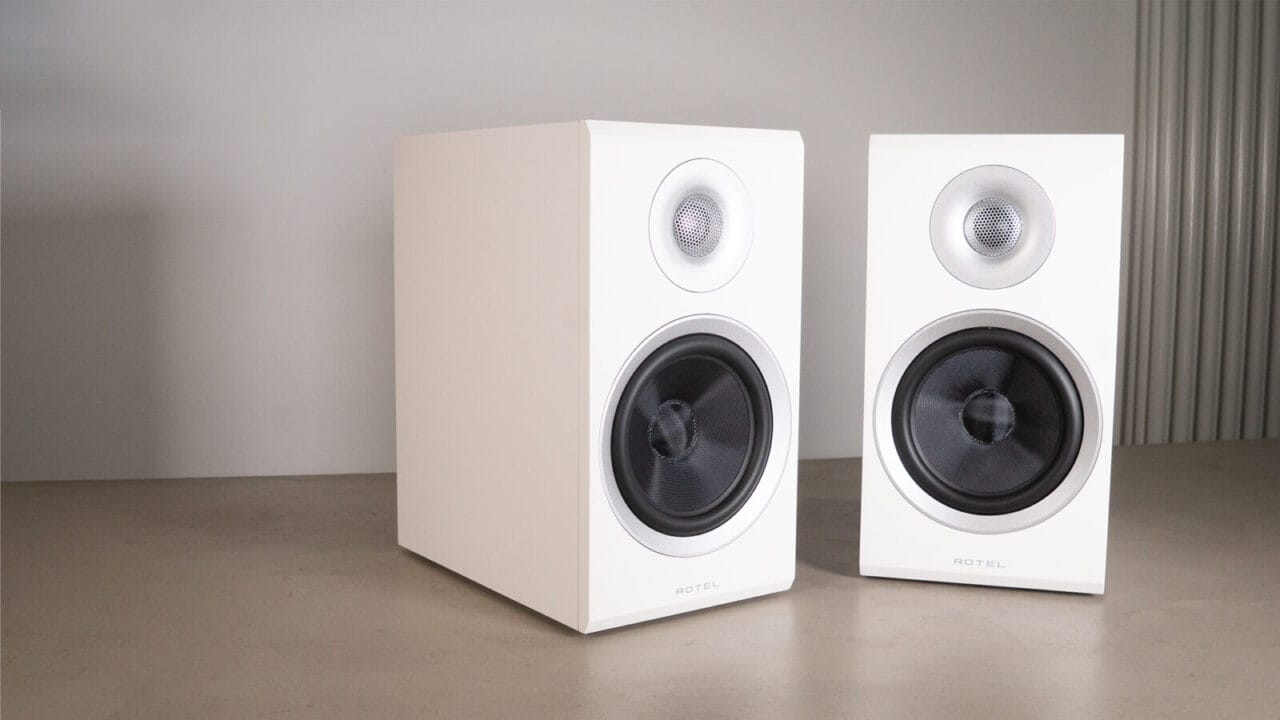
Good to be back – the Amora 5 is Rotel’s first loudspeaker in years
Made to make your mouth water
As soon as you clap eyes (and ears…but we’ll come to that later) on the Amora 5, it’s obvious that these are no cottage industry creations. As product execution and quality goes, they’re slick. Very slick. Being offered in a choice of matt black or white, perhaps bucking the trend for the Opal Fruit colourways some brands are now favouring.
This approach extends to the drive unit surrounds too, being black on the black model and colour coordinated in silver for our samples in white.
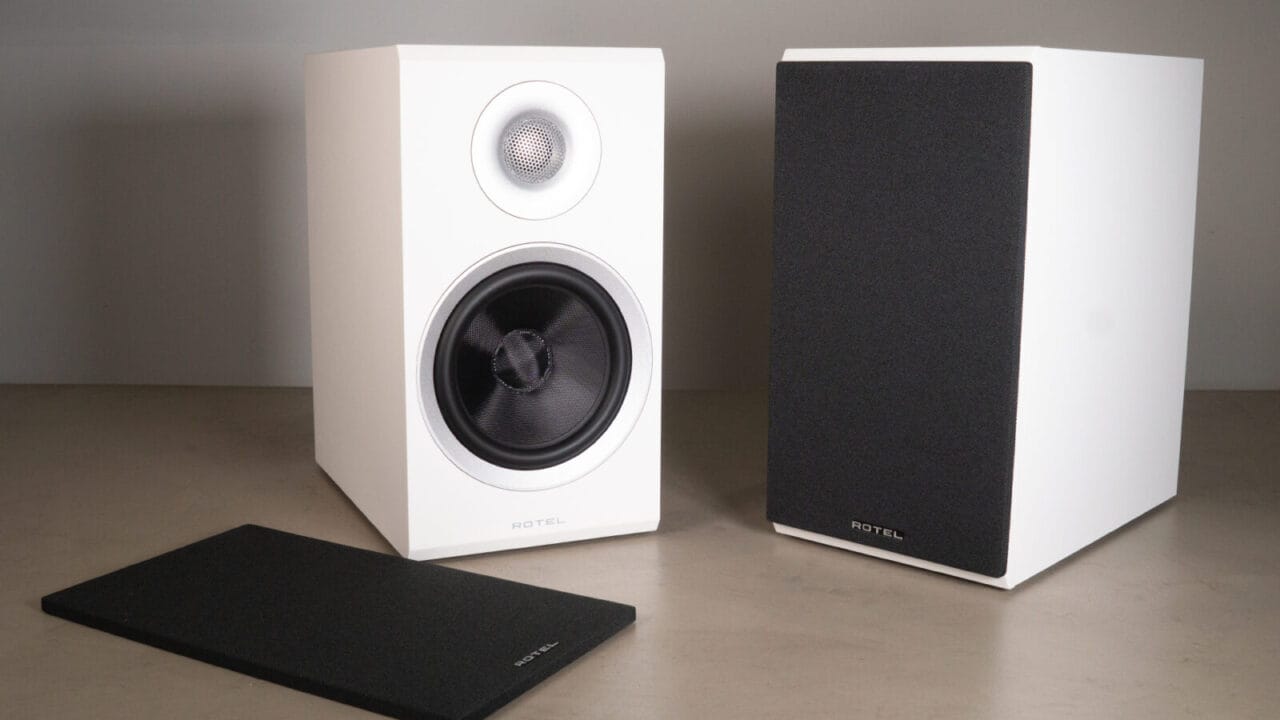
Magnetically attached grills are included, with the all important logo on both speaker and cover
The Amora 5’s resonance controlled MDF cabinets are straightforward enough, with the front baffle angled at its top and bottom. A simple, honest design you might say.
At 350 x 190 x 300mm (HWD) the Amora 5’s profile feels nicely proportioned for a relatively compact bookshelf/standmount speaker, being somewhat larger in size than my usual LS3/5a reference but almost identical to Bowers & Wilkins’ 606 S3 for example (which seems an obvious contemporary). And like the 606 S3, the Amora 5 is a two-way bass-reflex design, with a large fluted rear-firing bass port cited behind its tweeter, high up on the rear baffle.
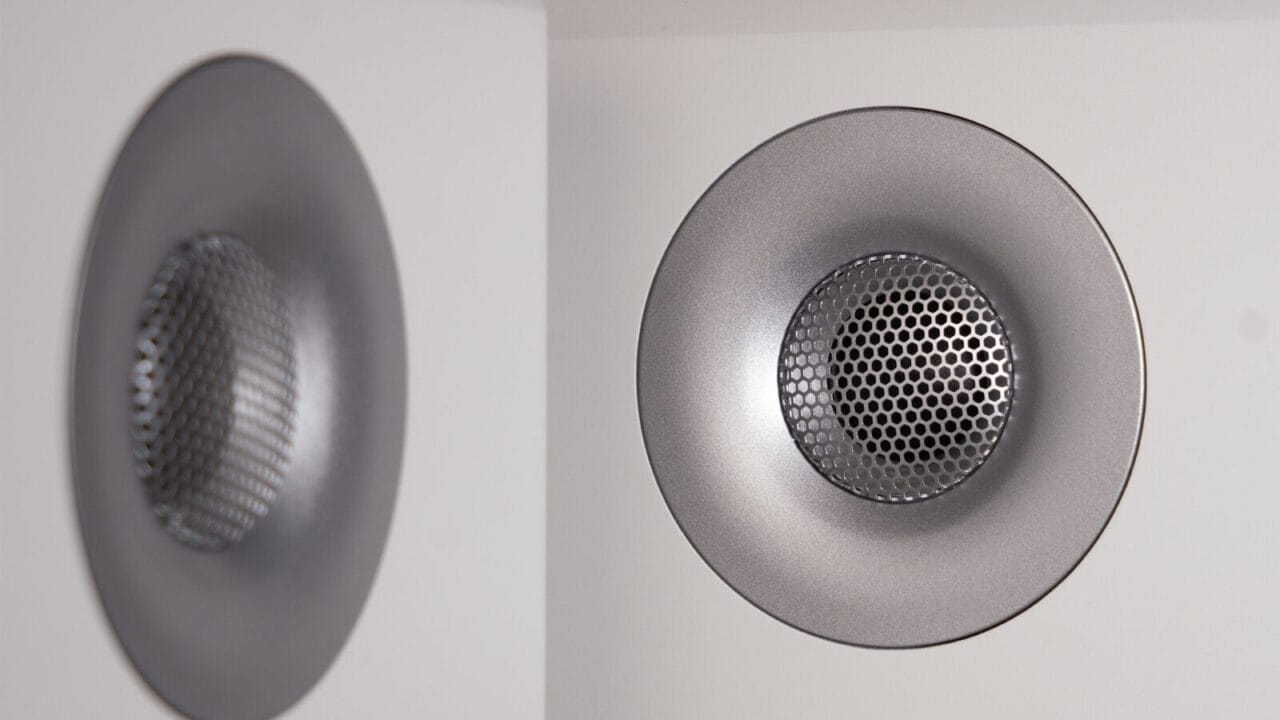
Amora 5’s tweeter is well protected, should you want to use the speakers sans clothe grilles
Said tweeter is a 25mm (1″) silk dome type, recessed behind a mesh grilled within a fluted waveguide and operating up to 28kHz.
On mid/bass duties, a 165mm (6.5″) woven composite fibre woofer is at play, working down to 48Hz and married to a precision-tuned 2.5kHz crossover. The speaker’s nominal impedance is a highly drive-able 8 ohms, with 87dB sensitivity.
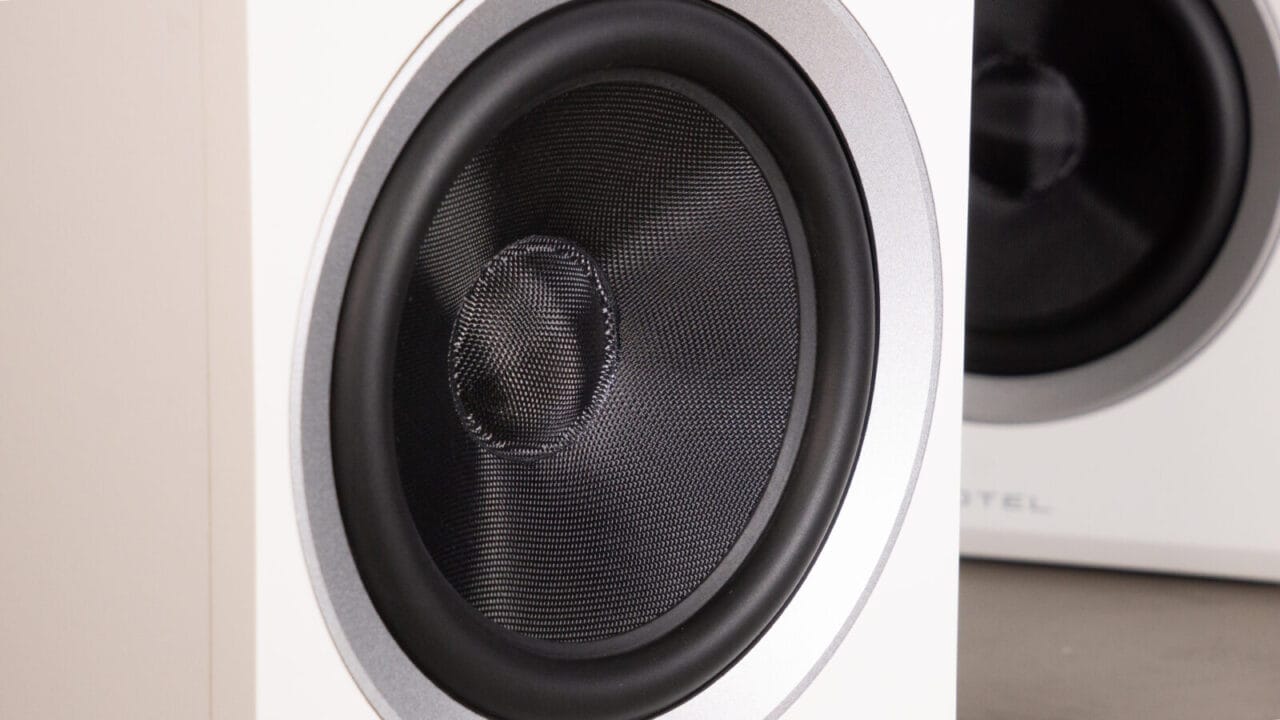
Woven composite bass drivers look just the part on the Amora 5
I do like it when loudspeaker manufacturers think to include protective pads, even just small rubber ones, to stop the speaker’s base getting scratched, and for this Rotel wins a brownie point, with extra marks for two-sets of speaker terminals should you be bi-wire inclined (I’m not, but it’s a nice option to have).
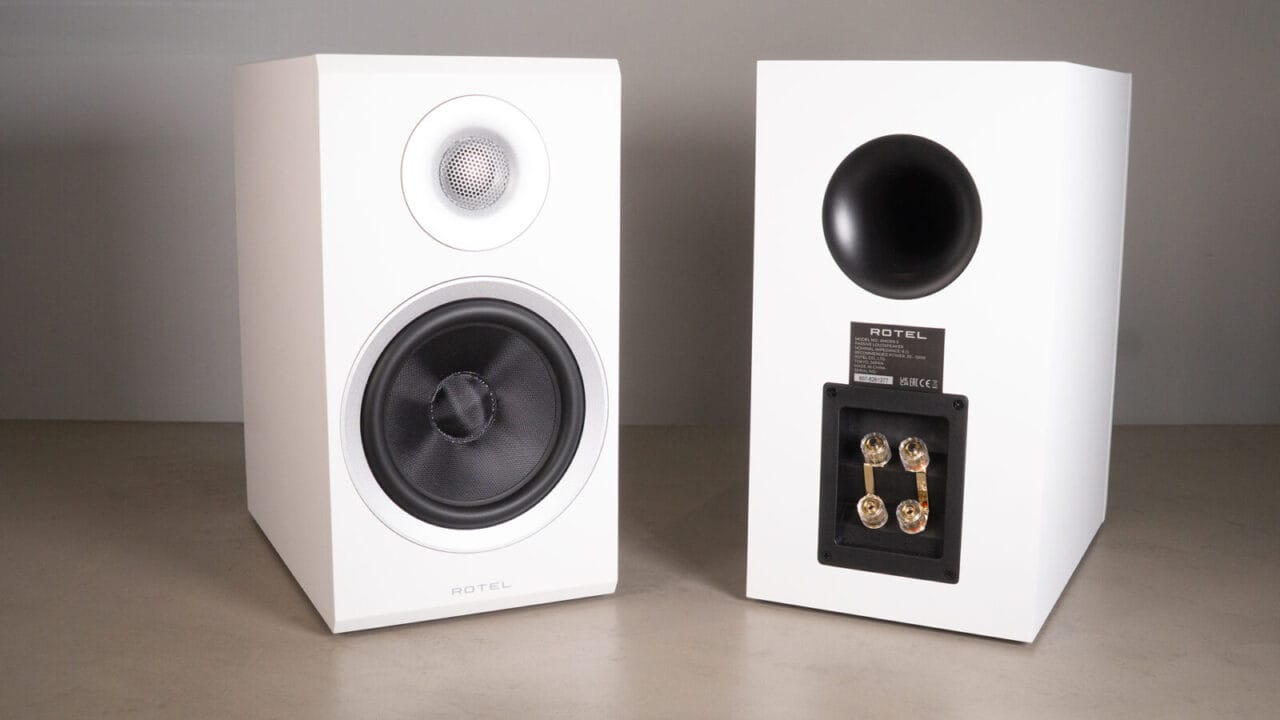
Front to back, the Amora 5 cuts a sleek jib
Performance
Running in a new speaker can reveal dramatic changes within a short space of time. Fresh from their packaging, the Amora 5 sounded a little closed in. But this quickly changed over a week or so of listening as their sound-field expanded and the bass extended.
Once settled, I started to circulate through different amplifier classes to drive them and what became apparent is that this speaker is rather more efficient than its 87dB sensitivity suggests.
With Class A, the crystal cleanliness of the amplifier was clearly apparent. Moving to valve amplifiers introduced a greater degree of texture and warmth, while losing a touch of that signature Class A clarity.
Swapping to Class AB, resolution and dynamics increased while losing a soupcon of timbre, this being delivered via the current dumping goodness of a recently serviced Quad 405-2 power amp. I first owned one of these 1982, and quickly sold it, being rather unimpressed. Recently I heard one via an old pair of Rogers speakers and decided I had been too hasty – system context is just so important.
Back to the Amora 5 and what all of this illustrates is that Rotel has engineered this to be a very transparent loudspeaker and therefore revealing of what’s feeding them, allowing you to clearly hear the differences. This was driven home when I removed the recently reviewed In-akustik cables for Van Den Hul and Van Damme variants. High frequencies became more glassy and sharp, and bass a tad more bloated – which is hardly surprising given the differences in prices
I finally settled on using my EAR834 pre-amp into a Bel Canto S300 Class D power amp. This pairing offers that degree of tube mid-range richness, together with some Class D punch (you’ll have noticed that I tend to enjoy the combination of valve and solid-state).
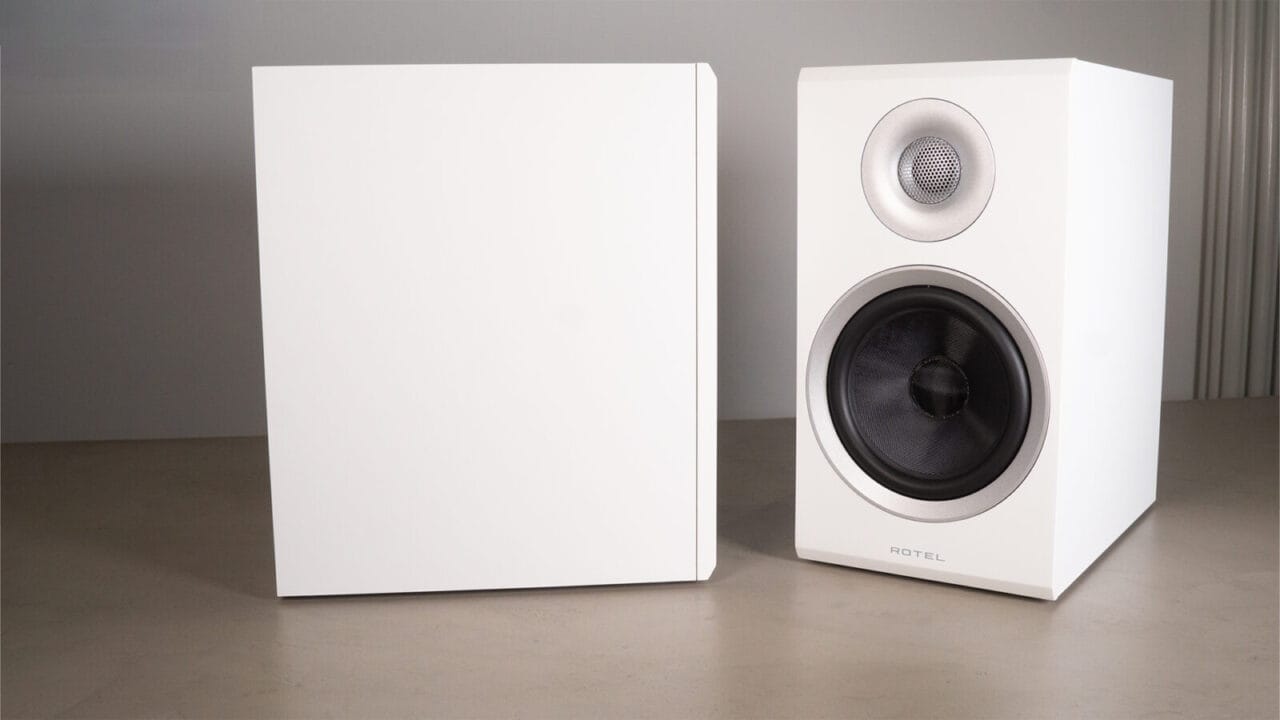
At 300mm deep, the Amora 5’s cabinet offers healthy levels of internal volume
Up close and personal
In addition to running my gamut of amplifiers I also played an increasingly varied range of musical genres through the Amora 5, because these speakers encourage experimentation.
It is easy to concentrate on rock and pop, as this is territory where the Amora 5’s more modern drivers really hit home, with an extended frequency response over my go-to BBC intended loudspeakers. But in the playlist I made to accompany this review, there’s plenty of mid-range centric offerings, sourced from Qobuz.
Listening nearfield (as I initially did) is akin to putting a microscope on the music, and the replay chain. The speakers are, in my case, about 20″ from my lugholes. Any sharpness or fuzziness is immediately obvious, and the Rotels passed this test with flying colours.
The abilities of the Amora 5’s tweeter were on immediate show with Signe, a 16-bit/44kHz render from Eric Clapton’s 1992 Grammy award-winning album, Unplugged, recorded live in Windsor I’ll have you know.
Signe is full of percussion perfection, much of it reaching up into the rafters – I enjoy trying to track the triangle. The Amora 5 is rather good at displaying all this high frequency detail, which also adds to the verisimilitude of Clapton’s and Andy Fairweather Low’s guitars. Resolution? Check.
Into The Storm (24-bit/44kHz) by Yes from their 2018 album Fly From Here – Return Trip is a big and bold performance, and the Rotels enter into the spirit things with worthy vim and verve. Lead guitar, bass guitar, bass drum, cymbals all present and correct. Accuracy? Check.
I am trying to avoid mentioning too many tracks, as I have my main system to get into (and I’ll get nagged by our officious Editor if I write too much), however, I feel obligated to mention this speaker’s music making abilities via Depeche Mode’s Live In Berlin album (16-bit/44kHz) and the splendid job they did of producing the opening bass notes and drums on Welcome To My World (Live).
Time to switch genres to Nina Simone and her Pastel Blues album at 24-bit/96kHz. Produced in 1965, this jazz, rhythm and blues fusion contains a live rendition of Sinnerman, which is packed full of raw power. It is not a great recording though, and Simone doesn’t have a well trained voice, but boy – she sure let’s rip! The resulting sound is full of inventive rhythmic choices, from drums to clapping hands with Simone backed by a range of voices which are presented with clarity.
And what the Rotel Amora 5 brings to the the track’s multiple parts is precision. For instance, at 4.20 minutes in, the double bass holds the timing as multiple hand claps fugue, at different places and paces. But the whole is held cohesively. Energy? Check.
In my view True Blood was not a great TV series, but it had a good first season, which also produced a soundtrack album that I enjoy. Lake Charles (Soundtrack Version) at 16-bit/44kHz is one of a number of memorable songs from it, which opens with a guitar and slide guitar. Lucinda Williams lightly slurred vocals are the central focus, as she spins a tale. The whole thing feels redolent of the Deep South, and the Amora 5 lets you hear just how good a recording this is, so you can appreciate each individual musician’s contribution.
To test how well behaved the Rotel speakers are I deliberately included two files that can spit with Simon & Garfunkel’s El Cóndor Passa (If I Could) and Neil Diamond’s Seongah And Jimmy. Those damned fricatives and ‘Sss’! I felt no need to reach for the volume control however, because these speakers are informative without etching.
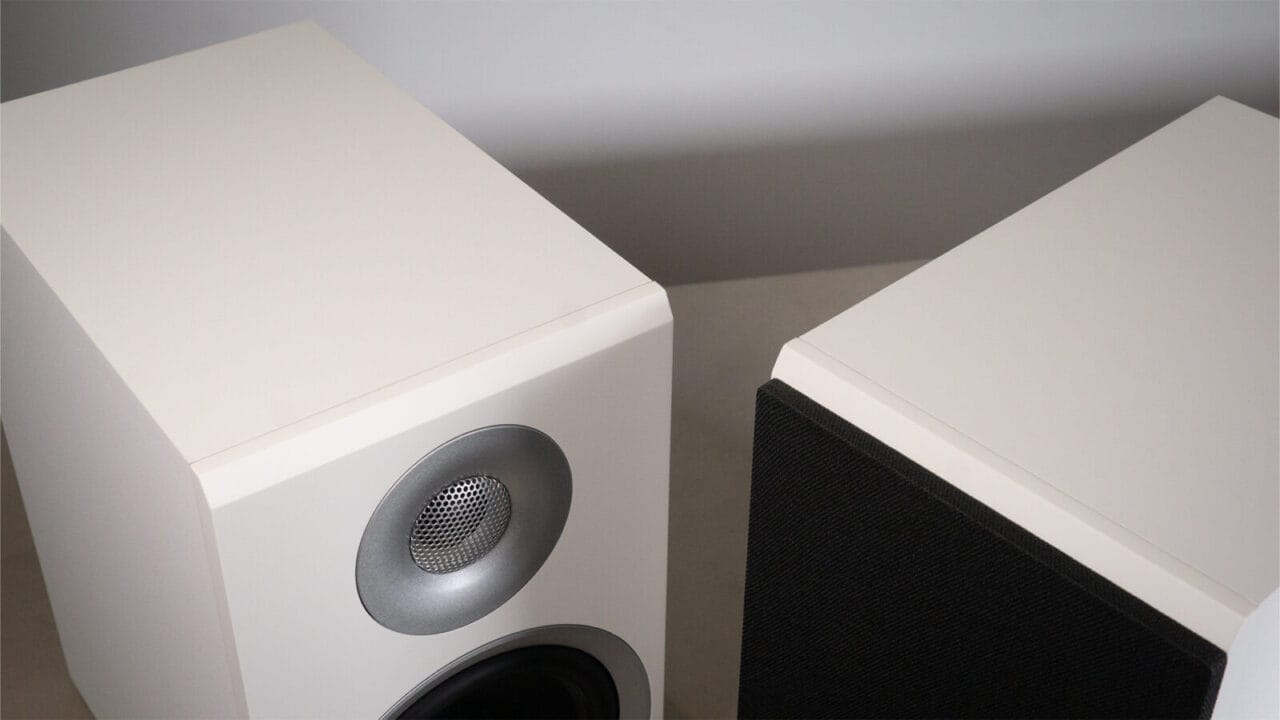
Amora 5 from above, showing their pronounced front baffles
Power to the people
Time to install the Amora 5 in my larger main system with them sat atop my 60” Foundation Stands, five feet apart and 18” from the rear wall.
My main system uses a Modwright valve pre-amp into an ever-green Naim NAP300DR power amp (valve plus solid-state – I told you!). This is an excellent combination, with the Amora 5 making full use of what is driving them.
Placing the speakers in a larger and more open space allows them to really breathe, the bass to bloom and the treble to sweeten. Yes, I lost the extra resolution that sitting so close to the speaker inevitably gives you, but I gain dimensionality and blossoming instrumentality.
My intention had been to focus on completely different tracks, but I simply cannot, at least not until I’ve circled back. That’s because the extra headroom the Amora 5 offers in this setting, going up to 28kHz, aids their sound-field precision, which is a delight to revel in. Signe is a fine example with the music nicely divorced from the speakers, hanging in space, with width and depth.
Into The Storm is now not just big and bold, as its production and mastering are also now on full display, allowing me to to appreciate how Yes were placing, echoing and using different elements to support and re-enforce their music, akin to a classical composer using a motif.
The speakers have a nice knack for pressurising the listening room, without becoming muddy or bloated and when Depeche Mode’s Live In Berlin arrived, it did so with purposeful pulses of bass moving across my listening room towards me. This is more than grin inducing. Talking of power, I read many years ago that Brahms’ 1st Symphony could be looked upon as Beethoven’s 10th, but I never felt this – philistine that I am. A few months ago as I was leaving choir practice, on a table in the vestry was a pile of books free to anyone who wanted them. One was an analysis of Schumann’s music. I confess I had listened to little of this. Having read a couple of chapters I lined up his 1st Symphony.
Qobuz offered me Wolfgang Sawallisch conducting the Saxon State Orchestra, on Schumann The Four Symphonies (24-bit/96kHz). The first movement opens with a brass fanfare, followed by a veritable wall of strings. The themes that follow remind me very much of earlier Beethoven symphonies, but with his later orchestration. There is a lyricism and power to this that is so inviting it draws me in, and despite their modest size, the Amora 5 reproduced this in my listening room with gusto.
In summary
While the Amora 5 could be described as a more traditional looking loudspeaker, the thought and materials that have gone into it are bang up to date.
The result is a speaker that’s simple to position and works well with a broad range of equipment, allowing you to build a fine sounding system around it. Also telling is how well this speaker responds to upgrades in the replay chain (well beyond the price of the speaker), revealing its potential for longevity in many systems and the quality it’s been engineered with, to hold its own with gear a few rungs up.
And that’s because it’s been voiced to provide an excellent musical panorama with whatever genres float your boats. Energy, resolution and accuracy? For the price, it’s got the lot.